ISO 20414 Test 18: walking speed in smoke
| Component | Smoke-speed law (Models › Smoke-speed) |
| Level | Runner with K injected (no FDS); FDS case with K read from committed FDS output |
| Asset | assets/ISO-table21, assets/iso_table21_coupled |
| Expected value from | hand calculation of the model’s law, as ISO 20414 asks; for the FDS case, K from FDS’s own slice, cross-checked against the deck’s soot; egress times predicted from clear runs of the same layout (no smoke) |
| Status | passes on the stored runs (figure script); CI checks the time ratio within 8 % |
Download the files for this page (28 kB zip)
What is tested
Whether smoke slows an occupant by exactly the factor the smoke-speed law gives, and whether that slower speed really changes the egress time. A factor that is computed but never applied, applied to the wrong speed, or applied twice, changes the egress time. In the FDS case, a wrong slice, quantity, height or position lookup changes the K the occupant sees.
Equation
Frantzich and Nilsson fitted \(v = \alpha + \beta K\) to 32 walks in a lit
smoke tunnel (Lund report 3126, Eq. 3, App. D, Table D2, model 1), with
α = 0.706 m/s and β = −0.057 m²/s (standard errors 0.069 and 0.015); see
Fundamentals › Walking speed.
FDS+Evac divides
by α to make it a factor of the unimpeded speed and adds a floor of 0.1.
That is the default law (lund) of pyFDS-Evac
(Models › Smoke-speed). It turns the
extinction coefficient K [1/m] into a speed factor f [-]:
The walking speed is \(v = f(K)\,v_0\), with \(v_0\) [m/s] the unimpeded speed. In a corridor where K is the same everywhere, the occupant walks the same distance at \(f v_0\) instead of \(v_0\), so ISO 20414’s expected result is
$$ \frac{t_{\mathrm{smoke}}}{t_{\mathrm{clear}}} = \frac{1}{f(K)} . $$Here the egress time t is the simulated time at which the occupant is
removed at the exit (run.log, “Simulation finished in”).
For the FDS case the deck prescribes a soot mass fraction \(Y_s\), and FDS computes \(K = K_m\,\rho\,Y_s\) with the mass extinction coefficient \(K_m = 8700\) m²/kg and the gas density ρ [kg/m³].
Setup
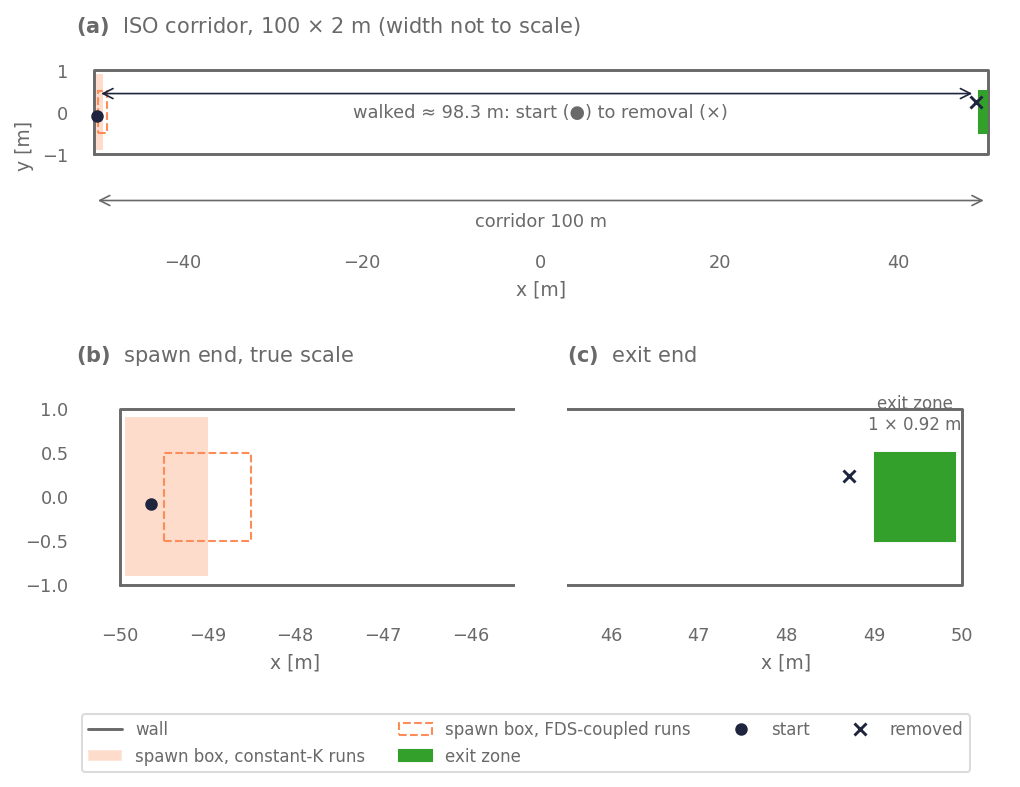
- Corridor: ISO 20414 Table 21, 100 × 2 m, with an exit zone of
1 × 0.92 m at the far end. One occupant, \(v_0\) = 1.25 m/s, seed 420, so
it starts at the same point in the clear and the smoky run. It starts at
x = −49.53 m and is removed at x ≈ 49.0 m, once its centre comes
within 0.03 m of the exit zone
(
direct_steering_runtime.py). So it walks about 98.5 m, not 100 m. The seed fixes the target point it heads for, so the path is the same in the clear and the smoky run. ISO’s absolute time depends on that distance, so the page predicts each smoky time from clear runs of the same layout. ISO leaves the quantitative method to the tester. - Constant K (
assets/ISO-table21, social force model): K = 0.5, 1, 3, 7.5 and 10 1/m, as in ISO’s Table 21, and at K = 1 also \(v_0\) = 1.0, 0.75, 0.5 and 0.25 m/s. Each smoky run has its own clear run. - FDS (
assets/iso_table21_coupled, collision-free speed model): the corridor filled with soot at \(Y_s = 9.546\times10^{-5}\), no fire, one mesh with 0.5 m cells. Slices of K at 2.0 m and at 1.6 m, which FDS writes at 1.5 m. The occupant reads the 1.5 m slice, nearest the default sampling height of 1.6 m. - Runs:
run.pywith a smoke update every 0.1 s and a time step of 0.01 s. Rerouting is off; irritant slowing (FIC) and incapacitation are off (--disable-tenability), as ISO asks: visibility only. 16 runs in all.
Expected
| Quantity | Value | From |
|---|---|---|
| f(0.5), f(1), f(3), f(7.5), f(10) | 0.95963, 0.91926, 0.75779, 0.39448, 0.19263 | the law above, by hand |
| 1/f for the same K | 1.0421, 1.0878, 1.3196, 2.5350, 5.1912 | by hand |
| K where the floor f = 0.1 starts | 11.15 1/m | by hand; no run reaches it |
| clear runs: \(t = L/v_0 + a\) | L = 98.321 m, a = 0.592 s, largest residual 0.016 s | fit to the five clear runs, \(v_0\) = 1.25 to 0.25 m/s |
| expected smoky egress time, social force | \(t_{\mathrm{pred}} = L/(f v_0) + a\) | the clear fit and f by hand |
| ρ of the deck’s air at 20 °C | 1.19889 kg/m³ | ideal gas, N₂ + 23.1 % O₂ by mass + soot, 28.84 g/mol |
| K the deck prescribes | 0.99567 1/m | \(8700 \times 1.19889 \times 9.546\times10^{-5}\) |
| K in the FDS slice at 1.5 m | 0.9954990 to 0.9955111 1/m, mean 0.99550 | read with fdsreader, all cells, all times |
| K in the FDS slice at 2.0 m | 0.9954427 to 0.9954541 1/m | read with fdsreader; the slice the occupant must not read |
| f and 1/f for the FDS case | 0.91963, 1.08740 | by hand, from the 1.5 m slice |
| expected smoky egress time, FDS case | \(t_{\mathrm{pred}} = t_{\mathrm{clear}}/f\) | the collision-free model has no inertia (a = 0) |
A smoky run at K and \(v_0\) is a clear run at desired speed \(f v_0\): the law only scales the desired speed. So the clear runs of the \(v_0\) sweep give the expected smoky time, start-up included.
Our inference for the slices: FDS’s density falls with height by \(\rho g z / p\). That predicts 1.74 × 10⁻⁴ below the deck’s value at 1.5 m and 2.32 × 10⁻⁴ at 2.0 m; the slices lie 1.70 × 10⁻⁴ and 2.27 × 10⁻⁴ below. The deck aimed at K = 1.0 1/m with 1.2041 kg/m³, the density of dry air (28.96 g/mol). Its background has no argon, so its molar mass and density are 0.43 % lower. That, plus the hydrostatic drop, and not a coupling error, is the gap to 0.9955.
Result
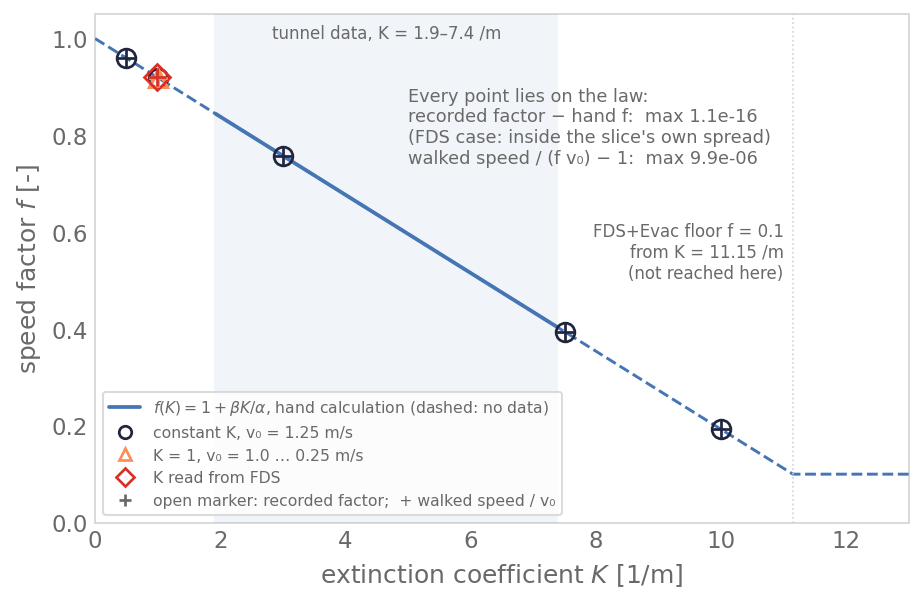
Every run records the factor of the law, and the occupant walks at that speed. Over the middle 40 m of the corridor, the speed along its path matches \(f v_0\) to 9.8 × 10⁻⁶.
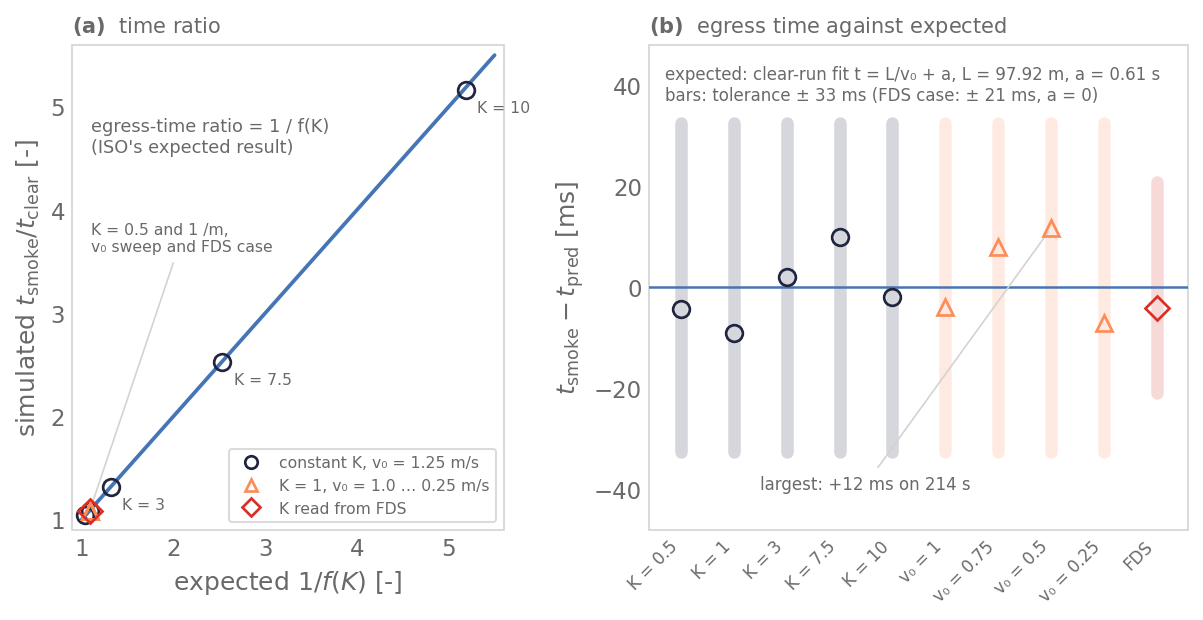
| Run | K [1/m] | \(v_0\) [m/s] | \(t_{\mathrm{clear}}\) [s] | \(t_{\mathrm{smoke}}\) [s] | \(t_{\mathrm{pred}}\) [s] | difference [s] | tolerance [s] | expected 1/f | simulated ratio |
|---|---|---|---|---|---|---|---|---|---|
| constant K | 0.5 | 1.25 | 79.24 | 82.55 | 82.558 | −0.008 | 0.036 | 1.04207 | 1.04177 |
| constant K | 1 | 1.25 | 79.24 | 86.15 | 86.157 | −0.007 | 0.036 | 1.08783 | 1.08720 |
| constant K | 3 | 1.25 | 79.24 | 104.39 | 104.390 | +0.000 | 0.036 | 1.31963 | 1.31739 |
| constant K | 7.5 | 1.25 | 79.24 | 200.01 | 199.988 | +0.022 | 0.036 | 2.53501 | 2.52410 |
| constant K | 10 | 1.25 | 79.24 | 408.91 | 408.913 | −0.004 | 0.036 | 5.19118 | 5.16040 |
| constant K | 1 | 1.0 | 98.91 | 107.55 | 107.549 | +0.001 | 0.036 | 1.08783 | 1.08735 |
| constant K | 1 | 0.75 | 131.69 | 143.21 | 143.201 | +0.009 | 0.036 | 1.08783 | 1.08748 |
| constant K | 1 | 0.5 | 197.25 | 214.52 | 214.505 | +0.015 | 0.036 | 1.08783 | 1.08755 |
| constant K | 1 | 0.25 | 393.87 | 428.41 | 428.417 | −0.007 | 0.036 | 1.08783 | 1.08769 |
| K from FDS | 0.99550 | 1.25 | 78.44 | 85.30 | 85.296 | +0.005 | 0.021 | 1.08740 | 1.08746 |
| Check | Expected | Simulated |
|---|---|---|
| recorded factor, constant K | f(K) by hand | equal to 1.1 × 10⁻¹⁶ |
| recorded K, FDS | inside the 1.5 m slice, outside the 2.0 m slice | 0.9955019 to 0.9955078: inside, outside |
| recorded factor, FDS | inside f of the 1.5 m slice’s range | inside |
| walked speed / \(f v_0\) | 1 | 1 − 9.8 × 10⁻⁶ at worst |
| egress time | \(t_{\mathrm{pred}}\) within the tolerance | all 10 inside, largest +0.022 s on 200 s |
The simulated ratio is always a little below 1/f, by up to 0.59 % at K = 10. That is the start-up time a: it does not scale with 1/f, so \(t_{\mathrm{smoke}}/t_{\mathrm{clear}} \cdot f - 1 = -a(1-f)/t_{\mathrm{clear}}\), which predicts −0.60 % at K = 10. Once a is taken from the clear runs, each egress time matches to 22 ms. The collision-free model in the FDS case has no start-up and matches the ratio to 6 × 10⁻⁵.
Pass criteria
- Factor. The recorded factor equals f(K) by hand to round-off, ≤ 10⁻¹². For the FDS case, the recorded K lies within the 1.5 m slice’s range and outside the 2.0 m slice’s range, and the factor within f of the 1.5 m range. The two ranges are 4.5 × 10⁻⁵ apart, almost four times the spread within one.
- Speed. The speed along the path over the middle 40 m equals \(f v_0\) within 10⁻⁵. This tolerance is a margin, not derived. The collision-free model walks exactly at \(f v_0\); the social force model walks 2.2 to 9.8 × 10⁻⁶ slower, a property of the movement model. The smallest error the check must catch, a factor not applied at K = 0.5, is 1 − f = 4 %, four orders of magnitude larger.
- Egress time. Each egress time is a whole number of time steps Δt = 0.01 s. For the social force runs, \(|t_{\mathrm{smoke}} - t_{\mathrm{pred}}| \le r_{\max} + 2\,\Delta t\) = 0.036 s. The clear fit’s largest residual \(r_{\max}\) = 0.016 s covers the fit’s misfit; one Δt is the rounding of the smoky time, one the rounding in the fitted line. For the FDS case, \(|t_{\mathrm{smoke}} - t_{\mathrm{clear}}/f| \le (1 + 1/f)\,\Delta t\) = 0.021 s: the clear time’s rounding, scaled by 1/f, plus the smoky time’s. The expected time uses no smoky run. Two runs lie just outside the clear runs’ speed range (0.25 to 1.25 m/s): K = 10 at 1.25 m/s (\(f v_0\) = 0.241 m/s) and K = 1 at 0.25 m/s (0.230 m/s). Their predictions are small extrapolations; both pass.
The pytest tests ask for less: the ratio within 8 %, and the factor equal to six decimals (#259).
Run it yourself
The tests run both cases in about 20 s. They are weaker than this page: the coupled test reads the 2.0 m slice, not the 1.5 m slice the default height picks; both compute the expected factor with the code’s own function; and the time ratio passes within 8 % (#259):
uv run pytest tests/test_smoke_speed.py -k iso_table21 tests/test_iso_table21_coupled.pyFor the figures, run the 16 cases with run.py. The FDS output is committed
in assets/iso_table21_coupled/fds/; to rebuild it, run
uv run python assets/iso_table21_coupled/build_geometry.py and then
fds iso_table21_coupled.fds (about 10 s). assets/ISO-table21 stops at
300 s, too early for K = 10 and for \(v_0\) = 0.25 m/s, so the constant-K
runs use a copy with 600 s:
OUT=<out>
run() {  # name scenario [extra options]
  name=$1 scen=$2; shift 2
  mkdir -p $OUT/evac/$name
  uv run python run.py --scenario $scen --seed 420 --smoke-update-interval 0.1 \
    --no-enable-rerouting --disable-tenability "$@" \
    --output-sqlite $OUT/evac/$name/run.sqlite \
    --output-smoke-history $OUT/evac/$name/smoke_history.csv > $OUT/evac/$name/run.log
}
for v in 1.25 1 0.75 0.5 0.25; do
  d=$OUT/scenarios/v0_$v; mkdir -p $d; cp assets/ISO-table21/geometry.wkt $d/
  uv run python -c "import json,sys; c=json.load(open('assets/ISO-table21/config.json')); \
c['config']['simulation_settings']['simulationParams']['max_simulation_time']=600; \
[d['parameters'].update(v0=float(sys.argv[1])) for d in c['distributions'].values()]; \
json.dump(c, open(sys.argv[2]+'/config.json','w'), indent=2)" $v $d
done
run clear $OUT/scenarios/v0_1.25
for K in 0.5 1 3 7.5 10; do run K$K $OUT/scenarios/v0_1.25 --constant-extinction $K; done
for v in 1 0.75 0.5 0.25; do
  run v0_${v}_clear $OUT/scenarios/v0_$v
  run v0_${v}_K1 $OUT/scenarios/v0_$v --constant-extinction 1
done
cp -R assets/iso_table21_coupled/fds $OUT/fds
run coupled_clear assets/iso_table21_coupled/config.json
run coupled_fds assets/iso_table21_coupled/config.json --fds-dir $OUT/fds
uv run python scripts/verification/iso_test_18_figures.py --data $OUT
The script prints the table above, writes the figures, and exits with an
error if a pass criterion fails. The runs behind
this page, made on the branch of
#401 at
8fc26b1 with a clean tree, give this table. The same commands on main
at 9c820e0f (Python 3.12.13) print the same table and figures.
Limits
- Only the default law is run in the ISO layout. The
fridolfoption (speed_law="fridolf"), reachable only from Python, is checked by the S2 corridor test, not here. - K = 0.5, 1 and 10 1/m lie outside the tunnel data (about 1.9 to 7.4 1/m, the range given on the Fundamentals page; not re-checked against the report for this page). Passing Test 18 verifies the code, not the law, there.
- The FDS case confirms that the slice nearest 1.6 m is read. The two slices differ by only 6 × 10⁻⁵ 1/m, from hydrostatics. The test cannot show sampling in a real vertical or horizontal gradient, or at the occupant’s current position and time (#24).
- No run reaches the floor f = 0.1 (K ≥ 11.15 1/m).
- In the social force runs the occupant spawns 0.47 m from the back wall. The wall push briefly takes it above \(f v_0\) at the start (0.34 m/s at K = 10, against 0.24 m/s). This is movement-model behaviour; the time criterion absorbs it through the start-up time a of the clear runs.
- One occupant per condition, one seed. The ISO test asks for no more, but it says nothing about crowds in smoke.
- The tight criteria on this page are checked by the figure script on stored output. CI checks the time ratio within 8 %, reads the 2.0 m slice in the coupled test, and takes the expected factor from the code under test (#259).
assets/ISO-table21/ISO-table21.fdsis a template deck with a fire; no test and no run on this page uses it.