Smoke-speed model
Note
This page is the specification of the smoke-speed model. For worked cases on the assets (runs, figures, numbers), see Speed in practice.
Based on: Walking speed in smoke and Extinction coefficient.
Symbols follow the notation table. The Python
API (extinction sources, SmokeSpeedModel, conversion helpers) is in
docs/smoke-speed-model.md.
Coded form
The model turns the extinction coefficient K [1/m] at the agent’s position
into a speed factor f [-], selected by SmokeSpeedConfig.speed_law
(pyfds_evac/core/smoke_speed.py). A non-finite or negative K is read as 0.
$$ f(K) = \min\!\left(1,\ \max\!\left(f_{\min},\ 1 + \frac{\beta}{\alpha}K\right)\right). $$"lund"(default),speed_factor_from_extinction:
$$ w = \min\!\left(v_0,\ \max\!\left(0.2,\ v_0 - 0.34\,(3 - V)\right)\right), \qquad f = \frac{w}{v_0}, \qquad f(0) = 1. $$"fridolf",speed_factor_from_extinction_fridolf: Eq. 7 of Fridolf et al. (2019) (method 3; also in Fridolf et al. 2018, a summary of their 2016 SP report), with \(V = C/K\) [m] and the agent’s smoke-free speed \(v_0\) [m/s],The reduction is additive, 0.34 m/s per metre of visibility below 3 m, and the floor is an absolute 0.2 m/s, not a fraction of \(v_0\). Above 3 m the speed is unchanged. The 2018 abstract gives no constant; the 2019 paper converted each data set with A = 2 (reflecting) or 8 (emitting) (Eq. 1). pyFDS-Evac uses the FDS default C = 3, so for reflecting targets it slows agents later and less than the calibration (onset at K = 1.0 instead of 0.67 1/m); set
visibility_factor_c = 2to match. Until #146 this option computed \(V/(V+2)\), a law with no known source.Where the law applies. It was calibrated on corridor and tunnel experiments; the authors call it mainly valid for tunnels with a simple layout (2019, §4) and do not recommend it for buildings with many exit choices, where speeds are expected to be lower (2018, concluding remarks). The measured speeds are averages that include pauses, so an agent that also pauses or detours in the model may count that time twice (our inference). The data come from non-irritant or semi-irritant smoke; multiplying by \(g(\mathrm{FIC})\) on top is a pyFDS-Evac choice, not part of the source.
Parameters
Fields of SmokeSpeedConfig, with the defaults in the code. run.py, the
web GUI and the terminal UI set only the last two (--smoke-update-interval,
--smoke-slice-height); the speed law and its coefficients need a
SmokeSpeedConfig built in Python (see the
parameter split).
| Field | Default | Unit | Meaning |
|---|---|---|---|
speed_law | "lund" | - | "lund" or "fridolf", matched exactly; any other value raises ValueError when SmokeSpeedConfig is built |
alpha | 0.706 | m/s | \(\alpha\), lund only |
beta | -0.057 | m²/s | \(\beta\), lund only |
min_speed_factor | 0.1 | - | \(f_{\min}\), lund only |
visibility_factor_c | 3.0 | - | C, fridolf only |
fridolf_slope | 0.34 | m/s per m | Speed drop per metre of visibility, fridolf only |
fridolf_visibility_threshold_m | 3.0 | m | Visibility below which speed drops, fridolf only |
fridolf_min_speed_m_per_s | 0.2 | m/s | Absolute speed floor, fridolf only |
update_interval_s | 1.0 | s | Time between samples of K for each agent |
slice_height_m | 1.6 | m | Height of the FDS slice that is read (FDS+Evac HUMAN_SMOKE_HEIGHT; the previous default was 2.0) |
The routing block has its own copy of alpha, beta and min_speed_factor,
used only to price routes; see the routing model.
Where it acts in the time step
Every update_interval_s (--smoke-update-interval in run.py),
run_scenario samples K at each agent’s position and stores f as the
agent’s smoke factor. The agent’s desired speed is then
\(v_0 \cdot f \cdot g(\mathrm{FIC})\) (direct_steering_runtime.py, set_agent_fic_factor),
where \(g\) is the irritant factor of the FED model.
\(g = 1\) unless --enable-fic-speed is given: it is off by default, as
FDS+Evac has no irritant slowdown.
An extinction sample outside the FDS domain reads K = 0 (clear air), so
the agent walks at full speed there, as in FDS+Evac (smoke_speed.py,
ExtinctionField.sample_extinction). The run logs one warning at the first
such sample, marks each smoke-history row outside with
in_fds_domain = False and counts the samples outside at the end. With
--require-fds-coverage a sample outside stops the run. Details on
FDS slice sampling.
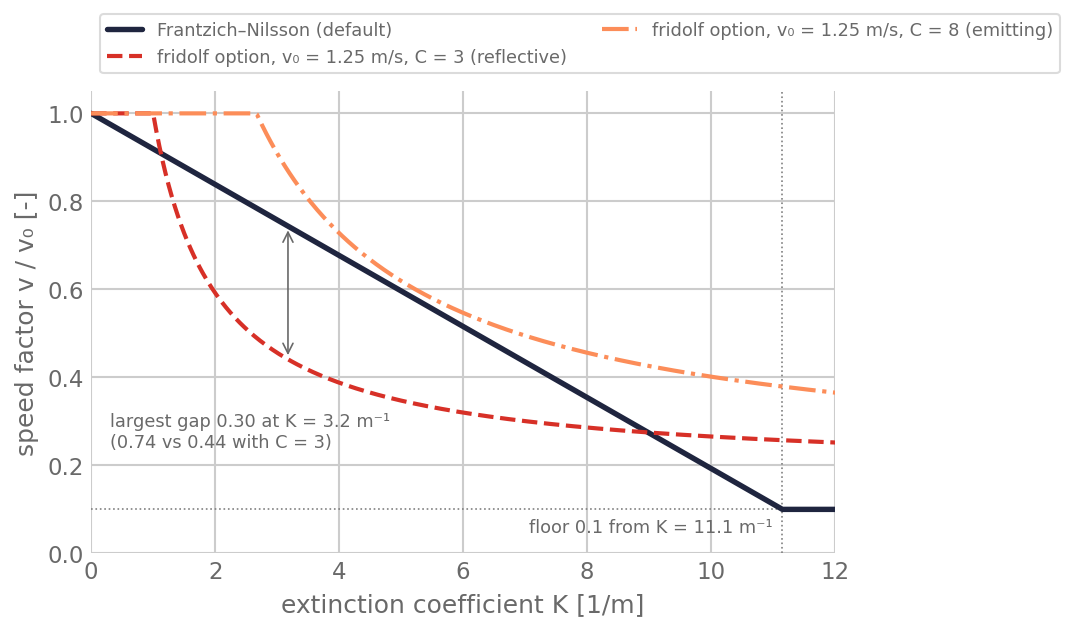
Speed factor \(v/v_0\) [-] against extinction coefficient K [1/m]. Solid dark
blue: Frantzich–Nilsson with the default constants, floor 0.1 reached at
K = 11.1 m⁻¹. The fridolf option (Fridolf et al. 2019, Eq. 7) at
\(v_0\) = 1.25 m/s with \(V = C/K\): red dashed for C = 3, orange dash-dotted
for C = 8. The arrow marks the largest gap between Frantzich–Nilsson and C = 3.
Script: scripts/figures/speed_laws.py. The figure does not yet mark where
the fridolf law is extrapolated, or the spread of \(v_0\)
(#228).
Background: the Concepts page and the talk A Modular Workflow for Visibility-Aware Evacuation Modelling.
For real FDS output, fdsreader provides the local extinction field
via SliceFieldSampler. For verification cases such as ISO 20414:2020 Test 18 (Table 21),
the runner can also apply a constant extinction coefficient directly.
If the FDS case has no SOOT EXTINCTION COEFFICIENT slice and no
--constant-extinction is given, the run logs a warning and continues with
no smoke-speed model: agents walk at clear-air speed
(#248). A
direct library call (load_slice_sampler or ExtinctionField.from_fds) on
such a case raises IndexError. EXTINCTION is an unrelated FDS quantity,
not the extinction coefficient (see
Extinction coefficient).
FDS data access
All FDS slice data is read through a single library:
fdsreader— reads raw FDS slice quantities with nearest-neighbor spatial and temporal lookup viaSliceFieldSampler(pyfds_evac/core/fds_sampling.py)- Used by both the smoke-speed model (extinction
K [1/m]) and the FED model (CO, CO2, O2, and optional irritant gases) - When a scenario needs both extinction and FED fields from the same FDS
case, pass a shared
fdsreader.Simulationinstance to avoid parsing the directory twice (see FDS sampling API)
Runs of the ISO 20414 Test 18 (Table 21) corridor, with a constant extinction coefficient and with FDS output, the plotting scripts and the verification figures are on Speed in practice.
Deviations from the literature
The published laws are on Walking speed in smoke. The code departs from them as follows.
- Fractional, not absolute. The linear law is applied as a factor of each
agent’s own \(v_0\) (
smoke_speed.py,speed_factor_from_extinction), the FDS+Evac normalisation of an absolute regression. It divides by the intercept \(\alpha\), an extrapolation to K = 0, not a measured free walking speed. - Floor. \(f_{\min}\) is FDS+Evac’s convention, not a measured minimum; Ronchi et al. (2013) put the minimum speed in both the Jin and the Frantzich–Nilsson data at about 0.3–0.4 m/s.
- Range and spread. The law is evaluated at every K, including below the tunnel data, and uses only the mean coefficients, not their standard deviations.
- The
fridolfoption. Fridolf et al. state visibility, not K; the 2018 abstract gives no constant and the 2019 paper used A = 2 for reflecting and 8 for emitting items. The code uses C = 3 by default (see Walking speed in smoke). \(v_0\) is each agent’s own free speed, as in their method 3, not the truncated normal distribution (mean 1.35 m/s, SD 0.25 m/s, 0.85–1.85 m/s) that method 3 draws it from. - Irritancy counted twice (with
--enable-fic-speed). Frantzich and Nilsson’s smoke contained acetic acid, so \(f(K)\) already includes irritant slowing, and multiplying by \(g(\mathrm{FIC})\) partly counts irritancy twice. SFPE Eq. 63.14 adds the two losses instead (#153, #147). - Combination with irritants. With
--enable-fic-speed, \(g(\mathrm{FIC})\) multiplies \(f\); see the FED page.
Verification
- ISO 20414 Test 18: walking time through a corridor of constant extinction, with a constant K and with FDS output.
- S2 corridor
(
tests/verification/test_s2_corridor_speed.py): the speed factor reaches the agent in a coupled run on a synthetic field.