Heat
Note
This page is the specification of the heat dose. For the verification case (a uniform hot room at 100, 150 and 200 °C), see Heat dose.
Based on: Heat and Incapacitation thresholds.
FDS+Evac has no heat dose. In pyFDS-Evac it is opt-in, and when it is off nothing on this page affects a run.
What is computed
With --enable-heat-fed (opts.enable_heat_fed) and a TEMPERATURE slice in
the case, each agent accumulates a convective heat dose at
_heat_fed_rate_per_minute (pyfds_evac/core/fed.py), ISO 13571:2012
Eq. (9) for fully clothed subjects (§8.3.1), unless --heat-clothing unclothed selects ISO Eq. (10), --heat-endpoint selects another law
(Endpoint) or --heat-fed-method total-flux selects the flux
law (Total flux):
with T the gas temperature in °C at the agent’s position, read from the
TEMPERATURE slice at --smoke-slice-height (1.6 m by default, as
FDS+Evac’s HUMAN_SMOKE_HEIGHT). No heat flux enters the law, neither
incident nor net: it takes the gas temperature only. The dose is updated on the same interval as
the gas FED (--smoke-update-interval) and is a running total of its own,
never added to the gas FED.
Why the default is convective. ISO 13571:2012 Eq. (9) is ISO’s recommended convective law, with a stated ±25 % uncertainty (§8.3.1–8.3.2), and needs only the gas temperature. The total-flux form is opt-in because Eq. 70.47 is “proposed” with ε, h_c and the surface temperature given only as ranges or not at all (Ch. 70, p. 2319), so every value it needs beyond T is an assumption; used alone it also gives no dose below the 2.5 kW/m² cut, up to about 200 °C in smoke, where the hot-air data give minutes (#223). The convective default omits the radiant term that ISO §8.4 and Eq. 70.46 require above 2.5 kW/m²; under a hot layer it under-predicts the dose.
If the case has no TEMPERATURE slice, the run continues without a heat dose
and logs a warning. In the FED history heat_fed_cumulative then reads 0 and
temperature_celsius 20.0 °C, and metrics has no heat_fed_max (see
Outputs › FED history).
Outside the TEMPERATURE slice (outside the FDS domain) T reads 20 °C,
with no warning. FDS+Evac uses its ambient temperature TMPA there. The
default clothed law gives a small dose rate at 20 °C,
1.2 × 10⁻⁴ /min, so FED 1 would take about 137 h. The FED history marks
these rows with in_fds_domain = False; with --require-fds-coverage a
sample outside stops the run. Details on
FDS slice sampling.
A heat-only case needs no soot. Without a SOOT EXTINCTION COEFFICIENT
slice the run logs two warnings and continues: there is no smoke-speed
model, so agents walk at clear-air speed and route costs see K = 0, and the
visibility model falls back to clear air
(#248).
Neither enters the heat-dose rate; both can change where agents walk, and
so the temperature they are exposed to.
Clothing
--heat-clothing {clothed,unclothed} (opts.heat_clothing, the
clothing argument of DefaultHeatFedModel) selects one of the two
convective laws of ISO 13571:2012 §8.3 (§8.3.1, §8.3.2), both for air with less than 10 %
water vapour by volume, with t in min and T in °C
(HEAT_CLOTHING_LAWS):
--heat-clothing | ISO 13571:2012 | \(t_{I\,\mathrm{conv}}\) [min] | Source cited by ISO |
|---|---|---|---|
clothed (default) | Eq. (9), fully clothed | \(4.1\times10^{8}\,T^{-3.61}\) | Crane (1978) |
unclothed | Eq. (10), unclothed or lightly clothed | \(5\times10^{7}\,T^{-3.4}\) | Purser, SFPE Handbook; the constants of Eq. 63.44 |
The rate is \(1/t_{I\,\mathrm{conv}}\); a temperature at or below 0 °C,
or not finite, gives zero. ISO recommends Eq. (9) for fully clothed
subjects and states an uncertainty of ±25 % for both. Eq. (9) gives about
three times the time of Eq. (10): 24.7 against 7.9 min at 100 °C, 5.7
against 2.0 min at 150 °C, 2.0 against 0.75 min at 200 °C. Before
#290 the
default was Eq. 63.44; --heat-clothing unclothed reproduces it exactly.
SFPE Ch. 63 treats the unclothed expressions as the relevant ones unless
protective clothing is worn (p. 2336); the default follows ISO instead
(Fundamentals › Heat).
--heat-clothing has no effect with --heat-endpoint or
--heat-fed-method total-flux, and logs a warning there and without
--enable-heat-fed. The run manifest records heat_clothing whenever one
of the two laws is in use.
Endpoint
--heat-endpoint {tolerance,injury,fatal} (default: none) replaces the ISO
law with the convective law of one endpoint of Ch. 63, so that heat FED = 1 means
that endpoint. Each endpoint is stored with its radiant dose r of Eq. 63.43
(HEAT_ENDPOINTS in pyfds_evac/core/fed.py), so a radiant constant from one
endpoint cannot be paired with the convective law of another:
--heat-endpoint | Radiant r [(kW/m²)^4/3 min] | Convective law, t [min], T [°C] |
|---|---|---|
tolerance | 1.33 | Eq. 63.45: \(2\times10^{31}\,T^{-16.963} + 4\times10^{8}\,T^{-3.7561}\) |
injury | 10 | Eq. 63.46: \(5\times10^{22}\,T^{-11.783} + 3\times10^{7}\,T^{-2.9636}\) |
fatal | 16.7 | Eq. 63.47: \(2\times10^{18}\,T^{-9.0403} + 10^{8}\,T^{-3.10898}\) |
r from pp. 2382 and 2384, the laws from pp. 2382–2383; the pairing is
explained in Heat. The rate is \(1/t\)
(endpoint_heat_fed_rate_per_minute); a temperature at or below 0 °C, or
not finite, gives zero. --heat-endpoint without --enable-heat-fed logs a
warning and leaves the heat dose off. r enters the dose only
with --heat-fed-method total-flux (Total flux); with the
convective laws it is recorded only. The fatal r is
16.7 as printed on pp. 2382 and 2384; Purser’s spreadsheet uses 16.667
(personal communication), and the code follows the Handbook. By maintainer decision,
heat FED = 1 is meant as the fatal endpoint; --heat-endpoint fatal gives
that meaning. Without the option the convective dose is the ISO law of
--heat-clothing.
The caption of Table 63.21 (p. 2385) says Eq. 63.44, but its per-minute values
are those of Eq. 63.45; the tests use the table as the oracle for
tolerance.
The Handbook relates Eqs. 63.45–63.47 to heated air with less than 10 %
water vapour by volume (p. 2383) and gives no upper temperature. Assumption:
the upper limit is taken as 205 °C, the highest dry-air tolerance point of
Table 63.17 (Veghte, 4 min, p. 2375). With an endpoint, each FED history
sample whose temperature exceeds 205 °C (HEAT_CONVECTIVE_VALIDITY_MAX_C) or
is not a finite number is flagged. The flag does not clip the rate: Table
63.21 applies the law at 405 °C. A non-finite sample adds no dose. Humidity
is not sampled, so its status is reported as unknown rather than flagged.
Total flux
--heat-fed-method total-flux (opt-in, with --enable-heat-fed; default
convective, the laws above) replaces the convective laws with the
total-flux form of spec 016,
which builds on a draft by Ruggiero Lovreglio, reviewed by David Purser.
The heat flux to
the skin is Eq. 63.49 (p. 2383, symbols on p. 2384), total_heat_flux_kw_m2:
with \(T_g\) the gas temperature at the agent’s position (the same
TEMPERATURE slice), \(T_s\) the skin temperature, both in K, and
\(\sigma = 5.67\times10^{-8}\) W m⁻² K⁻⁴ (p. 2384). Both terms are in W/m²
and divided by 1000 together; this is a decision of spec 016, since the
Handbook prints the division on the convective term only. The rate is
Eq. 63.43 with the endpoint dose D in place of r
(total_flux_heat_fed_rate_per_minute):
- D is the radiant dose of
--heat-endpoint(1.33, 10 or 16.7); without it, the fatal 16.7, as heat FED = 1 is meant as the fatal endpoint. - 2.5 kW/m² threshold on the radiant term only. The radiant term of
q counts as zero in the dose where it is below 2.5 kW/m²
(ISO 13571:2012 §8.2, §8.4; 2.5 itself counts), for every regime and
source. The convective term \(h\,(T_g - T_s)\) counts at every level: with
the threshold on the total q, clear air (ε = 0.05, h = 8) would give no
dose below about 310 °C. ISO’s 2.5 kW/m² is an incident flux; the code
applies it to the net or excess radiant term (spec 016).
heat_flux_kw_m2stays the physical q; the constant isISO_RADIANT_THRESHOLD_KW_M2. - Not added to a convective law. The rate is \(q^{1.33}/D\) alone.
- Where the q that enters the dose (convection plus the counted radiant
term) is at or below zero, or the temperature is not finite, the rate is
zero: no dose, and no recovery. The physical q can be negative while
this q is positive: a layer cooler than the skin still leaves the
convective dose of hot air at the head
(
test_layer_regime_cool_layer_still_gives_convectionintests/test_heat_layer_flux.py).
This is the “head in smoke” regime of spec 016 (--heat-regime smoke, the
default): ε applies to the gas at the head, and no external radiation is
added unless the radiant term comes from INTEGRATED INTENSITY
(Radiant flux from INTEGRATED INTENSITY).
The “below a hot layer” regime is described in
Hot layer. ε, h and \(T_s\) have no sourced values; their
defaults are assumptions (HEAT_FLUX_ASSUMED_PARAMETERS):
| Parameter | Default | CLI flag | Source status |
|---|---|---|---|
| ε | 0.5 | --heat-emissivity | Assumption. p. 2384: 0.05 for a gas, “perhaps 0.5 for smoke” |
| h [W m⁻² K⁻¹] | 5.0 | --heat-convective-coefficient | Assumption. p. 2384: “approximately 5–8 for slow-moving air”, no unit; 5 is the value of the spec 016 convection check |
| \(T_s\) [°C] | 35.0 | --heat-skin-temperature | Assumption. Not given for Eq. 63.49; 35 °C is the value in Lovreglio’s draft, held fixed |
Invalid values (ε outside [0, 1], h < 0, or non-finite) are rejected.
--heat-fed-method without --enable-heat-fed logs a warning and leaves
the heat dose off.
Where the radiant threshold acts
With the defaults above, smoke at the head below about 285 °C gives no radiant dose: its radiant term stays under 2.5 kW/m², and the dose is convection alone. What follows from that:
- Longer times than the convective default. At 200 °C the time to heat FED = 1 is 21.6 min, against 6.7 min with the radiant term always counted and 2.0 min for ISO Eq. (9), the convective default. The endpoints differ (fatal D = 16.7 here, prevention of escape for Eq. (9)), but total flux at its defaults is not the more conservative choice: from 100 to 400 °C it gives the longer time throughout.
- A step in the rate. Where the radiant term reaches 2.5 kW/m² it enters the dose at once: near 285 °C the time to FED = 1 falls from 12.4 to 2.9 min.
- ε matters only above the threshold. At \(T_s\) = 35 °C the radiant term reaches 2.5 kW/m² at about 207 °C for ε = 1 (or a black layer, \(\varphi\,\varepsilon_L\) = 1), 285 °C for ε = 0.5 (or \(\varphi\,\varepsilon_L\) = 0.5) and 698 °C for ε = 0.05. Below that temperature ε does not change the dose.
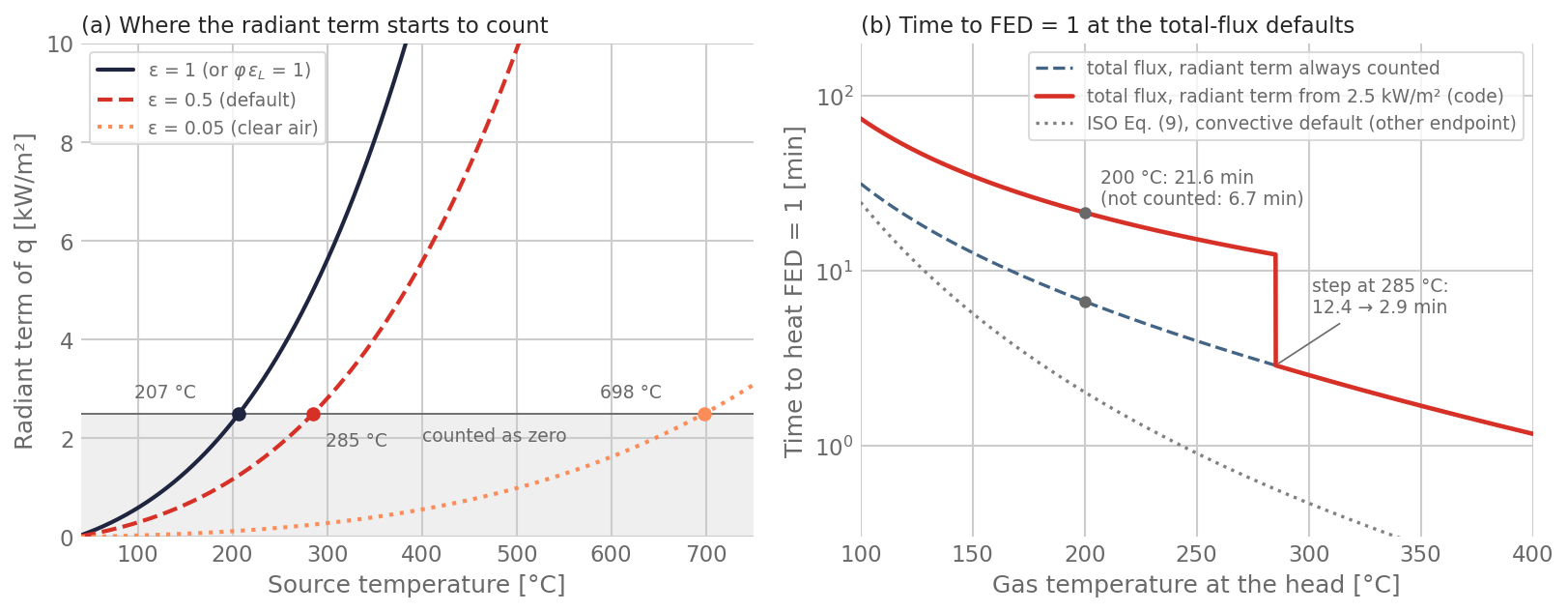
(a) The radiant term of Eq. 63.49 at \(T_s\) = 35 °C; below 2.5 kW/m²
(shaded) it counts as zero. (b) Time to heat FED = 1 in a uniform room at
the total-flux defaults (ε 0.5, h 5, fatal D 16.7): solid with the
threshold, as the code runs; dashed with the radiant term always counted;
dotted, ISO Eq. (9), a different endpoint. Computed through
DefaultHeatFedModel. Script: scripts/figures/heat_radiant_threshold.py.
Why the threshold sits on the radiant term, and on net flux
- Follow ISO. ISO 13571:2012 sets the radiant contribution to zero where the radiant flux to the skin is below 2.5 kW/m² (§8.2, §8.4). The code follows it by maintainer decision. Before, total flux had no threshold; that followed Purser’s spreadsheet and had no published source.
- Radiant term only. ISO applies the limit to the radiant term, not to convection. With the threshold on the total q, clear air (ε = 0.05, h = 8) would give no dose below about 310 °C, where the hot-air data give minutes. Convection therefore counts at every level.
- Net or excess flux, not incident. ISO calls 2.5 kW/m² an incident
flux level. The code compares it with the radiant term as it has it: a
net σT⁴ difference for the gas and layer terms, the excess
f (U − 4σ\(T_s^4\)) for
INTEGRATED INTENSITY. At the Handbook’s 200 °C / 2.5 kW/m² anchor (black layer, φ = 1) the net term is 2.33 kW/m², about 18 % below the incident 2.84 kW/m², so that anchor adds no radiant dose. The threshold is therefore reached at a hotter source than on incident flux. This is recorded in spec 016, not corrected, and listed in Assumptions. - A fixed constant. 2.5 kW/m² is
ISO_RADIANT_THRESHOLD_KW_M2(fed.py), applied bycounted_radiant_flux_kw_m2, with no flag.
Hot layer
--heat-regime layer (opt-in, with --heat-fed-method total-flux) takes
the head to be in clear air below a hot upper layer (spec 016, “Regimes”;
#222).
The Handbook says only that a subject “in air (with a low emissivity), below
a hot smoke layer” receives radiation from the layer (p. 2384), and that
2.5 kW/m² corresponds approximately to a hot layer at 200 °C (p. 2382). The
flux to the skin is convection from the gas at the head plus the radiant
term of Eq. 63.49 with the layer as source and a view factor,
layer_radiant_flux_kw_m2:
with \(T_L\) the temperature of a second TEMPERATURE slice at
--heat-layer-height, sampled at the agent’s x, y. The rate is
\(q^{1.33}/D\) as above.
- No radiant term of the gas at the head. In this regime the εσ term of
the gas at the head is dropped, so
--heat-emissivityhas no effect. The layer term is never added on top of the in-smoke radiant term: with \(T_g = T_L\), ε = 0.5 and φ = ε_L = 1 that sum would be 1.5 σΔT⁴, against σΔT⁴ here. - Net flux. \(q_{\mathrm{ext}}\) is a net flux (a σT⁴ difference), not the incident flux of the radiant tolerance data. At the 200 °C anchor (black layer, φ = 1, \(T_s\) = 35 °C) it is 2.33 kW/m² net against 2.84 kW/m² incident, both within 15 % of the Handbook’s 2.5 kW/m². 2.33 is below the 2.5 kW/m² radiant threshold, so a layer at the anchor adds no radiant dose; a black layer with φ = 1 counts from about 207 °C (Where the radiant threshold acts).
- The regime is a user choice for the whole run. No source gives a rule to decide it per agent (#275).
- A layer cooler than the skin gives a negative \(q_{\mathrm{ext}}\),
which is below 2.5 kW/m² and counts as zero in the dose; it appears only
in
heat_flux_kw_m2. A non-finite layer temperature gives no dose. Where the layer slice has no value, the layer temperature falls back to 20 °C, as the temperature at the head does. This fallback is an unsourced assumption. Below the skin temperature it makes \(q_{\mathrm{ext}}\) slightly negative (cooling), about −0.09 φ ε_L kW/m² at \(T_s\) = 35 °C; that counts as zero in the dose, so the fallback changes onlyheat_flux_kw_m2, not the dose.
φ, \(\varepsilon_L\) and the layer height have no sourced values and no
defaults; the layer regime without any of them is rejected, as are a
non-finite layer height and --heat-regime layer with
--heat-fed-method convective:
| Parameter | Default | CLI flag | Source status |
|---|---|---|---|
| regime | smoke | --heat-regime | User choice; no sourced rule |
| layer height [m] | none (required) | --heat-layer-height | Depends on the ceiling height |
| φ | none (required) | --heat-view-factor | Unsourced; spec 016 gives about 1 for the crown, about 0.5 for the face |
| \(\varepsilon_L\) | none (required) | --heat-layer-emissivity | Unsourced; p. 2384 gives 1 for a black body, “perhaps 0.5” for smoke |
φ and \(\varepsilon_L\) outside [0, 1] or non-finite are rejected.
--heat-regime without --enable-heat-fed logs a warning and leaves the
heat dose off.
Radiant flux from INTEGRATED INTENSITY
--heat-radiant-source integrated-intensity (opt-in, total-flux only;
default gas, the ε term above) takes the radiant term from the FDS
INTEGRATED INTENSITY slice at the slice height, the same height as the
TEMPERATURE slice
(#221).
FDS’s U = ∫ I dΩ [kW/m²] (FDS User’s Guide 6.10.1, Table 22.4, p. 403) is the
radiation arriving from all directions, not the flux onto a surface. A
surface sees one hemisphere, with rays weighted by cos θ, so its incident
flux lies between U/4 (a sphere, or a plate in an isotropic field) and U
(one small source seen face-on); U/2 holds for a plate facing a uniform
layer (spec 016). The flux to the skin is
with \(T_s\) in K (radiant_flux_from_integrated_intensity_kw_m2 for the
incident f U), and the rate is \(q^{1.33}/D\) as above.
- The radiant term is the excess over a skin-temperature field, f (U − 4σ\(T_s^4\)), by maintainer decision (#221), with the same \(T_s\) as the convective term. 4σ\(T_s^4\) is the U of an isotropic black field at the skin temperature, so that field gives q = 0 for every f in [0.25, 1]: surroundings at skin temperature exchange no net heat with the skin, whatever the orientation factor. An isotropic field at T gives 4fσ(T⁴ − \(T_s^4\)); at f = 1/4 that is σ(T⁴ − \(T_s^4\)), the radiant term of Eq. 63.49 with ε = 1, and what an FDS skin gauge reports in that field (FDS User’s Guide 6.10.1, Eq. 22.35, p. 381). A source seen face-on in surroundings at skin temperature (f = 1, U = q\(_{\mathrm{src}}\) + 4σ\(T_s^4\)) gives its own flux q\(_{\mathrm{src}}\). The Handbook calls Eq. 63.49 “the total incident flux to the skin” (p. 2383), and spec 016 takes the radiant tolerance data as incident, so this basis is a choice, not a reading of the sources.
- No negative dose. Where the q that enters the dose (convection plus
the counted radiant term) is at or below zero, the rate is 0; there is no
recovery. An excess below zero (U < 4σ\(T_s^4\)) counts as zero, so hot
air at the head still gives its convective dose while
heat_flux_kw_m2is negative. A 20 °C room with no fire (U = 1.68 kW/m² < 4σ\(T_s^4\) = 2.04 kW/m², air below \(T_s\)) gives no dose for any f. - The ε term is not added. U already contains the emission of the gas
at the head, so ε σ (\(T_g^4 - T_s^4\)) would count it twice;
--heat-emissivityis ignored with this source. --heat-u-factorf in [0.25, 1] has no default. No single factor holds (see Limits below), so f must be given with this source; without it, or outside [0.25, 1], the run stops with an error. f is the user’s choice, not an assumption of the code.- A case with no
INTEGRATED INTENSITYslice is an error, not a zero: the run would otherwise read as a case without radiation. The source with the convective method is an error too. - Both slices are read at one height. The
INTEGRATED INTENSITYslice nearest the slice height must lie at the z of theTEMPERATUREslice; otherwise the run stops with an error, even when both lie within the 0.5 m that only warns for other slices. - Both slices must cover every agent. A point inside one slice and outside
the other stops the run with an error; a missing U is not read as zero.
Outside both (outside the FDS domain) U and q are NaN in the FED
history and the rate is zero; the run logs one warning the first time
this happens, not one per agent or update, and marks each such row with
in_fds_domain = False. - A non-finite U gives a zero rate, as for the gas term.
- With
--heat-regime layeras well, U supplies the radiant term and the layer term is not added; the run logs one warning and the manifest recordslayer_term: false. Reasoning: FDS’s radiation solution already contains the layer’s emission, so the sum would count it twice; of the two, U is the better-resolved input, since it integrates the whole radiation field at the head (layer, flame, walls, the gas around the head), while the layer term takes one slice temperature, a user view factor and a user emissivity. The layer term is used only when U is not the radiant source. There is no per-sample fallback from U to the layer term: inside the domain both slices must cover every agent, so U is always there, and outside it (the only place U is missing) the layer slice has no value either.
Limits of the INTEGRATED INTENSITY source
- Ambient background. U is not zero in a cold room (1.68 kW/m² at 20 °C), but the excess basis subtracts the field at skin temperature, so surroundings at or below \(T_s\) give no dose for any f. Surroundings warmer than the skin but with no fire (a warm day, a heated room) give a radiant dose only where \(f\,(U - 4\sigma T_s^4)\) reaches 2.5 kW/m²; below that only convection counts.
- [0.25, 1] is not a bound for every orientation. In the FDS radiometer data of #224, below a hot layer the plate facing up gets about 0.41 U, but a plate facing down gets about 0.13 U and some facing sideways about 0.22 U, less than f = 0.25 gives. Beside a burner, plates facing up or away from the flame get about 0.12–0.14 U. One f serves one orientation.
- Gauge devices are the preferred input (spec 016): FDS
GAUGE HEAT FLUX GASdevices give the flux to a skin-like plate from the full radiation solution, with no factor (FDS User’s Guide 6.10.1, Eq. 22.35, p. 381). They are not read yet (#276). - Possible double count with convection. The hot-air data behind Eqs. 63.45–63.47 may already include radiation from the walls of the test chambers. If so, adding f U to the convective term partly counts that radiation twice. This is an open question (#221).
- Falling exposure. As for every summed dose, Eq. 63.48 holds only while exposure is steady or rising.
Incapacitation
When the cumulative heat dose reaches the agent’s heat threshold, the agent stops and stays in place as an obstacle for the rest of the run, as for the gas dose (Models › FED).
- One threshold for gas and heat. The heat threshold is
fed_threshold(--fed-threshold, 1.0 by default), as ISO 13571:2012 asks for one threshold for both FED and FEC in an estimation (§5.4) and finds the time for heat in the same manner (§8.5).--heat-fed-threshold(TenabilityConfig.heat_fed_threshold, default none) sets a separate heat threshold; that departs from ISO, so the run logs a warning and the manifest recordsheat_fed_threshold_override. deterministic(default). Every agent uses the heat threshold. No published source gives a population spread for heat tolerance: SFPE Ch. 63 gives population figures for heat only for radiant lethality (p. 2382). Read as a log-normal, those figures give σ ≈ 0.22; the gas value σ = 0.94 would put 29 % of agents below FED 0.60, where they imply 1 % (Incapacitation thresholds). That is why heat stays deterministic by default (#225).probabilistic(opt-in). Each agent draws its own threshold once, from a stream seeded by the run’s seed and its spawn order, independent of the gas threshold: \(D_i = D \cdot \exp(\sigma Z)\), with D the heat threshold, \(Z \sim N(0, 1)\). The default σ = 0.94 is borrowed from the gas dose, an assumption with no data basis for heat. The Handbook’s radiant lethality figures point to a much narrower spread, for an endpoint not modelled here (Incapacitation thresholds, #225).
The gas dose is also deterministic by default; the two modes are set separately
(--incapacitation-mode and --heat-incapacitation-mode).
The two doses use one threshold but do not share an endpoint. Gas FED = 1 is
Purser’s incapacitation endpoint. Without --heat-endpoint, heat FED = 1
is the time of ISO Eq. (9) or (10), which ISO introduces as the time to
prevention of escape and also calls the time to experiencing pain (§8.3,
§8.3.1; see What is not modelled). Both stop the agent in
the same way and set the same incapacitated flag; only
incapacitation_cause tells which endpoint was reached.
| Field | Default | CLI flag |
|---|---|---|
enable_heat_fed | False | --enable-heat-fed |
heat_fed_threshold | none, fed_threshold | --heat-fed-threshold |
heat_incapacitation_mode | "deterministic" | --heat-incapacitation-mode |
heat_susceptibility_sigma | 0.94 | --heat-susceptibility-sigma |
heat_clothing | "clothed" | --heat-clothing |
heat_endpoint | None (ISO law of heat_clothing) | --heat-endpoint |
heat_fed_method | "convective" | --heat-fed-method |
heat_radiant_source | "gas" | --heat-radiant-source |
heat_u_factor | none, required with integrated-intensity | --heat-u-factor |
heat_regime | "smoke" | --heat-regime |
The 2.5 kW/m² radiant threshold of Total flux is not a heat threshold in this sense: it decides which radiant flux enters the dose, is a fixed constant and has no flag.
--disable-tenability turns off the stop; the dose is still computed.
Output
The FED history CSV (--output-fed-history) carries temperature_celsius,
heat_fed_rate_per_min and heat_fed_cumulative per agent and update, and
incapacitation_cause (gas, heat or gas+heat) for agents that stopped.
With --heat-endpoint it also carries heat_endpoint,
heat_outside_validity (True above 205 °C or for a non-finite temperature)
and heat_humidity (always unknown). The run manifest then records
heat_endpoint and heat_validity: the 205 °C limit, marked as assumed, the
humidity status and the < 10 % water-vapour limit. incapacitation_cause still reads heat for every
endpoint; heat_endpoint says which one.
With --heat-fed-method total-flux the FED history also carries
heat_flux_kw_m2 (q), and the manifest records heat_fed_method and
heat_flux_parameters (ε, h, \(T_s\), D, radiant_threshold_kw_m2,
and the names of the assumed parameters). With --heat-regime layer, heat_flux_kw_m2 includes
\(q_{\mathrm{ext}}\), the FED history also carries
heat_layer_temperature_c (\(T_L\)), and heat_flux_parameters also
records regime, view_factor, layer_emissivity and layer_height_m;
it still records ε, which has no effect in that regime. With
--heat-radiant-source integrated-intensity the FED history also carries
heat_integrated_intensity_kw_m2 (U), and heat_flux_parameters adds
radiant_source, u_factor and radiant_flux (excess); ε is then not
listed as assumed, as it is not used.
heat_flux_kw_m2 is the physical q, before the radiant threshold. Where
the radiant term is below 2.5 kW/m², heat_fed_rate_per_min is therefore
not heat_flux_kw_m2^1.33/D: it is the convective part alone raised to
1.33, divided by D (zero where the head is at or below the skin
temperature).
With an endpoint, heat_outside_validity still flags samples
above 205 °C: that limit belongs to the convective data of Eqs.
63.45–63.47, not to the flux law.
The manifest records heat_clothing (clothed or unclothed) when the
ISO law is in use, that is without --heat-endpoint and with
--heat-fed-method convective, and heat_fed_threshold_override when
--heat-fed-threshold was set.
The incapacitated column is true whichever dose stopped the agent, so it
mixes the gas and heat endpoints; filter on incapacitation_cause to count
them apart. gas+heat means both doses crossed their thresholds on the same
update; a crossing by the other dose after the agent has stopped is not
recorded.
What is not modelled
The values the heat dose and its tests rest on without a source are listed in Assumptions (unsourced values).
- Radiant heat from hot surfaces or a flame in view. The convective laws
count convective heat only. The total-flux method adds the radiation of the
gas around the head, or with
--heat-regime layerthat of a hot upper layer. Flux from hot surfaces or a flame in view enters only through--heat-radiant-source integrated-intensity, with a user factor (see Limits of the INTEGRATED INTENSITY source). Gauge devices are not read (#221, #276). FDS reference data for that term exist but are not read by the model: Heat radiometer reference decks (#224). - Layer temperature and emissivity. The layer temperature is read from
one slice at one height: it reads ceiling-jet temperatures near the
ceiling and assumes one ceiling height for the whole domain. There is no
layer reduction from several heights, and \(\varepsilon_L\) is a constant,
not taken from FDS’s
ABSORPTION COEFFICIENT(#274). - Regime selection. The regime is one user choice for the whole run.
In the smoke regime the default ε = 0.5 treats every head as in smoke.
Above about 285 °C that overestimates the dose in clear hot air; set
--heat-emissivity 0.05for clear air. Below about 285 °C the radiant term is under the 2.5 kW/m² threshold for either value, and ε does not change the dose. In the layer regime an agent that walks into the smoke still gets the layer formula. How to decide the regime per agent is open (spec 016, open question 4; #275). - Total-flux parameters. h, \(T_s\) and ε are assumptions (see Total flux); \(T_s\) is fixed and does not rise with exposure (spec 016, open questions 1 and 2).
- The default endpoint. Without
--heat-endpoint, heat FED = 1 is the time of ISO Eq. (9), or of Eq. (10) with--heat-clothing unclothed. ISO introduces both as the time to prevention of escape and also calls it the time to experiencing pain (§8.3, §8.3.1). Ch. 63 labels Eq. 63.44 (= Eq. (10)) a time to incapacitation, but its times lie near the Handbook’s tolerance curve (Eq. 63.45) rather than its injury or fatal ones (#220). - Population spread. No consulted source gives a spread of tolerance for the convective dose; the opt-in σ = 0.94 is borrowed from the gas dose (#225).
- Validity range. Humidity is not sampled, so humid smoke is never
flagged;
heat_humidityreadsunknown(#272). Without--heat-endpoint, temperatures above 205 °C are not flagged either, although Eq. 63.44 rests on the same data (p. 2382); ISO states no temperature range for Eqs. (9) and (10). - Web GUI. The GUI offers
--heat-clothing(a dropdown) and--heat-fed-thresholdin its FED group. The other heat options are fields of its collapsed “Other” section, not next to them (Web GUI; #270, #311). - Terminal UI. The terminal UI offers every heat option in its Heat section: the common ones first, the other 11 under “Advanced” (Terminal UI).
- Falling exposure and recovery. The summed dose assumes exposure that is steady or rising (Eq. 63.48; ISO 13571:2012 §8.4 states it for the temperature experienced by the occupant); a fleeing agent’s exposure falls, and no recovery is modelled.
- Clothing beyond the two ISO laws.
--heat-clothingswitches between fully clothed and unclothed for the whole run; there is no per-agent clothing, no face covering, and no clothing term in the endpoint laws, the total-flux method or the radiant terms. - Effects on walking speed or route choice. The heat dose only incapacitates (#81).
Verification
The heat laws are checked against hand formulas and the tables of SFPE Handbook Ch. 63 (equation level), in coupled corridor runs on synthetic fields, and on FDS cases at 100, 150 and 200 °C. The default ISO Eq. (9) has expected times only on the FDS cases (#307), and the layer regime has no FDS case yet (#308). The checks, their numbers and the test assumptions are on Verification › Heat dose and Heat radiometer.
Relation to ISO 13571:2012
ISO 13571:2012 clause 8 (Fundamentals) has both convective laws and the 2.5 kW/m² radiant threshold in common with the code, and none of its other options:
| Option | ISO 13571:2012 counterpart |
|---|---|
Default, --heat-clothing clothed | Eq. (9), §8.3.1: fully clothed, uncertainty ±25 % (§8.3.2) |
--heat-clothing unclothed (Eq. 63.44) | Eq. (10), §8.3.2: same constants, for unclothed or lightly clothed subjects, uncertainty ±25 % |
--heat-endpoint tolerance, injury, fatal (Eqs. 63.45–63.47) | None |
--heat-fed-method total-flux (Eqs. 63.49 and 63.43, dose D) | None: ISO has no total-flux form, no ε, h or \(T_s\), and no radiant dose |
| Radiant law, any regime or source | None: ISO’s radiant laws are Eqs. (7) (burns) and (8) (pain), \(a\,q^{-b}\) with other exponents and q defined only as the radiant heat flux; the code does not use them |
| Radiant term counted as zero below 2.5 kW/m² | Adopted from §8.2, §8.4, where 2.5 kW/m² is an incident flux level; the code compares it with the net or excess radiant term, not the incident flux (spec 016) |
| Heat FED kept apart from the gas FED | Consistent: ISO treats heat as a component of its own (§4.1, §4.6 a) |
Heat threshold = fed_threshold (default) | Our reading of §5.4 (one threshold for FED and FEC in an estimation) with §8.5 (heat time found in the same manner); ISO does not name the heat FED in §5.4 |
--heat-fed-threshold, separate from the gas threshold | A departure from §5.4; logged and recorded in the manifest |
| Heat σ | None: ISO gives no population spread for heat |
ISO gives no upper temperature for Eqs. (9) and (10), so the 205 °C limit of the endpoint laws stays an assumption; its humidity condition, less than 10 % water vapour by volume (§8.3), is the one the code already records.
Assumptions (unsourced values)
Values in the heat code that no consulted source fixes. Each can change a result; none is a Handbook tolerance.
| Parameter | Value | CLI flag / config key | Where used | Why this value | What would source it |
|---|---|---|---|---|---|
| Convective coefficient h | 5 W/(m²·K) | --heat-convective-coefficient / convective_coefficient (DEFAULT_HEAT_CONVECTIVE_COEFFICIENT) | Total-flux q, every regime and radiant source | Low end of “approximately 5–8 for slow-moving air” (p. 2384, printed without a unit); the value of the spec 016 convection check | h measured for a walking, clothed person in hot air or smoke |
| Skin temperature \(T_s\) | 35 °C, fixed | --heat-skin-temperature / skin_temperature_celsius (DEFAULT_HEAT_SKIN_TEMPERATURE_C) | Total-flux convective and radiant terms, and 4σ\(T_s^4\) of the excess INTEGRATED INTENSITY term | The value in Lovreglio’s draft; the Handbook gives none for Eq. 63.49 | Skin temperature data under heat exposure, including its rise (spec 016, open question 2) |
| Gas emissivity ε | 0.5 | --heat-emissivity / emissivity (DEFAULT_HEAT_EMISSIVITY) | Total-flux gas term at the head (--heat-regime smoke, --heat-radiant-source gas) | “perhaps 0.5 for smoke” (p. 2384); treats every head as in smoke. Below about 285 °C it does not change the dose (radiant threshold) | ε per agent from FDS absorption and path length (#274, #275) |
| Temperature fallback | 20 °C | none (HeatFedInputs.temperature_celsius) | Temperature at the head outside the TEMPERATURE slice; layer temperature where the layer slice has no value (#222) | A room ambient; below \(T_s\) it gives a small negative layer flux, which counts as zero in the dose and shows only in heat_flux_kw_m2 | The case’s ambient TMPA |
| Convective validity limit | 205 °C | none (HEAT_CONVECTIVE_VALIDITY_MAX_C) | heat_outside_validity flag with --heat-endpoint (Eqs. 63.45–63.47, #220); does not clip the rate | Highest dry-air tolerance point of Table 63.17 (Veghte, 4 min, p. 2375); the Handbook gives no upper temperature | The temperature range of the data Purser fitted Eqs. 63.45–63.47 to |
| Radiant threshold basis | 2.5 kW/m² on the net or excess radiant term | none (ISO_RADIANT_THRESHOLD_KW_M2, fixed) | Total-flux radiant term, every regime and source | ISO 13571:2012 §8.2, §8.4 give 2.5 kW/m² as an incident flux level; the code compares it with the radiant term it computes, about 18 % below incident at the 200 °C anchor (2.33 against 2.84 kW/m², spec 016) | Whether the threshold, and the radiant tolerance data, hold for incident flux or for net flux at the skin |
| U factor f | in [0.25, 1], no default | --heat-u-factor / u_factor (HEAT_U_FACTOR_RANGE) | --heat-radiant-source integrated-intensity (#221) | Geometric bounds: U/4 for a sphere or an isotropic field, U for one small source face-on; the #224 data put some orientations below 0.25 | Gauge devices per orientation (#276) |
| Flux basis of f U | excess over a skin-temperature isotropic field, f (U − 4σ\(T_s^4\)) | none (fixed) | --heat-radiant-source integrated-intensity | Maintainer decision: surroundings at skin temperature give no flux for any f; at f = 1/4 equals Eq. 63.49 with ε = 1 and the FDS skin gauge (FDS User’s Guide 6.10.1, Eq. 22.35). The Handbook calls Eq. 63.49 incident (p. 2383) | Whether the radiant tolerance data (Table 63.19) hold for incident flux or for flux above the skin’s own exchange |
| U with the layer regime | U supplies the radiant term; layer term not added | --heat-regime layer with --heat-radiant-source integrated-intensity | Total-flux q when both are set | U already contains the layer’s emission and is the better-resolved input | Gauge devices, which replace both (#276) |
| Heat σ | 0.94 | --heat-susceptibility-sigma / heat_susceptibility_sigma | Probabilistic heat mode only (--heat-incapacitation-mode probabilistic) | Borrowed from the gas dose (#225); the radiant lethality figures imply about 0.22 | A population spread for the convective dose, e.g. the probits of Hockey & Rew (1996), not read |
| Clothing | fully clothed, every agent | --heat-clothing / heat_clothing (DEFAULT_HEAT_CLOTHING) | Convective law without --heat-endpoint or total flux (#290) | Maintainer decision following ISO 13571:2012, which recommends Eq. (9) for fully clothed subjects (§8.3.1); SFPE Ch. 63 treats the unclothed law as the relevant one unless protective clothing is worn (p. 2336) | Clothing data per occupancy or per agent |
| One threshold for gas and heat | heat threshold = fed_threshold | --heat-fed-threshold / heat_fed_threshold overrides it | Heat incapacitation | Maintainer reading of ISO 13571:2012 §5.4 with §8.5; the standard does not say whether the heat FED shares the gas threshold (Incapacitation thresholds) | A statement of the standard, or data on heat and gas thresholds in the same people |
The assumptions of the test decks and test bands (the #224 and #221 decks, the skin gauge, the table reading, the test bands and the flame pass) are on Verification › Heat dose; they do not affect a run.
Sources
- Purser, D. A., & McAllister, J. L. (2016). Assessment of hazards to occupants from smoke, toxic gases, and heat. In SFPE Handbook of Fire Protection Engineering (5th ed., Ch. 63). Springer. doi:10.1007/978-1-4939-2565-0_63
- Purser, D. A., & McAllister, J. L. (2026). Assessment of hazards to occupants from smoke, toxic gases, and heat. In Society of Fire Protection Engineers (Ed.), SFPE Handbook of Fire Protection Engineering (6th ed., Ch. 70, pp. 2271–2352). Springer. doi:10.1007/978-3-031-59212-6_70
- Lovreglio, R. FED Heat v3. Unpublished draft, which cites the 6th ed., Ch. 70. Reviewed by D. Purser (personal communication, 2026).
- McGrattan, K., et al. (2025). Fire Dynamics Simulator User’s Guide, FDS 6.10.1. NIST Special Publication 1019. Table 22.4 (p. 403) and Eq. 22.35 (p. 381).