Irritant gases
Irritant gases such as hydrogen chloride (HCl), hydrogen bromide (HBr), hydrogen fluoride (HF), sulphur dioxide (SO₂), nitrogen dioxide (NO₂), acrolein and formaldehyde act in two ways. Sensory irritation of the eyes and upper airways is felt immediately and depends on the concentration: it impairs escape at once. Damage to the deep lung depends on the inhaled dose and develops over hours. The literature treats the two with different quantities, and the standards and the handbook combine them differently.
The quantities are the concentration criteria (ISO’s FEC and Purser’s FIC), the denominators each one uses, Purser’s relation between FIC and walking speed, and the lung dose. In short, the published rule adds the speed losses from smoke and from irritants. It does not multiply them (Eq. 70.12).
Symbols follow the notation table. The equations below keep the sources’ own notation (FEC, \(F_{\mathrm{FIC}}\), \(F_{\mathrm{FLD}}\)).
ISO 13571: a separate concentration endpoint
ISO 13571:2012 treats asphyxiants and irritants separately, because they are “physiologically unrelated and mechanistically independent” (§4.2.1). For irritants it considers only eye and upper-respiratory-tract sensory irritation. It computes a fractional effective concentration (FEC) [-] for each irritant at each time increment, from the concentration and not from the dose, and compromised tenability is predicted when the sum of the FECs exceeds a threshold (§4.2.3). The FEC is a separate endpoint: it is not added to the asphyxiant fractional effective dose (FED). The same threshold value must be used for FED and FEC in a given estimation (§5.4). Pulmonary irritation is excluded because its serious effects appear hours to days after exposure (§4.2.1).
In ISO’s Eq. (4) (§6.2.1, p. 7), each term is the volume fraction of an irritant divided by \(F_i\), the concentration of that irritant at which tenability is expected to be seriously compromised:
$$ \mathrm{FEC} = \sum_i \frac{\varphi_i}{F_i} $$ISO gives \(F_i\) [µl/l, equal to ppm] as HCl 1000, HBr 1000, HF 500, SO₂ 150, NO₂ 250, acrolein 30 and formaldehyde 250, with an uncertainty of ±50 % (§6.2.1). The sum is formed at each time increment and treated as instantaneous (§6.2.1, NOTE 1). Irritants have no effect on the asphyxiant FED (§6.1, NOTE 5). ISO 13571 gives no relation between irritants and walking speed.
Purser: the fractional irritant concentration (FIC)
Purser and McAllister (2026, Society of Fire Protection Engineers (SFPE) Handbook, 6th ed., Ch. 70, p. 2287) define the fractional irritant concentration (FIC) [-] as a sum over irritants, each term being the current concentration divided by the concentration predicted to cause a chosen endpoint:
$$ \begin{aligned} &\mathrm{FIC} = \mathrm{FIC_{HCl}} + \mathrm{FIC_{HBr}} + \mathrm{FIC_{HF}} \\ &\quad + \mathrm{FIC_{SO_2}} + \mathrm{FIC_{NO_2}} + \mathrm{FIC_{CH_2CHO}} \\ &\quad + \mathrm{FIC_{CH_2O}} + \sum \mathrm{FIC}_x \quad \text{(Eq. 70.9)} \end{aligned} $$The chapter repeats the sum as Eq. 70.10 (p. 2289) and in its appendix (p. 2342, again labelled Eq. 70.9). The terms stand for immediate sensory effects, so Ch. 70 expects them to ease when the concentrations fall, for example when a person leaves the contaminated area (p. 2289). Like the ISO FEC, the FIC is a concentration criterion. It is not a dose and is not integrated over time.
Which endpoint goes in the denominator
The chapter uses two endpoints, and different equations use different ones:
- Escape impairment: Eq. 70.6 (p. 2278) and the text under Eq. 70.10 (p. 2289).
- Either endpoint: the appendix, which names both SFPE columns of Table 70.4 (p. 2342).
- Incapacitation: the walking-speed relation, Eq. 70.11, where FIC = 1 means incapacitation (p. 2289; Purser 2003, p. 99). Ch. 70 introduces it for concentrations below the SFPE incapacitation column (p. 2289).
- The 2016 edition of the chapter (5th ed., Ch. 63, p. 2325) read FIC = 1 as significant impairment and FIC = 5 as roughly incapacitation, which in our reading is the escape-impairment scale. The 6th edition drops that list.
The denominators [ppm] side by side: SFPE escape impairment, SFPE incapacitation and AEGL-2 for 10 min from Table 70.4 (p. 2288), and ISO 13571 \(F_i\) (§6.2.1, p. 7):
| Gas | SFPE escape | SFPE incap. | ISO \(F_i\) | AEGL-2 |
|---|---|---|---|---|
| HCl | 200 | 900 | 1000 | 100 |
| HBr | 200 | 900 | 1000 | 100 |
| HF | 200 | 900 | 500 | 95 |
| SO₂ | 24 | 120 | 150 | 0.75 |
| NO₂ | 70 | 350 | 250 | 20 |
| Acrolein | 4 | 20 | 30 | 0.44 |
| Formaldehyde | 6 | 30 | 250 | 14 |
Three things follow from the table (our arithmetic):
- The escape-impairment values are about 0.2 of the incapacitation values: 200/900 = 0.22 for the three halogen acids and 0.20 for the other four gases. This matches the 2016 reading, where FIC = 5 on the escape scale is roughly incapacitation.
- The sets disagree gas by gas. SFPE incapacitation and ISO differ by up to about 8× (formaldehyde, 30 against 250 ppm). SFPE escape impairment and ISO differ by up to about 40× (formaldehyde, 6 against 250 ppm). The same smoke gives very different FIC values depending on the set.
- ISO’s FEC and SFPE’s FIC do not share denominators, so an FEC of 1 and an FIC of 1 describe different mixtures.
The factor 0.3. Ch. 70 mentions it several times (pp. 2288, 2289, 2322, 2342). The escape-impairment values are to be used “with an FED factor of 0.3 to allow for sensitive individuals” (p. 2289), and “a factor of 0.3 FEC for escape impairment” should let nearly all exposed people escape (p. 2342). Page 2288 explains the number: some people may be impaired at about 0.3 of the concentration that affects the average person, which for HCl is 60 ppm instead of 200 ppm. In our reading, 0.3 is therefore a sensitive-person factor on the escape-impairment values. It is not the ratio between the escape and incapacitation columns (about 0.2), and it does not apply to the incapacitation values.
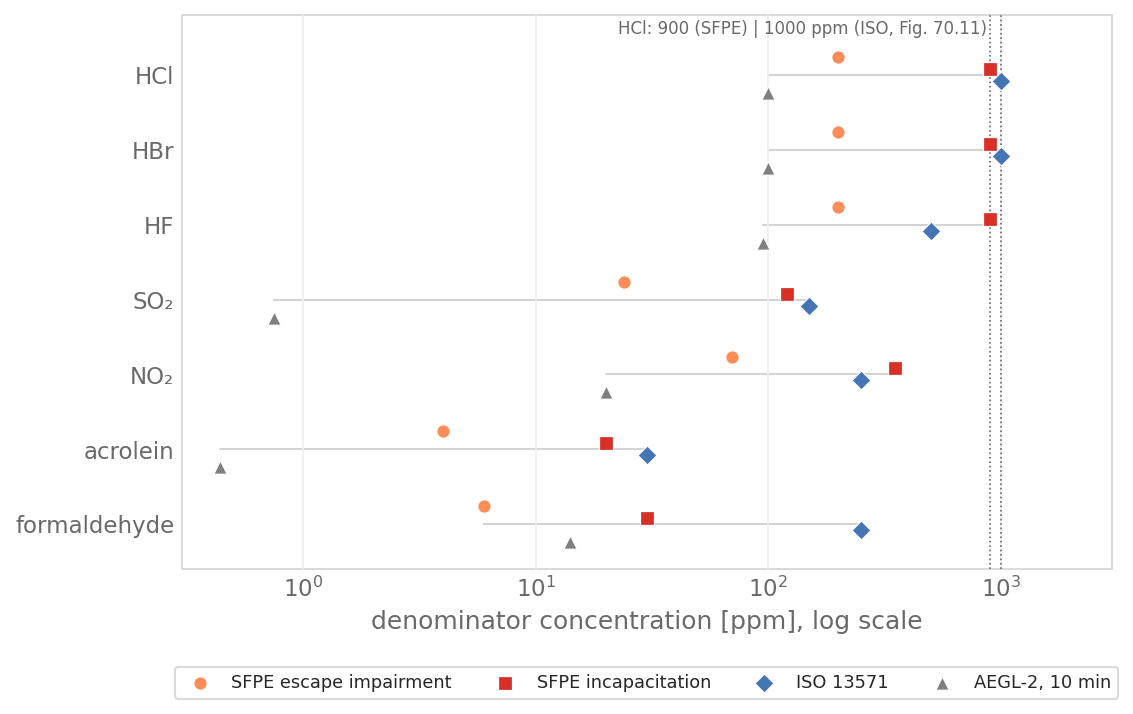
Denominators [ppm] per gas for four endpoint sets, log scale: SFPE escape
impairment and SFPE incapacitation (Table 70.4, p. 2288), ISO 13571
(§6.2.1, p. 7) and AEGL-2 for 10 min (Table 70.4). The dotted lines mark HCl
at 900 ppm (SFPE incapacitation) and 1000 ppm (ISO, the example of
Fig. 70.11). NO is left out: it has no escape-impairment value, its
incapacitation value is given only as “>1000”, and it is not in the FIC
sum. Script: scripts/figures/fundamentals_fic_denominators.py.
Irritants and walking speed (FIC)
Purser (2003, pp. 94 and 99–100) proposed that irritants do not slow people at low concentrations and stop effective movement at incapacitation, FIC = 1, with a sigmoid fall in between: “a curve has been fitted between these two extremes” (p. 94). Ch. 70 calls it an “estimated relationship” based on a concept and on the concentration estimated to be very painful (Fig. 70.11 and its text, p. 2289). Neither source gives walking data or fit statistics for it; in our reading, it is a concept curve with no walking data behind it. Ch. 70 gives it as
$$ F_{wv\,irr} = \frac{e^{-(1000\,x/b)^2} + (-0.2\,x + 0.2)}{1.2}, \qquad b = 160,\ x = \mathrm{FIC} \qquad \text{(Eq. 70.11)} $$where \(F_{wv\,irr}\) is the fractional walking speed (1 = normal walking speed of 1.2 m/s). The source states only the end point, 0 at FIC = 1 (p. 2289). Our arithmetic gives 1.000, 0.914, 0.714, 0.308, 0.141 and 0.083 at FIC = 0, 0.05, 0.1, 0.2, 0.3 and 0.5. The formula holds for 0 ≤ FIC ≤ 1 only: above 1 it turns negative, for example −0.083 at FIC = 1.5.
Jin’s experiments, which Ch. 70 cites for the link between irritancy and walking speed (p. 2289), give no FIC values: they index irritancy by the extinction coefficient K, and the smoke composition was not reported (Purser 2003, p. 98).
Which denominators? Ch. 70 writes Eq. 70.11 with FIC = 1 meaning incapacitation “(e.g., 1000 ppm HCl)” (p. 2289), as Purser does (2003, p. 99). That HCl example is the ISO value; the SFPE incapacitation value is 900 ppm. Purser defines the FIC of his speed curve as the concentration “expressed as a fraction of the concentration predicted to cause incapacitation” (2003, p. 99), so the curve takes the incapacitation denominators. With the escape-impairment set, walking speed would reach 0 at 200 ppm HCl instead of 900 ppm.
The earlier chapter (Purser 2002, SFPE 3rd ed., Sec. 2, Ch. 6) uses the other scale: FIC = 1 there means escape impairment, and incapacitation lies at a multiple of it that the chapter states three ways: FIC about 3–5 (p. 2–91), a factor of about four or more (p. 2–121), and 5–10 times the FIC (p. 2–132).
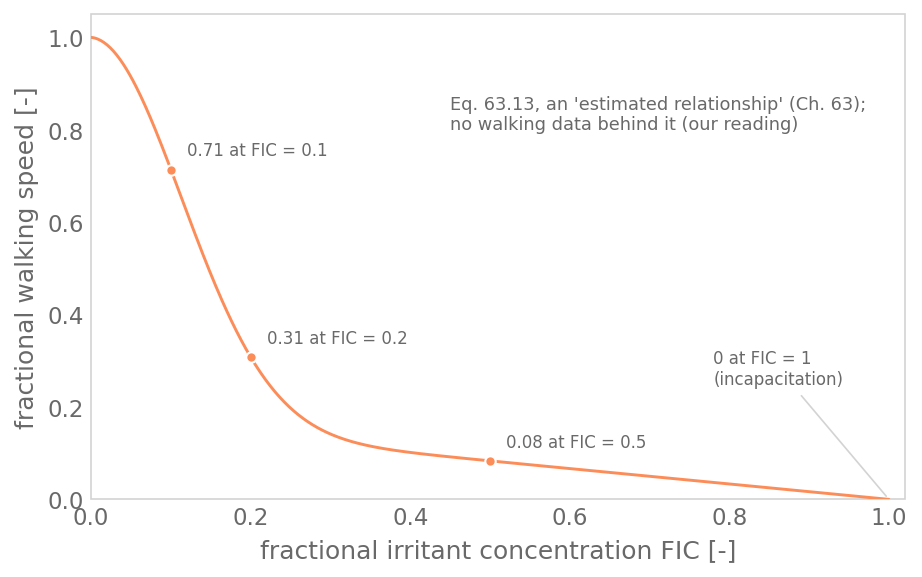
Fractional walking speed against fractional irritant concentration FIC
from Ch. 70, Eq. 70.11, drawn thin because, in our reading, no walking data
lie behind it. Dotted beyond FIC = 1, outside the curve’s range, where the
formula goes negative. Script: scripts/figures/fundamentals_irritant_speed.py.
Combining with smoke: the losses add
Purser multiplies the unexposed walking speed by the fraction (2003, p. 98). He treats the effects of smoke and irritants as essentially additive (p. 99) and adds their losses (Purser 2003, p. 100; Ch. 70, Eq. 70.12, p. 2289):
$$ F_{wv} = 1 - (1 - F_{wv\,smoke}) - (1 - F_{wv\,irr}) \qquad \text{(Eq. 70.12)} $$where \(F_{wv\,smoke}\) is the fractional walking speed due to smoke obscuration (see Walking speed in smoke). The walking speed is \(F_{wv}\) times the unexposed speed.
- No clipping. The sum can fall below 0, and neither source clips it. It is at most 0 whenever \(F_{wv\,irr} = 0\) (FIC = 1) and \(F_{wv\,smoke} < 1\).
- Non-irritant smoke only. \(F_{wv\,smoke}\) has to be a law for non-irritant smoke. Purser pairs it with his fit to Jin’s non-irritant data (2003, p. 98). Pairing it with Eq. 70.8, which is fitted to pooled “moderately irritant” data, would in our reading count irritancy twice (see Walking speed in smoke).
The equation as printed in Purser (2003)
Purser: a dose term for lung effects
The lung effects are a dose. The fractional lethal dose of irritants \(FLD_{irr}\) [-] sums, for each irritant, the Ct exposure dose [ppm·min] divided by the dose predicted to be lethal to half the population (Eq. 70.13, Table 70.5, p. 2290, e.g. 114 000 ppm·min for HCl). Purser notes that lung irritation has relatively little effect on escape capability and “can be omitted from an escape calculation” (p. 2342), but in the simplified asphyxiant equation he includes \(FLD_{irr}\) inside the sum that is multiplied by the CO₂ factor, because irritants impair lung function and add some hypoxia (Eq. 70.38; see Asphyxiant FED).
FDS+Evac and FDS
The guide to FDS+Evac, the evacuation module of the Fire Dynamics Simulator (Korhonen 2021, Eqs. 12 and 17, Table 2), follows this structure: its total dose
$$ \mathrm{FED_{tot}} = \left(\mathrm{FED_{CO}} + \mathrm{FED_{CN}} + \mathrm{FED_{NO_x}} + \mathrm{FLD_{irr}}\right)\times \mathrm{HV_{CO_2}} + \mathrm{FED_{O_2}} $$adds the irritant lethal dose into the incapacitation sum, and its Table 2 lists both the lethal doses \(F_{FLD}\) and the incapacitating concentrations \(F_{FIC}\). The values in that table agree with the SFPE columns of Tables 70.4 and 70.5. This sum is the Purser / FDS+Evac guide form; ISO 13571 keeps irritants out of the FED altogether.
No equation in the guide uses \(F_{FIC}\), and the FDS+Evac source
(evac.f90) computes no FIC. FDS+Evac slows people only through the
Frantzich–Nilsson relation of the guide’s Eq. 11, with a floor of
0.1·\(v_0\) (p. 29). FDS itself outputs \(\mathrm{FIC_{irr}}\) as a
diagnostic quantity (User’s Guide 2025, Eq. 22.50 and Table 22.3, p. 390).
Its denominators are the concentrations expected to cause incapacitation in
half the population, the same values as the SFPE incapacitation column.
Known limits
Human measurements at incapacitating concentrations cannot be made for ethical reasons, and most of the experimental work behind the irritant values used animals, mostly rodents, together with expert judgement (Ch. 70, p. 2288). The three FIC and FEC denominator sets (SFPE escape impairment, SFPE incapacitation, ISO) differ by up to about 40× for one gas (formaldehyde, 6 ppm for SFPE escape impairment against 250 ppm for ISO; our arithmetic), so the choice of endpoint set changes FIC more than the choice of speed law does. Individual sensitivity is wide: for HCl, Purser proposes 200 ppm as the escape-impairment concentration for the average person, but notes that some people may be impaired at 60 ppm and others may escape through about 400–600 ppm (p. 2288). The concentrations of acrolein and formaldehyde are rarely known in a fire, and Ch. 70 suggests a smoke-density surrogate when they are not (notes to Tables 70.4 and 70.5, pp. 2288 and 2290). The walking-speed curve Eq. 70.11 is a concept curve without fitted data and is defined only for FIC from 0 to 1.
Sources
- ISO (2012). ISO 13571:2012 Life-threatening components of fire — Guidelines for the estimation of time to compromised tenability in fires, §4.2, §5.4, §6.1 (NOTE 5) and §6.2.1 (Eq. 4, NOTE 1, p. 7). ISO, Geneva. iso.org/standard/56172. Read from the full text; paraphrased except the quoted phrase of §4.2.1.
- Purser, D. A., & McAllister, J. L. (2026). Assessment of hazards to occupants from smoke, toxic gases, and heat. SFPE Handbook of Fire Protection Engineering, 6th ed., Ch. 70, 2271–2352. pp. 2278, 2287–2290, 2310, 2342; Eqs. 70.6, 70.9–70.13, 70.38; Tables 70.4–70.5. doi:10.1007/978-3-031-59212-6_70
- Purser, D. A., & McAllister, J. L. (2016). Assessment of hazards to occupants from smoke, toxic gases, and heat. SFPE Handbook of Fire Protection Engineering, 5th ed., Ch. 63, 2308–2428. Cited only for the FIC scale of p. 2325, which Ch. 70 drops. doi:10.1007/978-1-4939-2565-0_63
- Purser, D. A. (2002). Toxicity assessment of combustion products. SFPE Handbook of Fire Protection Engineering, 3rd ed., Sec. 2, Ch. 6. NFPA, Quincy, MA. pp. 2–91, 2–121, 2–132.
- Purser, D. A. (2003). ASET and RSET: addressing some issues in relation to occupant behaviour and tenability. Fire Safety Science, 7, 91–102. pp. 94, 98–100. doi:10.3801/IAFSS.FSS.7-91
- McGrattan, K., Hostikka, S., Floyd, J., McDermott, R., Vanella, M., Mueller, E., & Paul, C. (2025). Fire Dynamics Simulator User’s Guide, 6th ed., Eq. 22.50 and Table 22.3, p. 390. NIST Special Publication 1019. doi:10.6028/NIST.SP.1019
- Korhonen, T. (2021). Fire Dynamics Simulator with Evacuation: FDS+Evac. Technical Reference and User’s Guide (FDS 6.7.6, Evac 2.6.0-draft), §3.4, Eq. 11, Table 2. VTT Technical Research Centre of Finland. github.com/tkorhon1/FDS-Evac-Guide. Secondary source.
How pyFDS-Evac uses this: see Fractional effective dose. Its opt-in irritant slowdown uses a different curve and multiplies it with the smoke factor (Models › FED).
How it is verified: the FED and FIC rows of the Verification index; the HCN, NOₓ and irritant terms are not yet verified end to end (#257).