Heat
Heat can incapacitate in three ways: heat stroke (hyperthermia), skin pain followed by burns, and burns to the respiratory tract (Purser and McAllister 2026, Society of Fire Protection Engineers (SFPE) Handbook, 6th ed., Ch. 70, p. 2345). The first is driven mainly by hot air around the body (convective heat), the second mainly by thermal radiation onto exposed skin. The two are described by separate equations with different endpoints, and neither should be read as the other.
Symbols follow the notation table; T is the gas temperature [°C]. The equations below keep the SFPE Handbook’s notation (\(t_I\), q, r).
Convective heat: time to incapacitation
Eq. 70.42 gives the time to incapacitation \(t_{I\,\mathrm{conv}}\) [min] at air temperature T [°C] for air with less than 10 % water vapour by volume and for exposures up to 2 h (p. 2318):
$$ t_{I\,\mathrm{conv}} = 5\times10^{7}\,T^{-3.4} \qquad \text{(Eq. 70.42)} $$The expression is derived from the tolerance data (Fig. 70.23, p. 2313; derivation on p. 2318). Purser notes that the expression follows the worst-case (100 % humidity) line and deviates from Blockley’s curve at the ends: it is somewhat non-conservative at high temperatures and somewhat over-conservative at low ones. For design, Ch. 70 proposes a better fit for mid-humidity conditions,
$$ t_{\mathrm{tol}} = 2\times10^{31}\,T^{-16.963} + 4\times10^{8}\,T^{-3.7561} \qquad \text{(Eq. 70.43)} $$with further expressions for serious injury (Eq. 70.44) and for fatal exposure (Eq. 70.45). No heat flux enters Eqs. 70.42–70.45: they take the air temperature only. For unprotected skin, the tolerance data put the limit for convected heat at about 120 °C; above it, pain comes quickly and burns follow within minutes (Ch. 70, p. 2319 and Table 70.18). Thermal burns to the respiratory tract do not occur unless the air is hot or humid enough to burn the facial skin (p. 2317), and saturated air can be breathed for more than a few minutes only up to 60 °C (pp. 2345–2346; Table 70.18, p. 2319).
Radiant heat: pain and burns
The tenability limit for radiant heat incident on skin is about 2.5 kW/m², below which exposure can be tolerated for at least several minutes; at and above it, pain is followed by burns within seconds (Ch. 70, p. 2317 and Table 70.18). Below this flux the radiant contribution is neglected. Above it, the time \(t_{I\,\mathrm{rad}}\) [min] to a given endpoint at incident radiant flux q [kW/m²] is
$$ t_{I\,\mathrm{rad}} = \frac{r}{q^{1.33}} \qquad \text{(Eq. 70.41)} $$where r [(kW/m²)^4/3·min] is the dose for the endpoint: about 1.33–1.67 for severe skin pain, 4.0–12.2 for second-degree burns and 16.7 for third-degree burns. Purser proposes 1.33 as a tolerance threshold and 10 as a threshold for incapacitation and serious injury (p. 2318). For the average population, r = 10 is also given as a 1 % fatality level and r = 16.7 as a 50 % lethal level (p. 2318); what these imply for the population spread is discussed under Incapacitation thresholds. For occupants passing under a hot smoke layer, 2.5 kW/m² corresponds approximately to a layer temperature of 200 °C (pp. 2317–2318).
Combining the two
Ch. 70 describes two ways to account for both. One sums the fractional effective doses (FED) over time,
$$ \mathrm{FED} = \int_{t_1}^{t_2}\left(\frac{1}{t_{I\,\mathrm{rad}}} + \frac{1}{t_{I\,\mathrm{conv}}}\right)\mathrm{d}t \qquad \text{(Eq. 70.46)} $$valid while the temperature is stable or increasing. The other computes the total heat flux to the skin from radiant and convective components (Eq. 70.47; Eq. 63.49 in the 5th edition, which the Models pages cite), which the Handbook calls the total incident flux (p. 2319) but writes as a net exchange with the skin surface, and applies Eq. 70.41 to it, with the dose D in place of r: 1.33 for pain, 10 for second-degree burns and severe incapacitation, 16.7 for third-degree burns and a potentially fatal exposure (p. 2319). In Eq. 70.47 the emissivity ε is 0.05 for a gas and “perhaps 0.5 for smoke”, and the convective heat transfer factor is “approximately 5–8 for slow-moving air”, with no unit given (p. 2319). The Handbook applies this method to total fluxes above 2.5 kW/m² (p. 2319). Below a hot layer in clear air, the significant radiant sources are the layer, the fire and hot surfaces (p. 2319). ISO 13571:2012 (§4.4) likewise assesses heat and radiant energy with an FED model analogous to the gas model; its equations are given below.
A summed dose is interpretable only when both terms are taken for the same endpoint. Ch. 70 pairs them as follows (pp. 2318–2319):
| Endpoint | Radiant r (Eq. 70.41) | Convective law |
|---|---|---|
| Tolerance, severe pain | 1.33 | Eq. 70.43 |
| Serious injury, incapacitation | 10 | Eq. 70.44 |
| Fatal | 16.7 | Eq. 70.45 |
Eq. 70.42 is labelled a time to incapacitation, but its times lie near the tolerance curve. Note (our arithmetic, not from the sources): at 100 °C it gives 7.9 min, against 12.3 min from Eq. 70.43 (tolerance) and 35.6 min from Eq. 70.44 (injury).
ISO 13571:2012, clause 8
ISO 13571:2012 gives its own heat method in clause 8 (pp. 9–10). Its endpoint is “compromised tenability”, the inability to perform cognitive and motor-skill functions at an acceptable level (§3.1); the standard avoids the word incapacitation because it can be read to include collapse and unconsciousness (§1).
Criteria. Of three ways heat threatens life (hyperthermia, body-surface burns, respiratory-tract burns), ISO keeps two for modelling: the threshold of second-degree skin burns, and hyperthermia severe enough to cause mental deterioration (§8.1). Respiratory-tract burns are not expected from air with less than 10 % water vapour by volume without burns to the skin or face, but can occur from saturated air above 60 °C (§8.1, Note).
Radiant heat. ISO gives about 2.5 kW/m² as the tenability limit for skin, which it calls an incident heat flux level; below it, exposure can be tolerated for 30 min or longer (§8.2). Ch. 70 says “at least several minutes” and more than 5 min (p. 2317, Table 70.18). Above the limit, with q the radiant heat flux [kW/m²] and times in minutes,
$$ t_{I\,\mathrm{rad}} = 6.9\,q^{-1.56} \qquad \text{(ISO Eq. 7, second-degree burns)} $$$$ t_{I\,\mathrm{rad}} = 4.2\,q^{-1.9} \qquad \text{(ISO Eq. 8, pain)} $$Both are taken from Wieczorek and Dembsey (2001), ISO ref. [17], with an estimated uncertainty of ±25 % (§8.2). ISO relates 2.5 kW/m² to a source surface temperature of about 200 °C (§8.2); Ch. 70 relates it to a hot layer at 200 °C (pp. 2317–2318). ISO does not use the dose form of Eq. 70.41.
Convective heat. For air with less than 10 % water vapour by volume (§8.3), with T the air temperature [°C]:
$$ t_{I\,\mathrm{conv}} = 4.1\times10^{8}\,T^{-3.61} \qquad \text{(ISO Eq. 9, fully clothed)} $$$$ t_{I\,\mathrm{conv}} = 5\times10^{7}\,T^{-3.4} \qquad \text{(ISO Eq. 10, unclothed or lightly clothed)} $$Eq. (9) is cited to Crane (1978), ISO ref. [18]. Eq. (10) is cited to Purser’s chapter in the 4th edition of the SFPE Handbook, ISO ref. [2], and has the constants of Eq. 70.42. ISO calls both empirical fits to human data, with an estimated uncertainty of ±25 % (§8.3.2). The 120 °C limit for unprotected skin is repeated there (§8.3.2, Note).
Combining. The heat FED is the sum over time steps of \(1/t_{I\,\mathrm{rad}} + 1/t_{I\,\mathrm{conv}}\) (ISO Eq. 11), the form of Eq. 70.46. ISO makes it conditional on the temperature experienced by the occupant being stable or increasing (§8.4); Ch. 70 states the condition for the temperature in the fire (p. 2318). The radiant term is set to zero where the radiant flux to the skin is below 2.5 kW/m² (§8.4). The time at which the sum exceeds the chosen threshold is the time to compromised tenability, in the same manner as for the gases (§8.5, pointing to §5.3); see Incapacitation thresholds.
What ISO does not give. No total-flux method: no Eq. 70.47, and so no emissivity, convective coefficient or skin temperature. No counterpart of Eqs. 70.43–70.45 and no radiant doses r. No temperature or flux range for Eqs. (7) to (10), and no exposure-duration limit for heat; the caution on exposures shorter than 1 min or longer than 1 h (§5.8) is stated for asphyxiant gases. Ch. 70 states “up to 2 h” for Eq. 70.42 (p. 2318).
| ISO 13571:2012 | SFPE Ch. 70 | |
|---|---|---|
| Radiant law | \(a\,q^{-b}\): Eq. (7) burns, Eq. (8) pain | \(r/q^{1.33}\) with r per endpoint (Eq. 70.41) |
| Radiant limit | 2.5 kW/m² incident; ≥ 30 min below | 2.5 kW/m²; several minutes, > 5 min below |
| 200 °C relates to | a radiating source surface | a hot layer |
| Convective laws | Eq. (9) clothed; Eq. (10) unclothed = Eq. 70.42 | Eq. 70.42; Eqs. 70.43–70.45 per endpoint |
| Combination | Eq. (11), summed FED | Eq. 70.46, or total flux (Eq. 70.47) |
| Summed dose valid while | temperature experienced by the occupant is stable or increasing | temperature in the fire is stable or increasing |
| Stated uncertainty | ±25 % for Eqs. (7)–(10) | none |
| Humidity limit | < 10 % water vapour | < 10 % water vapour |
| Duration limit for heat | none stated | up to 2 h (Eq. 70.42) |
Our reading of the text, not a statement of the standard:
- Endpoint of Eqs. (9) and (10). §8.3 introduces them as the time to prevention of escape; §8.3.1 calls the same time the time to experiencing pain. Ch. 70 calls Eq. 70.42 a time to incapacitation.
- Which radiant law enters Eq. (11). Eqs. (7) and (8) share the symbol \(t_{I\,\mathrm{rad}}\), and §8.4 does not say which one to use. Either choice sums a radiant endpoint (burns or pain) with a convective one that is not stated to be the same.
- Clothing. ISO recommends Eq. (9) for fully clothed subjects. Ch. 70 holds that light indoor clothing adds little tolerance and does not protect the hands and head, so it presents no expressions for clothed subjects and refers to ISO 13571 for them (p. 2283). How pyFDS-Evac chooses: Models › Heat › Clothing.
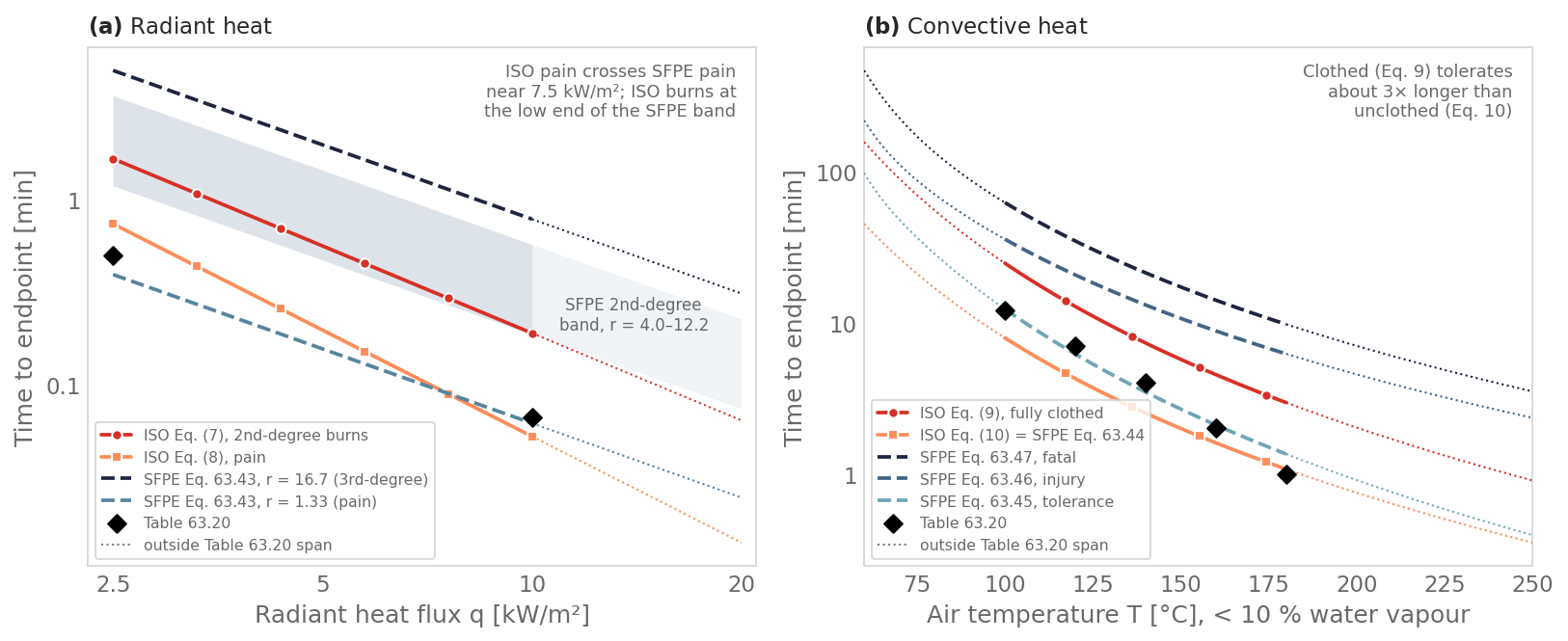
(a) Radiant: ISO’s burn law (Eq. 7, red, circles) runs through the low end of Ch. 70’s second-degree band; ISO’s pain law (Eq. 8, orange, squares) crosses Ch. 70’s pain dose r = 1.33 near 7.5 kW/m². (b) Convective: ISO’s clothed law (Eq. 9) gives about three times the tolerance time of the unclothed law (Eq. 10, identical to Eq. 70.42). Solid over the span of Table 70.18 (2.5–10 kW/m², 100–180 °C), dotted outside it: neither source states the data range of its fits.
Figure provenance
scripts/figures/fundamentals_heat_iso.py.Known limits
Some cross-references in the text of Ch. 70 do not match the printed
equation labels: the text derives \(t_{I\,\mathrm{conv}}\) “from Eq. 70.38”
(it is Eq. 70.42, p. 2318), sums the radiant and convective fractions “as in
Eq. 70.35” (the form is that of Eq. 70.46), and gives the endpoint times from
total flux “by Eq. 70.30” where the form is that of Eq. 70.41 (p. 2319). The
labels above are those printed beside each equation. The caption of
Table 70.19 says its rates follow Eq. 70.42, but the printed values (0.02,
0.19, 1.57 and 15.55 per minute at 65, 125, 220 and 405 °C) are those of
Eq. 70.43 (p. 2320). The note under Eq. 70.46 says that
\(t_{I\,\mathrm{rad}}\) tends to zero below 2.5 kW/m²; it is
\(1/t_{I\,\mathrm{rad}}\) that does.
Eq. 70.47 is printed with the division by 1000 on the convective term only,
although both terms are in W/m² and q is defined in kW/m².
The radiant tolerance data (Table 70.17) are incident flux on the skin,
whereas Eq. 70.47 is written as a net exchange with the skin surface; at the
200 °C anchor the two differ by about 20 %. FDS’s RADIATIVE HEAT FLUX and
RADIATIVE HEAT FLUX GAS outputs are net as well,
\(\varepsilon_s(\dot q''_{\mathrm{inc}} - \sigma T_s^4)\) with
\(\varepsilon_s\) the surface emissivity; INCIDENT HEAT FLUX is the
incident term \(\dot q''_{\mathrm{inc}}\) (FDS User Guide 6.10,
Sec. 22.10.12, pp. 380–382).
The convective data concern hyperthermia in air of low humidity, and the
radiant data concern bare skin: clothing changes both. None of these
equations describe the effect of heat on walking speed or on route choice.
Sources
- Purser, D. A., & McAllister, J. L. (2026). Assessment of hazards to occupants from smoke, toxic gases, and heat. SFPE Handbook of Fire Protection Engineering, 6th ed., Ch. 70, 2271–2352. Eqs. 70.41–70.47, Fig. 70.23 and Tables 70.17–70.19. doi:10.1007/978-3-031-59212-6_70
- Purser, D. A., & McAllister, J. L. (2016). Assessment of hazards to occupants from smoke, toxic gases, and heat. SFPE Handbook of Fire Protection Engineering, 5th ed., Ch. 63, 2308–2428. Cited only for the equation number Eq. 63.49 (p. 2383) used on the Models pages. doi:10.1007/978-1-4939-2565-0_63
- ISO (2012). ISO 13571:2012 Life-threatening components of fire — Guidelines for the estimation of time to compromised tenability in fires, §1, §3.1, §4.4, §5.8 and clause 8 (Eqs. 7–11). ISO, Geneva. iso.org/standard/56172. Read in full from a licensed copy.
- Wieczorek, C. J., & Dembsey, N. A. (2001). Human variability correction factors for use with simplified engineering tools for predicting pain and second degree skin burns. Journal of Fire Protection Engineering, 11(2), 88–111. ISO ref. [17] for Eqs. (7) and (8); not consulted. doi:10.1106/0D9U-KLP9-TG1P-XJ1B
- Crane, C. (1978). Human tolerance limit to elevated temperature: an empirical approach to the dynamics of acute thermal collapse. Federal Aviation Administration, Memorandum Report ACC-114-78-2. ISO ref. [18] for Eq. (9); not consulted.
How pyFDS-Evac uses this: see Models › Heat.
How it is verified: Heat dose and the heat rows of the Verification index.