Asphyxiant fractional effective dose
The fractional effective dose (FED) [-] is the fraction of an incapacitating dose received, summed over short time steps; incapacitation of a person of average susceptibility is predicted when it reaches 1. The asphyxiants in fires are carbon monoxide (CO), hydrogen cyanide (HCN), low oxygen (O₂) and carbon dioxide (CO₂), which speeds up breathing and so the uptake of the others, and is itself an asphyxiant from about 5 % (Purser and McAllister 2026, p. 2307).
Symbols follow the notation table. The equations below keep the sources’ own notation (\(F_I\) terms, concentrations in brackets such as [CO], ventilation \(V_E\)).
The ISO 13571 principle
ISO 13571:2012 (§6.1.1, Eq. 1) sums over gases i and time steps \(\Delta t\) [min] the ratio \(C_i\,\Delta t/(C\cdot t)_i\) of the average concentration \(C_i\) [µL/L] to the dose \((C\cdot t)_i\) that compromises tenability, or equivalently \(\Delta t / t_i\) (Eq. 1a). Its gas-specific terms are not reproduced here. Unlike Eq. 70.16 below, it expresses the CO term as a Ct dose of 35 000 ppm·min, which Purser and McAllister equate to light work at about 20 L/min rather than 25 L/min (2026, Note 2 to Eq. 70.16, p. 2344), and does “not incorporate the rarefaction of oxygen”, while treating CO₂ as a hyperventilation factor (ISO/TR 13571-2:2016, §6.2).
Purser’s simplified equation
Purser and McAllister (2026, Society of Fire Protection Engineers (SFPE) Handbook, 6th ed., Ch. 70) give, for loss of consciousness of an adult doing light work such as walking to escape,
$$ \begin{aligned} F_{IN} ={}& \big(F_{I_{CO}} + F_{I_{CN}}\\ &+ F_{I_{NO_x}} + FLD_{irr}\big)\times VCO_2\\ &+ F_{I_O} \quad \text{or}\quad F_{I_{CO_2}} \quad \text{(Eq. 70.38)} \end{aligned} $$with the terms, t in minutes and concentrations in ppm or % by volume:
- CO (Stewart equation, Eq. 70.16): \(F_{I_{CO}} = 3.317\times10^{-5}\,[\mathrm{CO}]^{1.036}\,V_E\,t/D\), with \(V_E\) = 25 L/min (light work) and D = 30 % carboxyhaemoglobin (COHb) by default; D is 40 % at rest and 20 % for heavy work (table under Eq. 70.16, p. 2298). With these defaults the coefficient is \(3.317\times10^{-5}\times 25/30 = 2.764\times10^{-5}\) per minute, the constant used by FDS+Evac, the evacuation module of the Fire Dynamics Simulator (Korhonen 2021, Eq. 13).
- HCN (Eq. 70.22): \(F_{I_{CN}} = [\mathrm{CN}]^{2.36}\,t/(1.2\times10^{6})\), where [CN] may be corrected for other nitriles and for the protective effect of NO and NO₂ as \([\mathrm{CN}] = [\mathrm{HCN}] + [\text{organic nitriles}] - [\mathrm{NO}+\mathrm{NO_2}]\) (Eq. 70.24, p. 2302). The note to Eq. 70.38 writes the same correction with \(0.67\,[\mathrm{NO}+\mathrm{NO_2}]\) (p. 2310), so the chapter gives two coefficients.
- NOₓ: \(F_{I_{NO_x}} = [\mathrm{NO_x}]\,t/1500\) (definitions under Eq. 70.38, p. 2310).
- Irritants: \(FLD_{irr}\), the fractional lethal dose of irritants (Eq. 70.13; see Irritant gases), included because irritants impair lung function and so add some hypoxia.
- CO₂ hyperventilation (Eq. 70.35): \(VCO_2 = \exp([\mathrm{CO_2}]/5)\). Purser recommends a limiting value of 70 L/min for \(V_E\times VCO_2\) (Ch. 70, pp. 2310 and 2343). At \(V_E\) = 25 L/min this caps \(VCO_2\) at 2.8, which Eq. 70.35 reaches at about 5.1 % CO₂ (our arithmetic).
- Low-oxygen hypoxia (Eq. 70.50): \(F_{I_O} = t/\exp\left[8.13 - 0.54\,(20.9 - [\%\mathrm{O_2}])\right]\), added outside the CO₂ multiplier because CO₂ improves oxygen uptake.
- CO₂ as an asphyxiant, \(F_{I_{CO_2}}\), from \(t_{I_{CO_2}} = \exp(6.1623 - 0.5189\,\%\mathrm{CO_2})\) (Eqs. 70.36–70.37), used as an alternative endpoint and normally negligible; sudden exposure to more than about 7 % CO₂, however, can itself cause rapid intoxication and collapse (pp. 2309–2310).
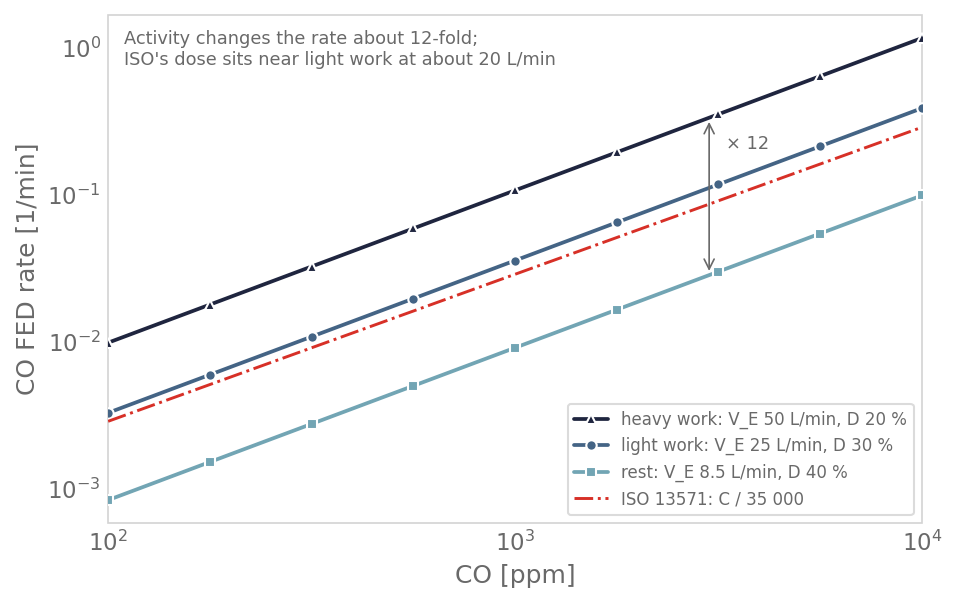
CO FED rate [1/min] from the Stewart equation, Eq. 70.16, for rest (pale blue, squares), light work (mid blue, circles) and heavy work (dark blue, triangles), and the ISO 13571 dose of 35 000 ppm·min (red, dash-dot). Heavy work accumulates dose about 12 times as fast as rest; the ISO rate equals the Stewart form at D = 30 % for a V_E of about 20 L/min.
Figure provenance
scripts/figures/fundamentals_fed_co.py.Published forms differ
Warning
FDS+Evac guide, Eq. 18 (low O₂). The guide (Korhonen 2021) divides the O₂ term by 60 while stating that t is in minutes. Taken literally, that gives an O₂ dose 60 times smaller than Purser’s Eq. 70.50. The code FDS+Evac runs does not do this: FDS divides by 60 only because its time step is in seconds. If you rebuild FDS+Evac’s FED from the guide, leave the 60 out. The evidence is in “The CO₂ factor and HCN term” below.
The FDS+Evac guide (Korhonen 2021, Eqs. 12–19) and the FDS User’s Guide
(McGrattan et al. 2025, Eqs. 22.42–22.49) do not use Eq. 70.38 as printed:
they take Eq. 70.34 for CO₂ instead of its simplification Eq. 70.35, and an
HCN term \(\exp(C/43)/220\) that is not in Chs. 69–70,
where “exponential” names the power law of Eq. 70.18 (p. 2301). The
FDS+Evac guide cites the 3rd edition for these equations, the header of the
FDS FED function (func.f90) the 4th, and the FDS User’s Guide the 5th.
The 3rd edition gives the term: \(F_{ICN} = \exp([\mathrm{CN}]/43)/220\)
(Purser 2002, p. 2-105), which it calls a simplification of
\(t_{ICN} = \exp(5.396 - 0.023\,C_{HCN})\) min (Eq. 9, regression
coefficient 0.984): \(1/0.023 \approx 43\) and \(e^{5.396} \approx 220\) (our
arithmetic). It has no offset. The 4th edition, which the FDS code cites, was
not read here. The User’s Guide
reference (ref. [91]) is Ch. 62 of the 5th edition, which contains neither
the VCO₂ form of Eq. 70.34 nor an HCN incapacitation term (text search of
that chapter). A result quoted as “Purser FED”
therefore depends on the variant used.
The CO₂ factor and HCN term (Eqs. 70.31–70.35)
A regression of minute volume on CO₂, fitted to three published human data sets (Eq. 70.31, Fig. 70.20), gives the factor \(\exp(0.2496\,\%\mathrm{CO_2} + 1.9086)/6.8\) (Eq. 70.32), simplified to \(\exp([\mathrm{CO_2}]/4)\) (Eq. 70.33). Because that overstates uptake, Ch. 70 modifies it after the Coburn–Forster–Kane equation to
$$ VCO_2 = \frac{\exp(0.1903\,\%\mathrm{CO_2} + 2.0004)}{7.1} \qquad \text{(Eq. 70.34)} $$and simplifies this to \(\exp([\mathrm{CO_2}]/5)\) (Eq. 70.35), the form used in Eq. 70.38. The two agree within about 4 % below 5 % CO₂, and at 0 % CO₂ Eq. 70.34 gives \(\exp(2.0004)/7.1 \approx 1.04\), not 1 (our arithmetic; Hostikka and Linna 2025 make the same point). The chapter’s own worked example (Table 70.14, p. 2311) lists \(VCO_2\) = 1.442, 2.376 and 4.434 at 1.5, 3.5 and 6 % CO₂; its caption and the text above it cite Eq. 70.19, the HCN time to incapacitation, for the asphyxiant sum. These match Eq. 70.32, not Eq. 70.35, which gives 1.35, 2.01 and 3.32 (our arithmetic), so the chapter is inconsistent here. Its 6 % point also exceeds the 70 L/min cap: 25 × 4.434 = 111 L/min (our arithmetic).
For HCN, the FDS+Evac guide uses
\(\left(\exp(C_{CN}/43)/220 - 0.0045\right)\) with
\(C_{CN} = C_{HCN} - C_{NO_2}\) (Korhonen 2021, Eqs. 14–15), citing Purser
in the 3rd edition (Purser 2002). The FDS User’s Guide writes the same term
with \(C_{CN} = C_{HCN} - C_{NO_2} - C_{NO}\) (Eqs. 22.44–22.45). Both
manuals print the offset 0.0045, whereas FDS func.f90 uses
0.00454545 ≈ 1/220; with 0.0045 the term is about \(4.5\times10^{-5}\)
per minute at 0 ppm instead of 0 (our arithmetic). The SFPE
Handbook gives the power form instead (Eq. 70.22); its rat-lethality FED in
the companion chapter subtracts [NOx] from [CN] with coefficient 1 and uses
yet another CO₂ factor, \(1 + (\exp(0.14\,[\mathrm{CO_2}]) - 1)/2\)
(Purser and Stec 2026, Eq. 69.3, p. 2239). The offset makes the term
zero at zero concentration: Hostikka and Linna (2025, Eq. 3) write it as
\(F_{I,CN0} = \exp(0)/220\). They cite a 2010 Purser chapter (“Toxic hazard
calculation models for use with fire effluent data”, their ref. [2]) for
three NOₓ reduction factors, 0 in simple conservative analyses, otherwise
2/3 or 1, “without a clear guidance which one to choose”; that chapter was
not read here. For low oxygen, the FDS+Evac
guide divides by an extra factor 60 while stating t in minutes (Eq. 18);
Eq. 70.50 and the FDS User’s Guide (Eq. 22.48) do not. Read literally,
Eq. 18 makes the O₂ dose 60 times smaller than Eq. 70.50. Our reading is
that the factor survives from the 2009 guide (VTT Working Papers 119, FDS
5.3.0), which gave every FED equation with t in seconds: its Eq. 12 is
\(4.607 \times 10^{-7}\,C_{CO}^{1.036}\,t\), i.e. \(2.764 \times 10^{-5}/60\),
and its Eq. 13 is \(t/(60\exp[8.13 - 0.54(20.9 - C_{O_2})])\), “where t is
time in seconds”. The 2021 guide rewrote Eqs. 13–17 per minute and dropped
the 60, but kept it in Eq. 18. The FDS code divides by 60 because its time
step is in seconds (func.f90, function FED, before and after commit
694e033), so the code is consistent: the discrepancy is in the 2021
guide’s text only. The 2009 guide also prints the CO₂ coefficient as 0.1930 (Eq. 14),
where Purser and the code use 0.1903.
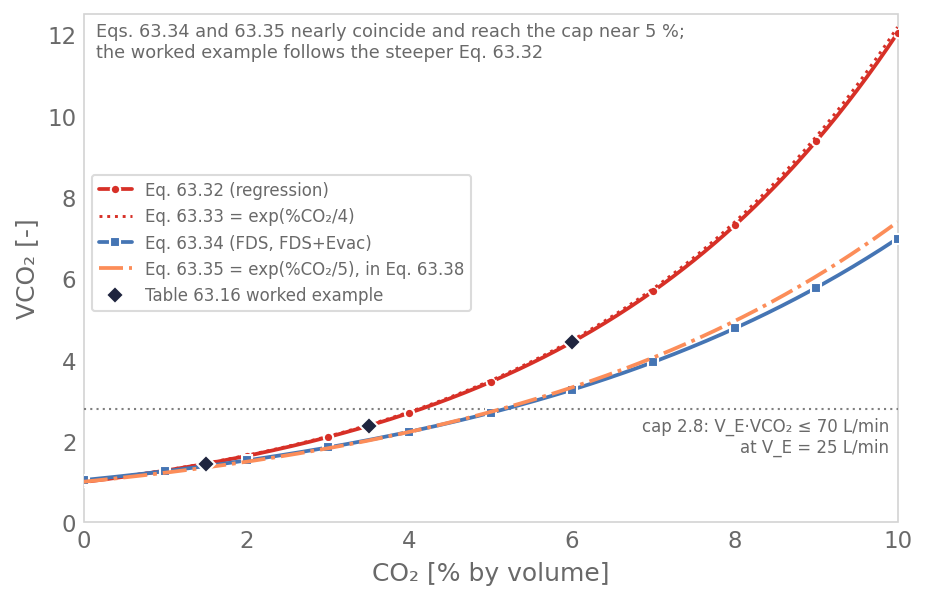
CO₂ hyperventilation factor VCO₂ from Ch. 70: the regression Eq. 70.32 (red, circles) and its simplification Eq. 70.33 (red, dotted), the modified Eq. 70.34 used by FDS and FDS+Evac (blue, squares) and its simplification Eq. 70.35, used in Eq. 70.38 (orange, dash-dot). Diamonds: the worked example, Table 70.14. Dotted grey: the cap of 2.8, i.e. 70 L/min at V_E = 25 L/min. Line styles here only separate the curves; all lie within the 0–10 % CO₂ data.
Figure provenance
scripts/figures/fundamentals_fed_co2.py.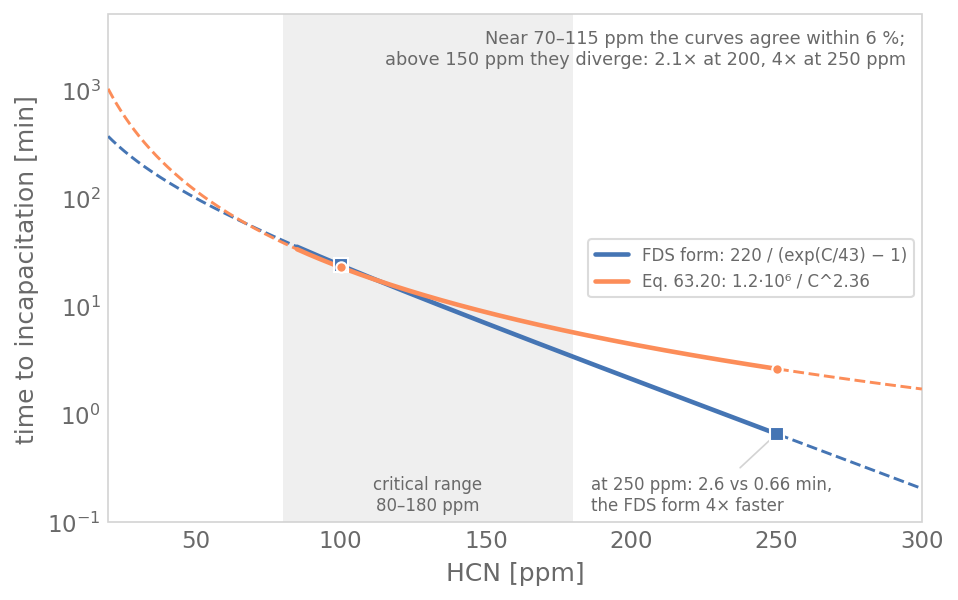
Time to incapacitation [min] by HCN: Ch. 70 Eq. 70.18 (orange, circles) and the FDS form 220/(exp(C/43) − 1) (blue, squares). Solid over the primate data behind Eq. 70.18 (about 85–250 ppm, Fig. 70.18), dashed outside; shaded: the critical range of about 80–180 ppm (p. 2301). The two agree within 6 % between about 70 and 115 ppm; at 250 ppm the FDS form gives 0.66 min against 2.6 min, four times shorter.
Figure provenance
func.f90 (function FED), which uses the offset 0.00454545 ≈ 1/220, not
the manuals’ 0.0045. The data span is that of Eq. 70.18’s primate points
(our reading of Fig. 70.18); no data behind the FDS form are verified here.
Ratios of Eq. 70.18 to the FDS form: 0.96 at 100 ppm, 1.27 at 150, 2.1 at
200 and 4.0 at 250 ppm (our arithmetic).
Script: scripts/figures/fundamentals_fed_hcn.py.The data behind the terms
- CO. The Stewart equation was obtained from young adult male volunteers; it somewhat underestimates uptake in children, and the Coburn–Forster–Kane equation is preferable near equilibrium (Ch. 70, Note 1 to Eq. 70.16, p. 2344). The linear form is offered for short exposures “when the blood concentration is well below saturation level” (p. 2294); that it overpredicts uptake as COHb approaches saturation is our inference, consistent with the source’s comparison: for a 4 h exposure to 840 ppm it predicts 72 % COHb where the Coburn–Forster–Kane equation predicts 50 % (p. 2295).
- HCN. The time to incapacitation \(t_{ICN} = 1.2\times10^{6}/[\mathrm{CN}]^{2.36}\) (Eq. 70.18) is fitted to resting primates, with a regression coefficient of 0.84 (p. 2301; Fig. 70.18, primate points from about 85 to 250 ppm). The legend of Fig. 70.18 gives the constant as \(1.21\times10^{6}\), the equation as \(1.2\times10^{6}\). It is applied to humans because the time to incapacitation of an average adult doing light work “would be similar to that in a resting monkey” (p. 2301). The critical range is about 80 ppm, below which incapacitation is unlikely within 1 h, to 180 ppm, above which it is rapid (p. 2301). Below about 85 ppm, the lower edge of the primate data, Eq. 70.18 is an extrapolation, and the 80 ppm bound sits at that edge (our reading of Fig. 70.18).
- Low oxygen. Eq. 70.25 is derived from the time of useful consciousness of resting humans after sudden decompression (under 1 s) to simulated altitudes of 20 000–40 000 ft, a sea-level equivalent of 9.6 % down to 3.9 % O₂ (Fig. 70.19, p. 2305). In humans there is little effect down to 15 % O₂ (p. 2303). Use above about 10 % O₂ is therefore an extrapolation (our inference); the equation gives \(t_{IO}\) ≈ 140 min at 15 % and about 35 h at 20 % O₂ (our arithmetic).
- CO₂. The minute-volume curve is an average of three human data sets covering 0–10 % CO₂ (Eq. 70.31, Fig. 70.20). \(t_{ICO_2}\) (Eq. 70.36) is derived from approximate tolerance data in Fig. 70.20, whose three points are 5 % for 30 min, 7.5 % for 10 min and 10.5 % for 2 min. It gives 9.7 min at 7.5 % and 2.0 min at 10.5 %, but 35 min at 5 % (our arithmetic; p. 2307 uses 35.44 min); the 5 % point is severe breathing discomfort, not loss of consciousness. Eq. 70.36 thus rests on data from 5 to 10.5 % CO₂ only; below 5 % it is an extrapolation (our inference).
- Activity. The default is light work; \(V_E\) = 8.5 L/min at rest and 50 L/min for heavy work (table beside Eq. 70.48, p. 2343).
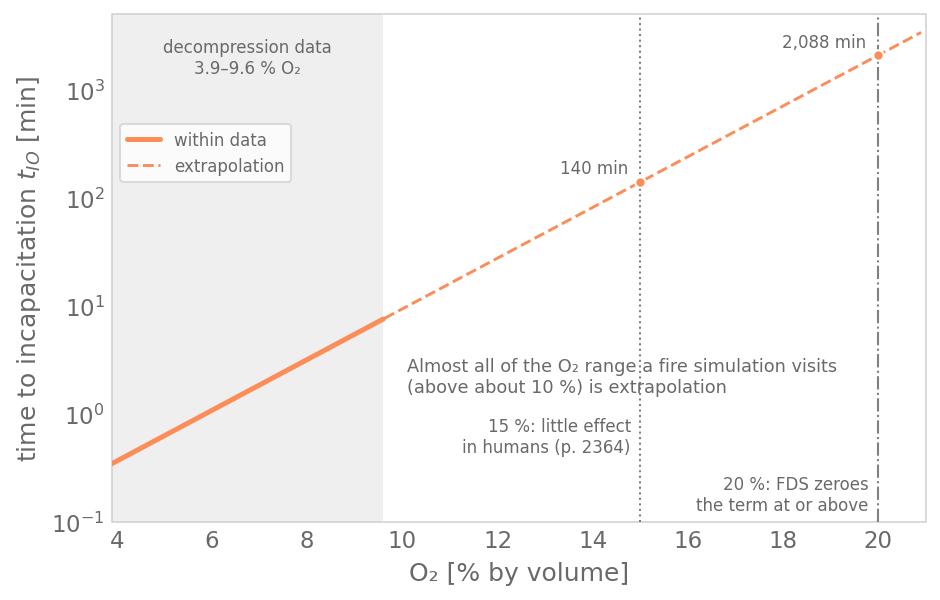
Time to incapacitation by low oxygen, \(t_{IO}\) [min], from Eq. 70.50 (derived as Eq. 70.25): solid over the decompression data (3.9–9.6 % O₂, shaded), dashed above. Dotted: 15 % O₂, down to which there is little effect in humans (p. 2303), 140 min. Dash-dot: 20 % O₂, at or above which FDS sets the O₂ term to zero, about 2090 min. Almost all of the O₂ range a fire simulation visits is extrapolation.
Figure provenance
func.f90 (function FED),
quoted, not imported. Script: scripts/figures/fundamentals_fed_o2.py.Known limits
The equations predict incapacitation of an average person; protecting more susceptible people needs a threshold below 1 (see Incapacitation thresholds). ISO 13571 (§5.8) finds very little reliable information on exposures shorter than 1 min or longer than 1 h, and its Introduction states that, for ethical reasons, much of the method cannot be validated with humans, although the CO database is extensive and well validated. The irritant term \(FLD_{irr}\) is defined as a fractional lethal dose (p. 2343) but described as a correction for the effect of irritants on lung function, which adds some hypoxia (p. 2310). Read the first way, Eq. 70.38 adds a lethal-dose fraction to incapacitating-dose fractions (Hostikka and Linna 2025); read the second way, it is a hypoxia correction scaled by the lethal dose. The chapter does not say which reading is intended.
Sources
- Purser, D. A., & McAllister, J. L. (2026). Assessment of hazards to occupants from smoke, toxic gases, and heat. SFPE Handbook of Fire Protection Engineering, 6th ed., Ch. 70, 2271–2352. doi:10.1007/978-3-031-59212-6_70
- ISO (2012). ISO 13571:2012 Life-threatening components of fire — Guidelines for the estimation of time to compromised tenability in fires. ISO, Geneva. iso.org/standard/56172. Read from the public preview (§1–6.1.1).
- ISO (2016). ISO/TR 13571-2:2016 Life-threatening components of fire — Part 2: Methodology and examples of tenability assessment. ISO, Geneva. iso.org/standard/65996. Read from the public preview.
- Korhonen, T. (2021). Fire Dynamics Simulator with Evacuation: FDS+Evac. Technical Reference and User’s Guide (FDS 6.7.6, Evac 2.6.0-draft), §3.4. VTT Technical Research Centre of Finland. github.com/tkorhon1/FDS-Evac-Guide. Secondary source.
- Purser, D. A., & Stec, A. A. (2026). Combustion toxicity. SFPE Handbook of Fire Protection Engineering, 6th ed., Ch. 69, 2225–2270. doi:10.1007/978-3-031-59212-6_69
- Purser, D. A. (2016). Combustion toxicity. SFPE Handbook of Fire Protection Engineering, 5th ed., Ch. 62, 2207–2307. Cited only as the FDS User’s Guide reference. doi:10.1007/978-1-4939-2565-0_62
- FDS source code,
Source/func.f90, functionFED, tag FDS6.7.6. github.com/firemodels/fds. Secondary source. - McGrattan, K., Hostikka, S., Floyd, J., McDermott, R., Vanella, M., Mueller, E., & Paul, C. (2025). Fire Dynamics Simulator User’s Guide, 6th ed. (FDS 6.10.1), §22.10.18. NIST Special Publication 1019. doi:10.6028/NIST.SP.1019. Secondary source.
- Hostikka, S., & Linna, A. (2025). On the use of surrogate gases in fire toxicity calculations. Fire Safety Journal, 156, 104435. doi:10.1016/j.firesaf.2025.104435. Secondary source.
- Purser, D. A. (2002). Toxicity assessment of combustion products. SFPE Handbook of Fire Protection Engineering, 3rd ed., 2-83–2-171. National Fire Protection Association, Quincy, MA. No DOI or public URL; cited through Korhonen (2021, ref. 29), which dates it 2003.
How pyFDS-Evac uses this: see Fractional effective dose.
How it is verified: CO dose in a sealed room and ISO 20414 Test 19.