ASET, RSET and the egress timeline
Performance-based fire-safety design compares two times. The available safe escape time (ASET) is the time until conditions in a space, or on the route out of it, become untenable. The required safe escape time (RSET) is the time occupants need to reach a place of safety. A design is acceptable when ASET exceeds RSET by an adequate margin (ISO/TR 16738:2009, §5.6).
The equations as published
ISO/TR 16738:2009 writes the margin of safety and the escape time as
$$ t_{\mathrm{marg}} = t_{\mathrm{ASET}} - t_{\mathrm{RSET}} \qquad \text{(ISO/TR 16738, Eq. 1)} $$$$ t_{\mathrm{RSET}} = t_{\mathrm{det}} + t_{\mathrm{warn}} + \left(t_{\mathrm{pre}} + t_{\mathrm{trav}}\right) \qquad \text{(Eq. 2)} $$All times are in seconds or minutes. \(t_{\mathrm{det}}\) is the time from ignition to detection, by a system or by the first occupant to notice fire cues. \(t_{\mathrm{warn}}\) runs from detection to a general alarm or warning. \(t_{\mathrm{pre}}\) is the pre-travel activity time, also called pre-movement or pre-evacuation time, and \(t_{\mathrm{trav}}\) is the travel time. The standard notes that the evacuation time \(t_{\mathrm{evac}}\) consists of the last two terms only, and it splits \(t_{\mathrm{pre}}\) into a recognition time and a response time. The Society of Fire Protection Engineers (SFPE) Handbook uses the same terms (Gwynne et al. 2026, Ch. 72, p. 2378).
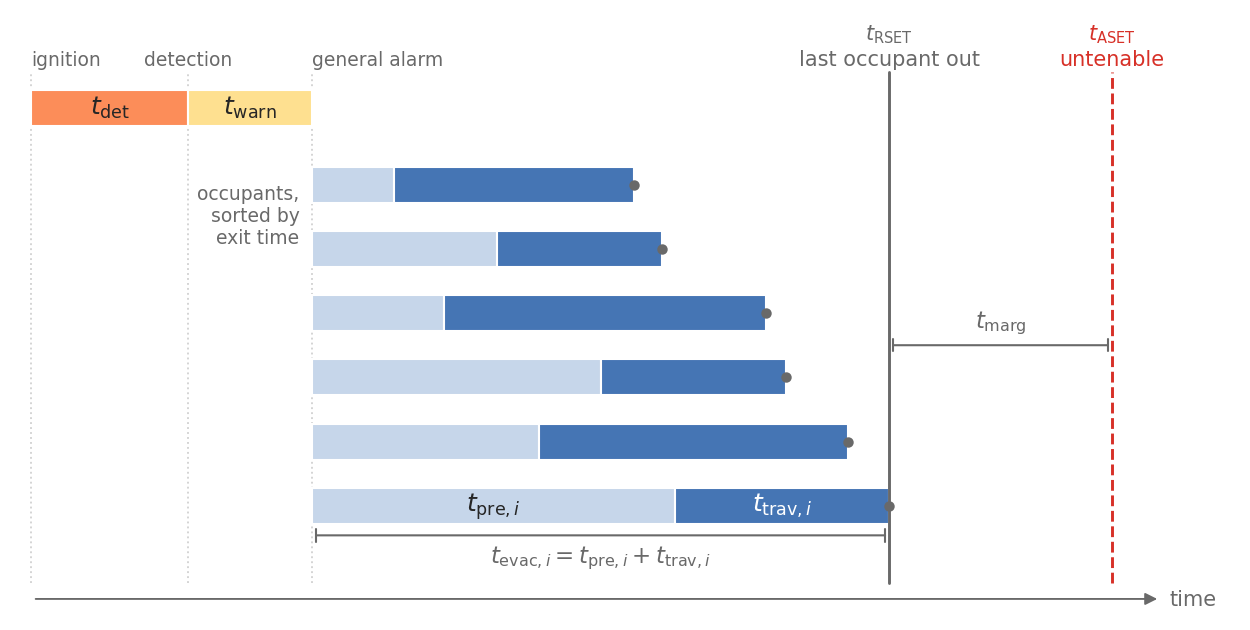
The egress timeline of Eqs. 1–2 as a schematic; the times are
illustrative. Detection and warning happen once for the whole building.
After the general alarm, each occupant has their own pre-travel time
\(t_{\mathrm{pre},i}\) (light) and travel time \(t_{\mathrm{trav},i}\)
(dark); a dot marks each exit. ISO/TR 16738 (§7) warns that the two
distributions interact, so they cannot be added directly. The figure draws
\(t_{\mathrm{RSET}}\) at the exit of the last occupant, the latest time from
ignition to exit, as RiMEA 4.1.1 (§2.13) defines its evacuation time, which starts at
ignition.
Figure inspired by Fig. 2 of RiMEA 4.1.1 (p. 10). Script:
scripts/figures/fundamentals_aset_rset_timeline.py.
What the timeline rests on
ASET comes from the fire (see Design fires): the time-concentration curves of heat, toxic gases and smoke at the occupants’ positions, compared with tenability limits. The fractional effective dose (FED), irritant, heat and visibility pages give those limits. ISO 13571:2012 (§5.1) states that its time to compromised tenability may reasonably be equated to ASET when escape to a place of refuge is the outcome considered.
Tenability is judged in one of two ways. With fixed limits, conditions at one height are compared with one value per hazard, and a space is untenable as soon as any value is exceeded: for exposures of up to 10 minutes, the Engineers Australia practice note gives 100 °C, 2.5 kW/m², 2,700 ppm CO, 140 ppm HCN and a visibility of 10 m, evaluated 2.0 m above the floor (2014, §5.2 and Fig. 8, p. 15). With a dose, the exposure of each occupant is summed over time along the path they take, and incapacitation is expected at a fractional effective dose of 1 for the median occupant (the same note, §5 and §5.3, after the SFPE Handbook and ISO 13571). The note computes heat exposure as one FED and toxic-gas exposure as another (§5.3). For more susceptible occupants a lower threshold may suit; see Incapacitation thresholds.
Fixed limits: the short-exposure criteria of the practice note (Fig. 8, “Tenability Criteria – Short Exposure”, p. 15); for small enclosures, of the order of 10 m, the note allows a visibility of 5 m. Dose along each path: the dose approach, schematic, for two occupants; the same fire gives each one a different dose. The curves are the toxic-gas FED; heat is judged as a second, separate FED (§5.3). Figure inspired by Fig. 8 of the Engineers Australia practice note for tenability criteria (2014).
New Zealand combines both. Clause C4.3 of the New Zealand Building Code requires that occupants are not exposed to a carbon monoxide FED above 0.3, a thermal FED above 0.3, or a visibility below 10 m (5 m in rooms of less than 100 m²). Under clause C4.4, the thermal FED and visibility limits do not apply where a sprinklered firecell cannot expose more than 1,000 occupants; only the CO dose is then checked (NZBC clauses C1–C6, p. 7). Verification Method C/VM2 measures all three 2.0 m above the floor and computes both doses with the procedures of ISO 13571 (it cites the 2007 edition): the CO dose includes CO, CO₂ and O₂, and the thermal dose includes radiative and convective heat (MBIE 2025, §2.1.6.1–2.1.6.3, p. 17). The commentary to the first edition says how the dose is summed: in time steps of at most 5 s, along the escape route of the last occupant to leave the room of fire origin, following that occupant’s location through the evacuation (MBIE 2012, pp. 47 and 49).
Germany grades its fixed limits by the time spent in an area. DIN 18009-2:2022-08 takes them from the vfdb guide (Table 1, Note 2): for a stay of more than 30 min, about 15 min or less than 5 min, CO 100, 200 or 500 ppm, against the 2,700 ppm above. Every assessment rests on these location-based limits; they bound conditions under which escape may be impaired but not prevented (Introduction, p. 6). A person-based dose may be added for particular questions, such as occupants in the room of fire origin (§7.2.1–7.2.3). All of these sets are compared in ASET-RSET maps after Schröder et al. (2020) › Tenability criteria in the literature.
RSET comes from people. ISO/TR 16738 (§5.4) reports that the pre-travel activity phase can often be the longest part of the total escape time. Each occupant has their own \(t_{\mathrm{pre}}\) and \(t_{\mathrm{trav}}\), so the standard treats them as distributions, and warns that within an enclosure the two terms cannot be added directly because the distributions interact (§7). See Pre-movement time.
Known limits
The definitions differ in where the clock starts. ISO/TR 16738 Eq. 2 and the SFPE Handbook count RSET from ignition: Ch. 66 defines RSET as the time from fire initiation until the last occupant reaches a safe place, and ASET as the time from fire initiation to the onset of untenable conditions (Tubbs and Alonso-Gutierrez 2026, p. 2158), and Ch. 72 starts its timeline at ignition (p. 2378). The 2016 edition (Bukowski and Tubbs 2016, Ch. 56, p. 2038) counted both from the notification of occupants, so older analyses may use that origin. When two analyses are compared, check which origin each uses. The terms also vary for the same quantities: “escape” in ISO/TR 16738; the SFPE Handbook mixes “evacuation”, “egress” and “escape” (Ch. 66, p. 2158; Ch. 72, p. 2378).
ASET varies with position and with the tenability criterion chosen, and the criterion itself is set for a fraction of the population (see Incapacitation thresholds).
A smoke limit can stand in for the others. For fires with soot, DIN 18009-2 (§7.2.2, p. 23) assumes that where the optical density D_L stays at or below 0.1 1/m, the limits for toxic products, irritants and gas temperature are usually met as well. The waypoint method judges visibility along the line of sight to a sign, not at the person (Seeing and using exit signs). Our reading: a sight-line criterion cannot stand in that way. A cell in dense smoke passes if its line of sight to a nearby sign is clear, so gases and heat there need their own limit or a dose.
Which part of the pre-movement distribution matters depends on density. Where occupant density is high relative to exit width, the pre-movement of the first few occupants and the exit flow capacity set the evacuation time; at low density, the late tail of the distribution does (Purser 2003, pp. 96–97).
Purser (2003, pp. 92–93) noted that most travel-time calculations assumed no interaction between occupants and the fire effluent, and that engineering tenability calculations used only smoke density and/or CO, with yields often treated as constants, usually for the well-ventilated case. DIN 18009-2 states the first assumption: it leaves any effect of fire and smoke spread on the escape time out of its scope (§5.2.3, Note 2, p. 15). For microscopic models it recommends at least ten runs and takes RSET as the 95 % quantile (§6.6.2; §8.3.1). A coupled run drops that assumption; see Evacuation with and without the fire.
The concept itself is disputed. Babrauskas, Fleming and Russell (2010, pp. 347–348) argue that RSET is a distribution rather than one number, that the test ASET > RSET hides how much more time one design gives than another, and that there is no agreed population for tenability criteria to protect. Following Fleming (2000), whom they cite, they propose reporting the margin ASET − RSET to compare designs (pp. 350–351). Their evidence comes from fires in single-family homes.
Sources
- ISO (2009). ISO/TR 16738:2009 Fire-safety engineering — Technical information on methods for evaluating behaviour and movement of people. ISO, Geneva. iso.org/standard/42887. Read from the public preview (§1–7).
- ISO (2012). ISO 13571:2012 Life-threatening components of fire — Guidelines for the estimation of time to compromised tenability in fires. ISO, Geneva. iso.org/standard/56172.
- RiMEA e.V. (2025). Guideline for Microscopic Evacuation Analysis, version 4.1.1, 11 September 2025. rimea.de. §2.8–2.13 (pp. 9–10) and Fig. 2 (p. 10).
- Tubbs, J. S., & Alonso-Gutierrez, V. (2026). Egress concepts and design strategies. SFPE Handbook of Fire Protection Engineering, 6th ed., Ch. 66, 2139–2164. p. 2158. doi:10.1007/978-3-031-59212-6_66
- Bukowski, R. W., & Tubbs, J. S. (2016). Egress concepts and design approaches. SFPE Handbook of Fire Protection Engineering, 5th ed., Ch. 56, 2012–2046. p. 2038; cited only for the notification origin of that edition. doi:10.1007/978-1-4939-2565-0_56
- Engineers Australia Society of Fire Safety (2014). Practice note for tenability criteria in building fires, version 2.0, 3 April 2014. Society of Fire Safety, NSW Chapter, Engineers Australia. engineersaustralia.org.au. §5 (p. 13), §5.2 and Fig. 8 (p. 15), §5.3 (p. 17).
- New Zealand Building Code (NZBC). Extract from the New Zealand Building Code: Clauses C1–C6 Protection from Fire, effective 1 July 2014. Schedule 1 of the Building Regulations 1992. Clauses C4.3 and C4.4 (p. 7). building.govt.nz.
- MBIE (2025). Verification Method C/VM2: Framework for fire safety design, 2nd edition, effective 28 July 2025. Ministry of Business, Innovation and Employment, Wellington. §2.1.6.1–2.1.6.3 (p. 17). building.govt.nz.
- MBIE (2012). Commentary for Verification Method C/VM2, December 2012. Ministry of Business, Innovation and Employment, Wellington. ISBN 978-0-478-39942-4. Written for the first edition of C/VM2; cited for the summation of the dose (commentary to Paragraph 2.2.1, pp. 47 and 49). Paraphrased.
- DIN (2022). DIN 18009-2:2022-08 Brandschutzingenieurwesen – Teil 2: Räumungssimulation und Personensicherheit. Beuth, Berlin. Introduction (p. 6); §5.2.3, Note 2 (p. 15); §6.6.2 (p. 21); §7.2.1–7.2.3 and Table 1 (pp. 22–24); §8.3.1 (p. 27). Paraphrased.
- Purser, D. A. (2003). ASET and RSET: addressing some issues in relation to occupant behaviour and tenability. Fire Safety Science, 7, 91–102. doi:10.3801/IAFSS.FSS.7-91
- Babrauskas, V., Fleming, J. M., & Russell, B. D. (2010). RSET/ASET, a flawed concept for fire safety assessment. Fire and Materials, 34(7), 341–355. doi:10.1002/fam.1025
- Gwynne, S. M. V., Boyce, K. E., & Lovreglio, R. (2026). Egress data for engineering analysis. SFPE Handbook of Fire Protection Engineering, 6th ed., Ch. 72, 2375–2484. p. 2378. doi:10.1007/978-3-031-59212-6_72
How pyFDS-Evac uses this: see the RSET ensemble how-to, and A crowd in a fire › ASET and RSET for a per-agent comparison on an FDS fire, and ASET-RSET maps after Schröder et al. (2020) for ASET, RSET and their difference as maps. Each agent carries its own dose along its path; see Fractional effective dose.
For the height pyFDS-Evac samples and how to check a run against C/VM2, see Selecting a slice height.
RSET from a run without the fire against a coupled run: Evacuation with and without the fire.
How it is verified: the Verification index; ASET and RSET themselves are outputs of a study.