Test 9: Crowd leaving a large public space
PASS1. Definition
A public space of 30 m by 20 m has four doors, each 1 m wide: two in the top wall and two in the bottom wall, 4 m from the side walls. A population of 1000 adults from Fig. 3, with immediate reaction, is spread evenly over the room and its speeds are distributed over the 1000 persons. Step 1 records the time at which the last person leaves. In step 2 doors 1 and 2 (the top doors) are locked and step 1 is repeated.
Source: RiMEA 4.1.1, Test 9, p. 34, Fig. 8, footnotes 7 and 8. This is a paraphrase, not the text of the standard.
Reference: RiMEA e.V. (2025). RiMEA: Richtlinie für Mikroskopische Entfluchtungsanalysen / Guideline for Microscopic Evacuation Analysis, version 4.1.1. https://rimea.de/ (Page numbers are the page numbers of the bilingual guideline (n / 56).)
2. Scenario
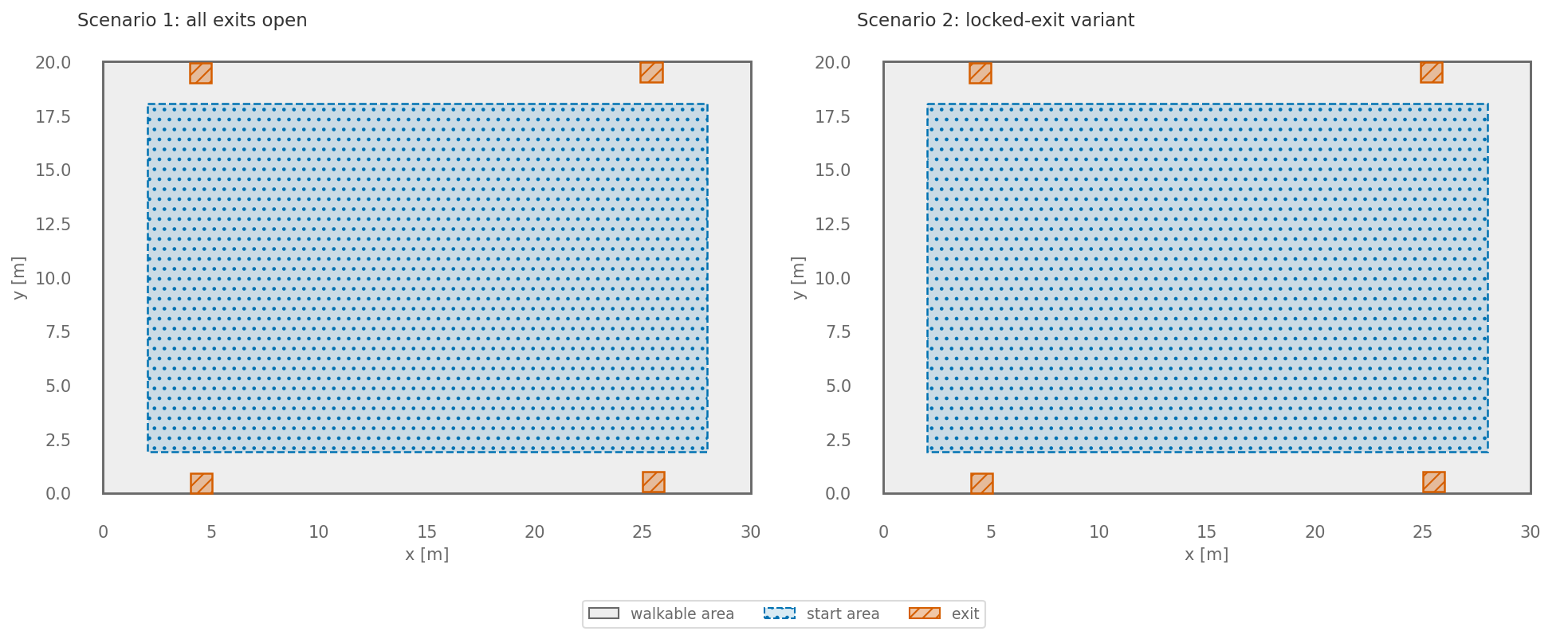
Scenario figure from the executed notebook.
3. What to expect
RiMEA expects the time to leave the room to roughly double with two doors locked. Footnote 7 (p. 34) says denser queues in front of the doors may raise the flow, so the test is not to be used as an exclusion criterion and only documents model behaviour. RiMEA sets no pass limit.
Our criterion: Closing 2/4 exits increases evacuation time
4. Our result
Status: PASS
Test cases of this row
| Case | Status | Result | Run |
|---|---|---|---|
test_ | PASS | evacuation_time_4_exits_vs_2_exits = 61.46, 120.5 s | n = 1000 · seed 42 |
test_: bound: agents_remaining = 0 in both runs; comparison: evacuation_time(2 exits) > evacuation_time(4 exits)closing_ exits_ increases_ time
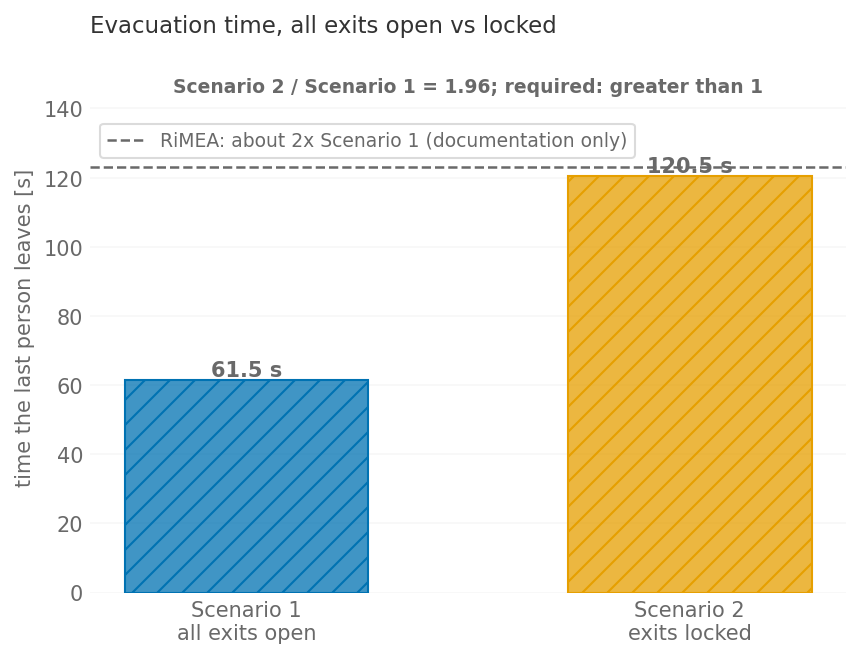
Result figure from the executed notebook.
5. Our implementation
Deviations from the standard:
- The pass rule is the suite’s own (decision D22): all agents evacuate in both runs and the evacuation with two exits takes longer than with four. The ratio of the two times is reported and is not asserted.
- The scenario is loaded from Rimea-09-large-public.zip (30 m by 20 m, doors 1 m wide as in Fig. 8, 1000 agents with Gaussian speeds, mean 1.6 m/s and standard deviation 0.2 m/s) and, for step 2, Rimea-09-large-public-locked.zip. The locked file keeps all four door polygons and locks the two doors in the top wall by routing: its journeys lead only to the two doors in the bottom wall, so no agent is sent to the others. The notebook loads the same two files.
- Agents do not choose a door. Journey weights fix the exit of each group: in the scenario files the weights split the agents evenly over the open doors.
- Agents have no premovement time, the default radius of 0.15 m and one seed (42). The speeds are not drawn from the RiMEA population of Fig. 3.
Model: CollisionFreeSpeedModel
- Test function: tests/vv/test_rimea.py::test_closing_exits_increases_time
- Scenario file: Rimea-09-large-public.zip
- Scenario file: Rimea-09-large-public-locked.zip