Test 2: Walking speed up stairs
PASS1. Definition
One person climbs a staircase 2 m wide and 10 m long, measured along the slope, at a defined walking speed. The test shows that the person covers the distance in the corresponding time. The considerations of Test 1 apply with adjusted distance, time and speed.
Source: RiMEA 4.1.1, Test 2, p. 29; stair speeds: section 3.2.2.3 and Table 3, pp. 14-15. This is a paraphrase, not the text of the standard.
Reference: RiMEA e.V. (2025). RiMEA: Richtlinie für Mikroskopische Entfluchtungsanalysen / Guideline for Microscopic Evacuation Analysis, version 4.1.1. https://rimea.de/ (Page numbers are the page numbers of the bilingual guideline (n / 56).)
2. Scenario
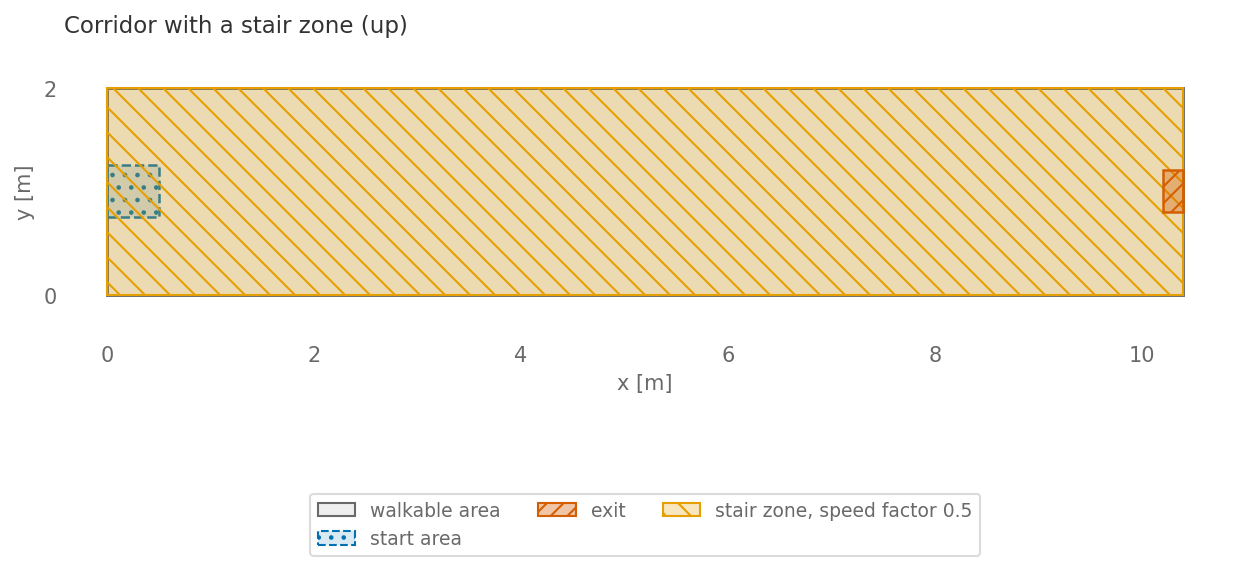
Scenario figure from the executed notebook.
3. What to expect
The person covers the 10 m in the time that follows from the defined stair speed. RiMEA names no stair speed and no time window for this test; Table 3 (p. 15) gives example stair speeds after Fruin, 0.32 to 0.58 m/s upwards. RiMEA sets no fixed pass limit (p. 28).
Our criterion: Walking speed maintained upstairs
4. Our result
Status: PASS
Test cases of this row
| Case | Status | Result | Run |
|---|---|---|---|
test_ | PASS | travel_time = 19.71 s accepted 19.5 – 20.5 s | n = 1 · seed 42 |
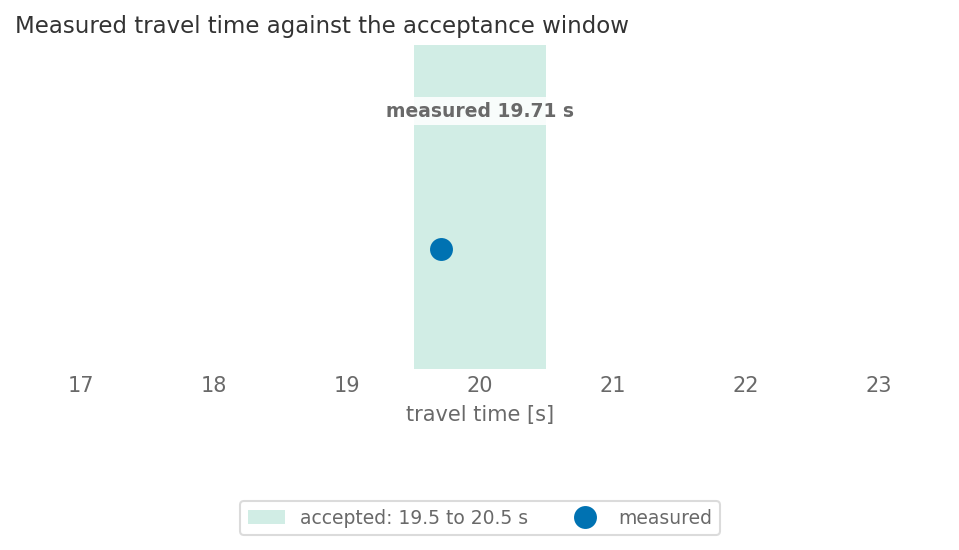
Result figure from the executed notebook.
5. Our implementation
Deviations from the standard:
- The stair is a flat corridor 2 m wide with a speed-factor zone of 0.5, not a stair object. A desired speed of 1.0 m/s then gives 0.5 m/s, inside the Fruin range for ascent. The model has no incline.
- The zone covers the whole 10.4 m corridor and the agent walks about 10 m from its start to the exit strip.
- The pass rule is the suite’s own: the travel time lies between 19.5 and 20.5 s (10 m at 0.5 m/s is 20 s, with a tolerance of 0.5 s). RiMEA gives no window for this test.
Model: CollisionFreeSpeedModel
- Test function: tests/vv/test_rimea.py::test_travel_time
- Scenario file: Rimea-02-upstairs.zip