Test 14: Choice of route
PASS1. Definition
A start area and a target area are joined by two flights of stairs and a corridor on the ground floor, which is the shorter route, and by a longer corridor on the upper floor. The test documents whether the pedestrians take the shorter route via another storey or stay on the longer route on one storey. The answer is one of ‘short’, ’long’, ‘mixed’ or ‘configurable’.
Source: RiMEA 4.1.1, Test 14, p. 44, Fig. 18. This is a paraphrase, not the text of the standard.
Reference: RiMEA e.V. (2025). RiMEA: Richtlinie für Mikroskopische Entfluchtungsanalysen / Guideline for Microscopic Evacuation Analysis, version 4.1.1. https://rimea.de/ (Page numbers are the page numbers of the bilingual guideline (n / 56).)
2. Scenario
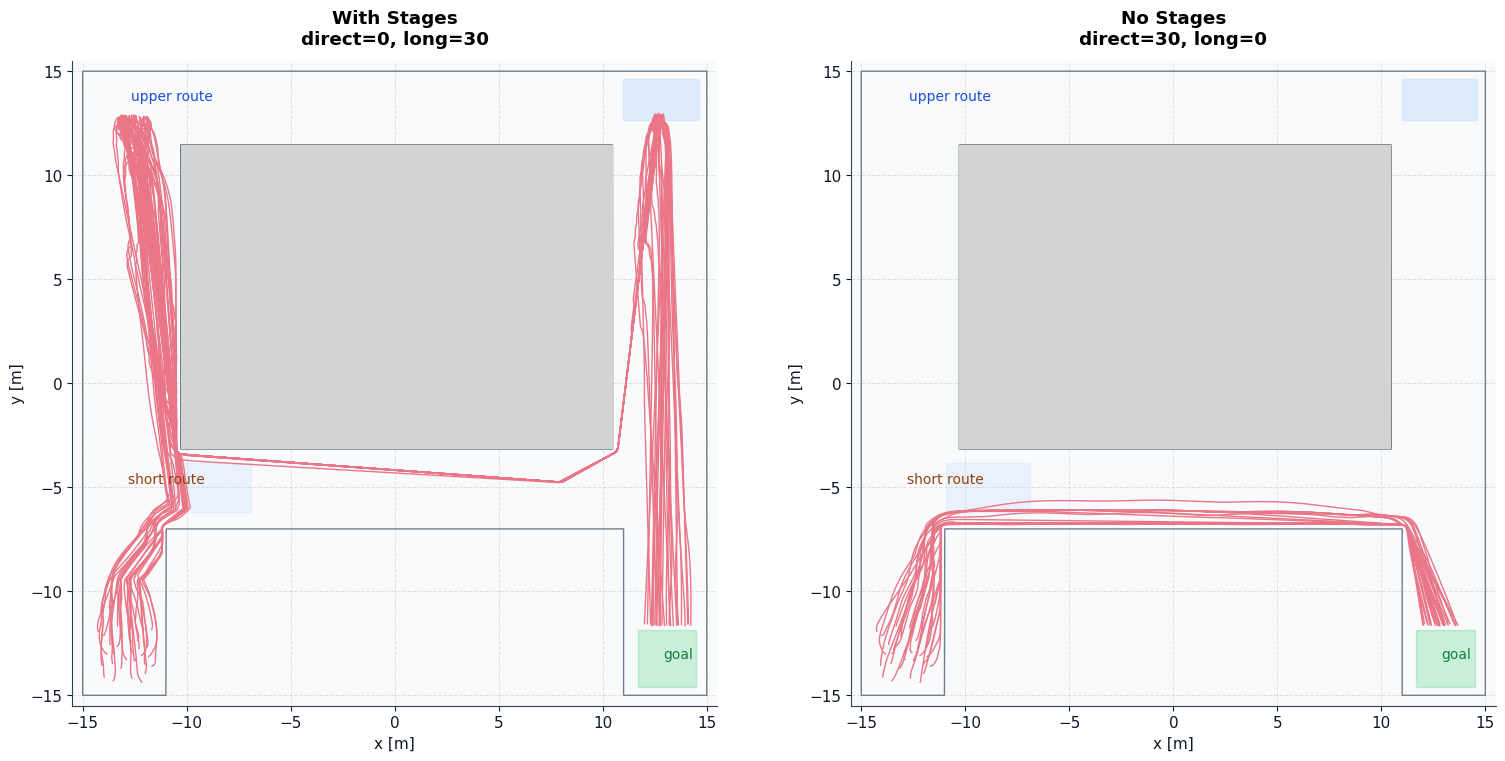
Scenario figure from the executed notebook.
3. What to expect
RiMEA names no expected route: it asks for one of the four answers to be documented. It sets no pass limit (p. 28).
Our criterion: Document short vs long route preference
RiMEA 4.1.1 asks for the route-choice behaviour to be documented. The test shows that agents follow configured waypoints (RiMEA answer: configurable). The scenario is single-level, with no stairs or floors.
4. Our result
Status: PASS
Test cases of this row
| Case | Status | Result | Run |
|---|---|---|---|
test_ | PASS | agents_on_long_route_vs_short_stage_staged (count) staged_long_route: 30 staged_short_stage: 0 staged_total: 30 direct_long_route: 0 direct_short_stage: 30 direct_total: 30 | n = 30 · seed 42 |
test_: bound: staged_total = direct_total = 30; bound: direct_long_route = 0; comparison: direct_short_stage = direct_total; comparison: staged_long_route > staged_short_stageroute_ choice
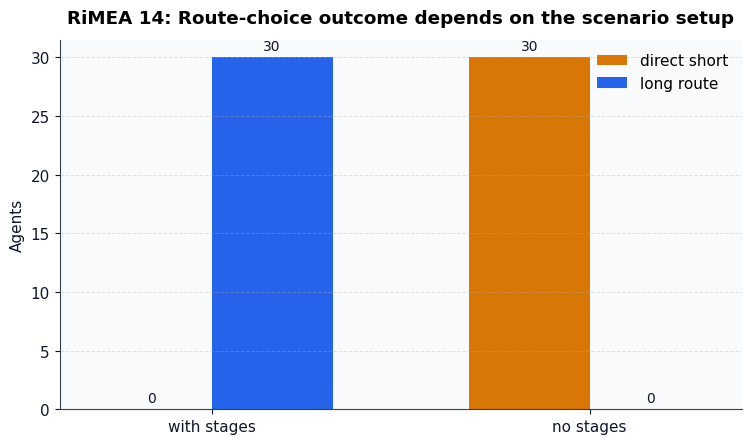
Result figure from the executed notebook.
5. Our implementation
Deviations from the standard:
- The scenario is a single-level 2D hall with a start area and a target area and no stairs or storeys, so there is no stair-speed trade-off between the routes.
- Agents do not choose between routes. The long route is set by a chain of five checkpoints that the agents visit before the exit, and the direct route has only the exit. The result supports the answer ‘configurable’.
- The test replaces the scenario’s flow spawning (100 agents) with a batch of 30 agents and counts an agent on the long route when its largest y exceeds 12 m. The pass rule is the suite’s own: with the direct journey all 30 agents take the short route, and with the checkpoint journey more agents take the long route than the short one.
Model: CollisionFreeSpeedModel
- Test function: tests/vv/test_rimea.py::test_route_choice
- Scenario file: Rimea-14.zip