Test 12d: Bottleneck width and flow
PASS1. Definition
The lower geometry of Fig. 13 has two rooms of 10 m by 10 m joined by a bottleneck 5 m long. The bottleneck width w is varied over 0.8, 1.0 and 1.2 m. 150 agents of the RiMEA standard population, with no response time, start in room 1 and the goal lies at the right edge of room 2. Real-life tests (Fig. 15) show the flow rising with the width. The test shows that the simulated flow rises with w.
Source: RiMEA 4.1.1, Test 12d, p. 41, Figs. 13 (lower geometry) and 15. This is a paraphrase, not the text of the standard.
Reference: RiMEA e.V. (2025). RiMEA: Richtlinie für Mikroskopische Entfluchtungsanalysen / Guideline for Microscopic Evacuation Analysis, version 4.1.1. https://rimea.de/ (Page numbers are the page numbers of the bilingual guideline (n / 56).)
2. Scenario
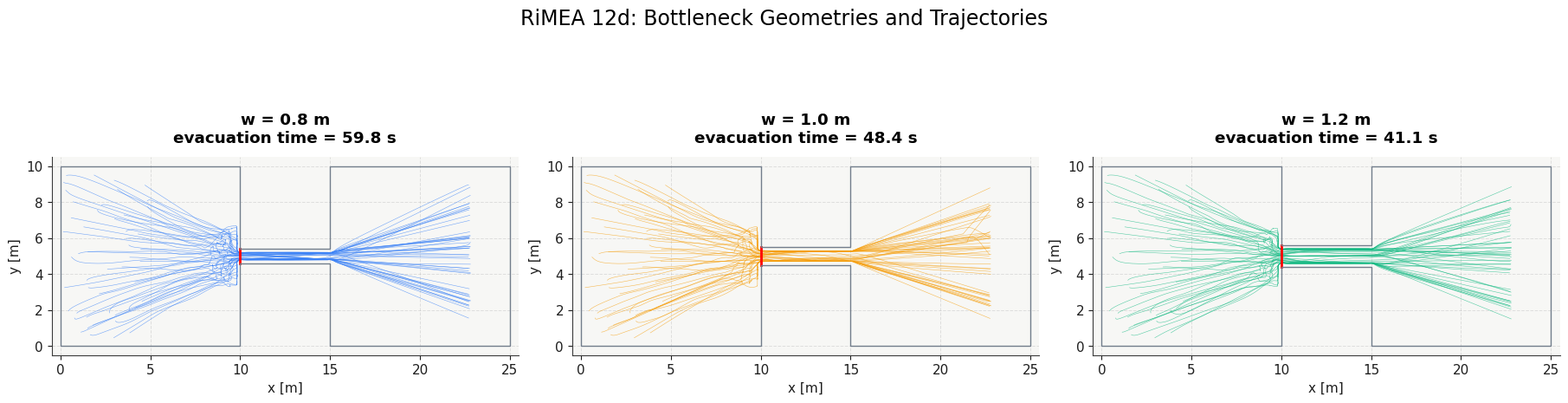
Scenario figure from the executed notebook.
3. What to expect
The flow increases with the bottleneck width. RiMEA names no flow values and sets no pass limit (p. 28).
Our criterion: Wider bottleneck yields faster evacuation
4. Our result
Status: PASS
Test cases of this row
| Case | Status | Result | Run |
|---|---|---|---|
test_ | PASS | flow_by_bottleneck_width_0.8_1.0_1.2 = 0.8357, 1.032, 1.217 agents/s | n = 50 · seed 42 |
test_: bound: agents_remaining = 0 for each width; comparison: flow(0.8 m) < flow(1.0 m) < flow(1.2 m)flow_ increases_ with_ width
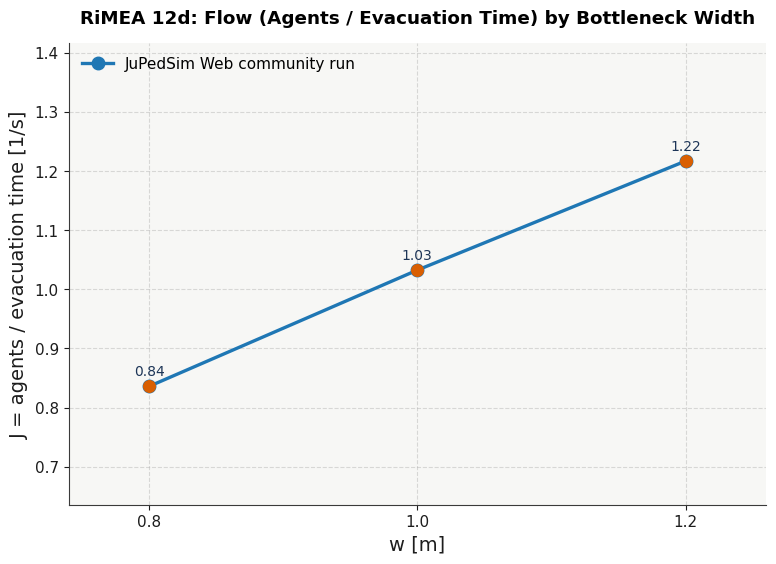
Result figure from the executed notebook.
5. Our implementation
Deviations from the standard:
- The test uses 50 agents, not 150.
- The test takes the flow as the number of agents divided by the total evacuation time of the run, which includes the walk to the bottleneck and on to the goal, so it is not a flow measured at the bottleneck. The notebook uses the same measure.
- The pass rule is the suite’s own: flow(0.8 m) < flow(1.0 m) < flow(1.2 m), with one run per width.
- The goal is a strip 2 m deep at 23 to 25 m rather than a line at the right edge. Agents have one desired speed (1.2 m/s), the suite’s default body radius of 0.15 m and one seed (42). RiMEA’s standard population (section 3.2.4, p. 16) defines sex and age; speeds follow from age (Fig. 3, p. 13) and body size is not defined.
Model: CollisionFreeSpeedModel
- Test function: tests/vv/test_rimea.py::test_flow_increases_with_width
- Scenario file: Rimea-12d-bottleneck.zip