Test 12b: Length of a bottleneck
PASS1. Definition
Two geometries each consist of two rooms of 10 m by 10 m joined by a bottleneck 1 m wide: a door in a wall 0.2 m thick, and a bottleneck 5 m long. 150 agents of the RiMEA standard population, with no response time, start in the left 5 m of room 1. Their goal lies at the right edge of room 2. The background: lab data (Fig. 12) show that the length of a bottleneck affects the flow, because slower persons hold up faster ones. The test shows that the time to clear room 1 is larger for the long bottleneck.
Source: RiMEA 4.1.1, Test 12b, pp. 38-39, Figs. 12 and 13. This is a paraphrase, not the text of the standard.
Reference: RiMEA e.V. (2025). RiMEA: Richtlinie für Mikroskopische Entfluchtungsanalysen / Guideline for Microscopic Evacuation Analysis, version 4.1.1. https://rimea.de/ (Page numbers are the page numbers of the bilingual guideline (n / 56).)
2. Scenario
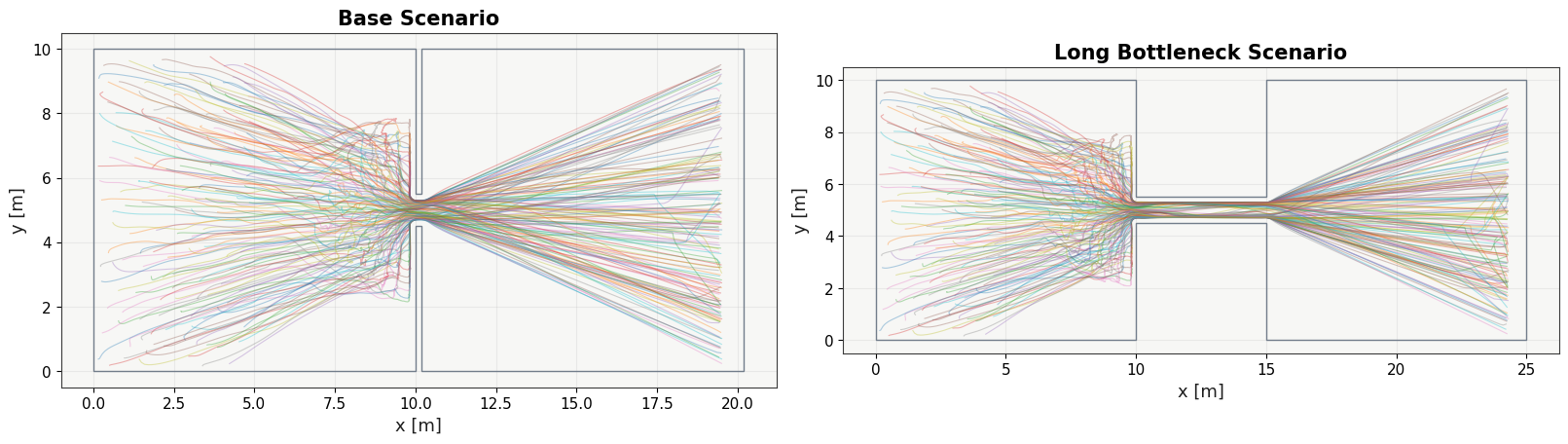
Scenario figure from the executed notebook.
3. What to expect
The room-1 clearance time is larger for the long bottleneck than for the short one. RiMEA states the direction only and sets no pass limit (p. 28).
Our criterion: Room-1 clearance time (last occupant leaves room 1) is larger for a 5 m bottleneck than for a 0.2 m door
4. Our result
Status: PASS
Test cases of this row
| Case | Status | Result | Run |
|---|---|---|---|
test_ | PASS | room1_clearance_time_short_vs_long_bottleneck = 90.2, 101.8 s | n = 150 · seed 42 |
test_: bound: agents_remaining = 0 in both runs; comparison: room-1 clearance time(long bottleneck) > room-1 clearance time(short bottleneck)longer_ bottleneck_ slower
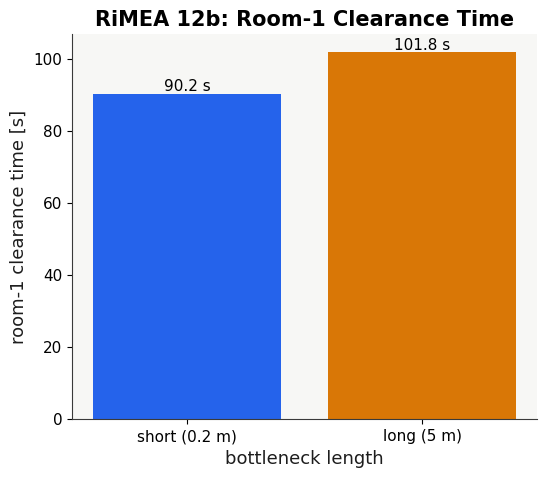
Result figure from the executed notebook.
5. Our implementation
Deviations from the standard:
- The room-1 clearance time is the time the last agent crosses the line at x = 10 m, the entrance of the bottleneck (decision D9), not the total evacuation time. The pass rule is the suite’s own: the long bottleneck takes longer, with one run per geometry and no margin.
- Agents have one desired speed (1.2 m/s), the suite’s default body radius of 0.15 m and one seed (42). RiMEA’s standard population (section 3.2.4, p. 16) defines sex and age; speeds follow from age (Fig. 3, p. 13) and body size is not defined.
Model: CollisionFreeSpeedModel
- Test function: tests/vv/test_rimea.py::test_longer_bottleneck_slower
- Scenario file: Rimea-12a-goal-position.zip
- Scenario file: Rimea-12b-bottleneck-length.zip