Test 11: Choice of escape route
TEST-LOCAL1. Definition
A public space of 30 m by 20 m has two exits, each 1 m wide, in the top wall: exit 1 at 21 m from the left wall and exit 2 5 m to its right. A population of 1000 adults from Fig. 3 with immediate reaction occupies the space from the left side at the maximum possible density, with a 2 m margin to the left and bottom walls. Walking speeds are distributed over the 1000 persons.
Source: RiMEA 4.1.1, Test 11, p. 36, Fig. 10. This is a paraphrase, not the text of the standard.
Reference: RiMEA e.V. (2025). RiMEA: Richtlinie für Mikroskopische Entfluchtungsanalysen / Guideline for Microscopic Evacuation Analysis, version 4.1.1. https://rimea.de/ (Page numbers are the page numbers of the bilingual guideline (n / 56).)
2. Scenario
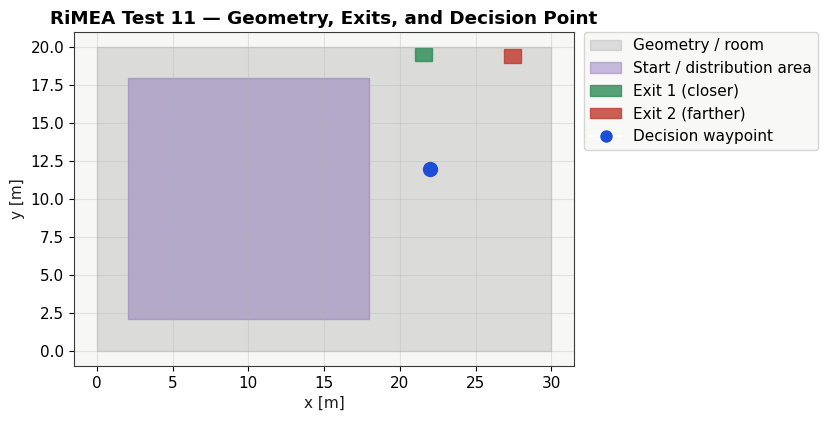
Scenario figure from the executed notebook.
3. What to expect
Most persons prefer the closer exit 1 and congestion forms in front of it, but some persons also use exit 2. RiMEA sets no numeric limit for ‘most’ or ‘some’ (p. 28).
Our criterion: Agents prefer the closer exit while some use the alternative exit
Exit choice is drawn once by a stochastic distance-based model implemented in the test file; the test verifies that model split, not simulator route choice.
4. Our result
Status: TEST-LOCAL
Test cases of this row
| Case | Status | Result | Run |
|---|---|---|---|
test_ | PASS | agents_per_exit_closer_and_farther = 814, 186 count | n = 1000 · seed 42 |
test_: bound: all agents evacuate; comparison: agents(closer exit) > agents(farther exit); bound: agents(farther exit) > 0prefer_ closer_ exit
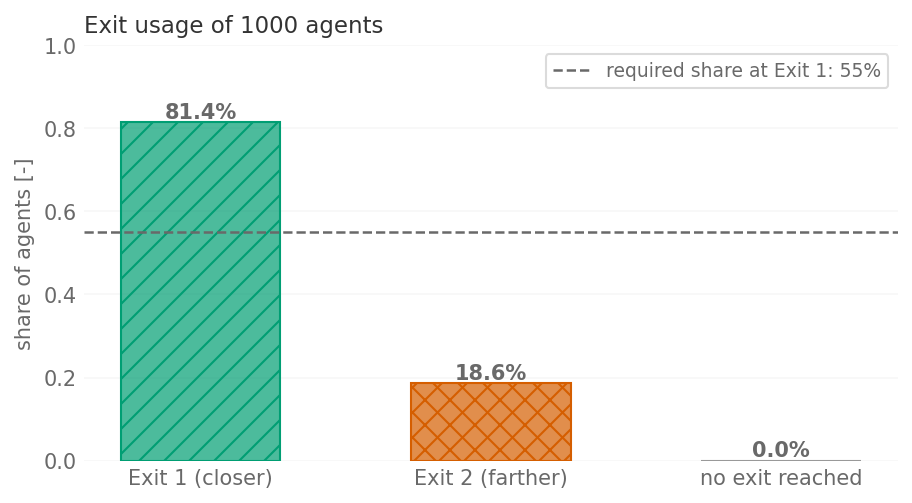
Result figure from the executed notebook.
5. Our implementation
Deviations from the standard:
- The test, not the simulator, chooses the exit. Before the run each agent draws its exit from a logistic function of the distance difference to the two exit centres (scale 3 m) with a seeded random generator, and is then routed to that exit. The assertions (more agents at exit 1 than at exit 2, and at least one at exit 2) count these draws. The simulation checks only that all agents evacuate. Congestion at exit 1 is not checked.
- The notebook uses the same scenario file and the same choice model. It counts exit use from the last recorded positions and requires at least 55 % of the agents at exit 1.
- The 1000 agents have a constant desired speed (1.2 m/s) and the default radius of 0.15 m. They start in an area of 16 m by 16 m at 2 to 18 m from the left and bottom walls, a density of about 3.9 persons per m². RiMEA asks for the maximum possible density and Fig. 10 dimensions only the 2 m margins. The exits are 1.1 m wide.
Model: CollisionFreeSpeedModel
- Test function: tests/vv/test_rimea.py::test_prefer_closer_exit
- Scenario file: Rimea-11-choice-escape.zip