Test 10: Allocation of escape routes
PASS1. Definition
A corridor section with 12 adjacent rooms (Fig. 9) holds 23 adults from Fig. 3 with immediate reaction: two persons in each room and one in room 3. The persons in rooms 1, 2, 3, 4, 7, 8, 9 and 10 are assigned to the main exit and all others to the secondary exit. Walking speeds are distributed over the 23 persons.
Source: RiMEA 4.1.1, Test 10, p. 35, Fig. 9. This is a paraphrase, not the text of the standard.
Reference: RiMEA e.V. (2025). RiMEA: Richtlinie für Mikroskopische Entfluchtungsanalysen / Guideline for Microscopic Evacuation Analysis, version 4.1.1. https://rimea.de/ (Page numbers are the page numbers of the bilingual guideline (n / 56).)
2. Scenario
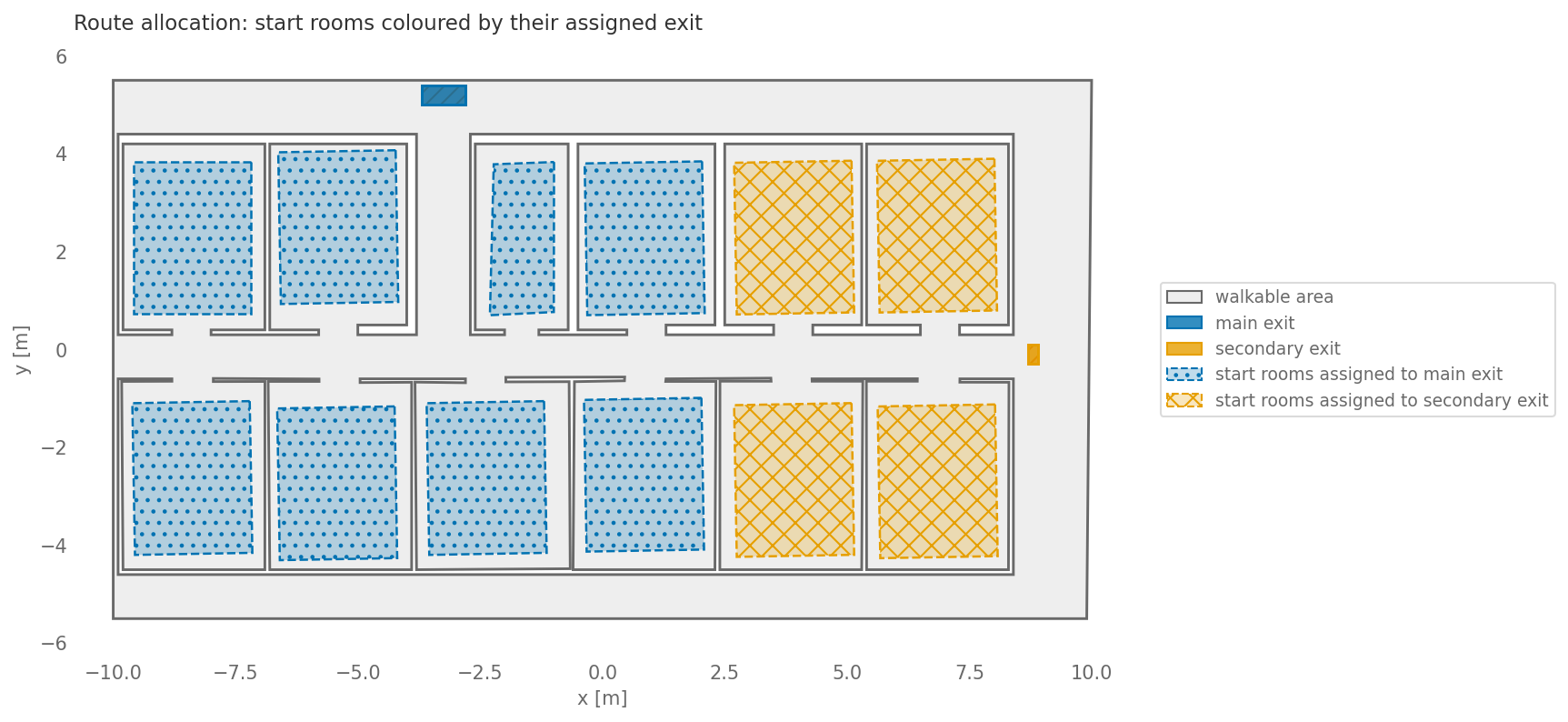
Scenario figure from the executed notebook.
3. What to expect
All persons go to the exit they are assigned to. This is a yes/no outcome; RiMEA gives no numeric limits (p. 28).
Our criterion: Agents use assigned escape routes
4. Our result
Status: PASS
Test cases of this row
| Case | Status | Result | Run |
|---|---|---|---|
test_ | PASS | agents_at_wrong_exit = 0 count accepted 0 – 0 count | n = 23 · seed 42 |
test_: bound: 0 <= measured <= 0 (agents at a non-assigned exit)agents_ use_ assigned_ exits
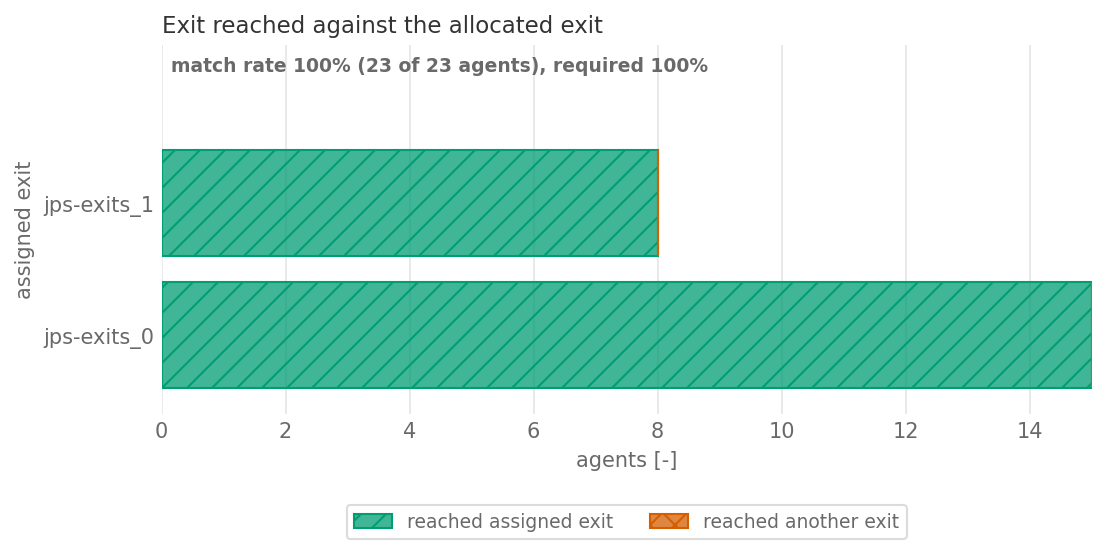
Result figure from the executed notebook.
5. Our implementation
Deviations from the standard:
- Walking speeds are constant (1.3 m/s) and not drawn from the population of Fig. 3. Agents use the default radius of 0.15 m and one seed (42).
- The pass rule is the suite’s own: all agents evacuate, and each agent’s last recorded position is nearest to the exit it was assigned to. Each room has its own journey fixed to its exit, so the test shows that assigned routes are followed.
Model: CollisionFreeSpeedModel
- Test function: tests/vv/test_rimea.py::test_agents_use_assigned_exits
- Scenario file: Rimea-10.zip