Verif.5.2: Maximum flow rates
PASS1. Definition
A room of 8 m by 5 m has a 1 m exit, centred on a 5 m wall. 100 occupants are placed in the room and assigned to the exit. The test is based on IMO Test 4. The test sets a conservative upper limit on the flow through the exit.
Source: NIST TN 1822, Verif.5.2, pp. 38-39. This is a paraphrase, not the text of the standard.
Reference: Ronchi, E., Kuligowski, E. D., Reneke, P. A., Peacock, R. D., Nilsson, D. (2013). The Process of Verification and Validation of Building Fire Evacuation Models. NIST Technical Note 1822. National Institute of Standards and Technology. 10.6028/NIST.TN.1822 (Page numbers are the printed page numbers of TN 1822.)
2. Scenario
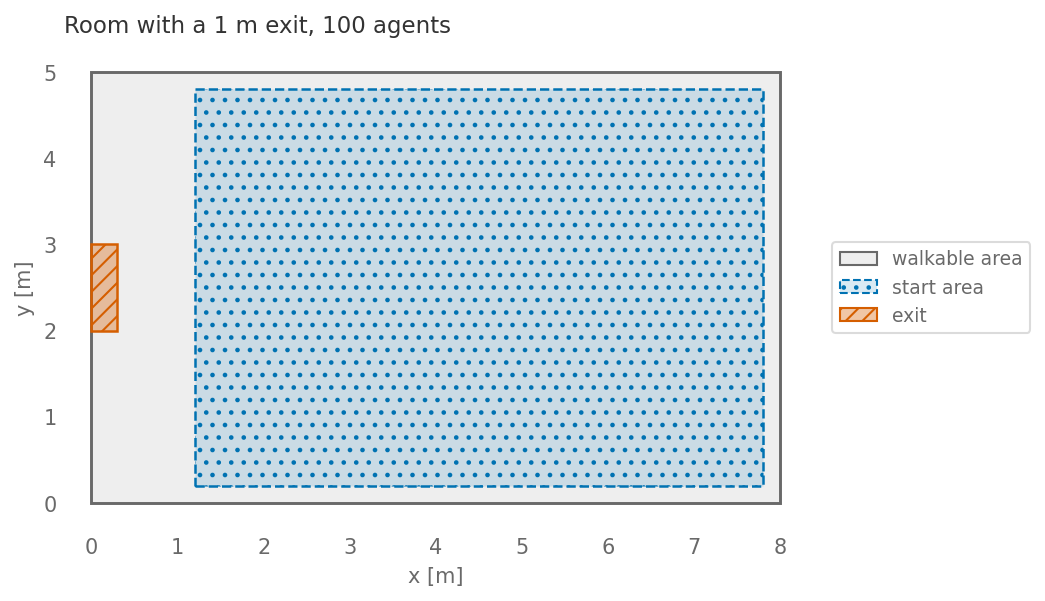
Scenario figure from the executed notebook.
3. What to expect
The flow at the exit over the whole period does not exceed a predefined maximum. TN 1822 gives 1.33 persons/m/s of IMO MSC/Circ.1238 as an example. A model that restricts door flows makes this a verification. A model with emergent flows makes it an external validation requirement. The tester documents the assumptions made for the flow, and for network models shows the sensitivity to the discretisation.
Our criterion: Specific flow <= 1.33 p/m/s with the exit throughput limiter enabled (IMO)
Verified with the jupedsim-scenarios exit throughput limiter enabled at 1.33 p/s (maintainer decision D12, restricted-flow reading); measured 1.31 p/m/s on seed 42. Flow is (N-1)/(t_last-t_first) over agent removal times, tolerance 1% for trajectory sampling. The emergent flow with the limiter off (~5.2 p/m/s) is reported in the notebook, not asserted.
4. Our result
Status: PASS
Test cases of this row
| Case | Status | Result | Run |
|---|---|---|---|
test_ | PASS | specific_exit_flow_limiter_off = 5.238 p/m/s | n = 100 · seed 42 |
test_ | PASS | specific_exit_flow_limiter_on = 1.315 p/m/s accepted ≤ 1.3433 p/m/s | n = 100 · seed 42 |
test_: information only: emergent flow, not assertedemergent_ flow_ without_ limiter_ is_ reported test_: bound: measured <= 1.33 * (1 + 0.01); exit limiter on, 1 m exitflow_ within_ cap_ with_ limiter
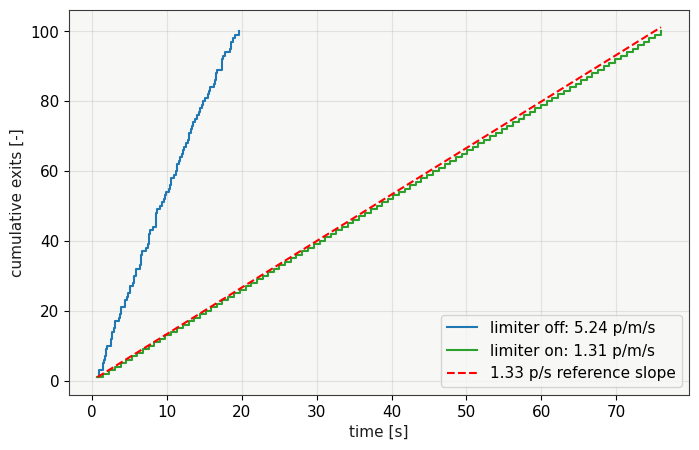
Result figure from the executed notebook.
5. Our implementation
Deviations from the standard:
- The restricted-flow reading is tested (decision D12): the jupedsim-scenarios exit throughput limiter is switched on at 1.33 persons/s, which is 1.33 persons/m/s for the 1 m exit, and the measured flow must not exceed it. This shows that the limiter enforces its cap. It does not show that the flow of the model without a limiter stays below the threshold.
- The flow without the limiter is reported and not asserted, because the model alone produces a flow well above 1.33 persons/m/s.
- The measured flow is (N - 1) / (t_last - t_first) / 1 m over the exit times of the 100 occupants. The pass rule is the suite’s own: it must not exceed 1.33 persons/m/s by more than 1 %, an allowance for the 0.1 s trajectory sampling.
- The 100 occupants stand in a 6.6 m by 4.6 m area of the room with the constant desired speed 1.2 m/s and the suite’s default body radius of 0.15 m. The test runs one seed (42).
Model: CollisionFreeSpeedModel
- Test function: tests/vv/test_nist.py::test_emergent_flow_without_limiter_is_reported
- Scenario file: Nist-5-2-max-flow.zip