Verif.3.2: Social influence
FAIL1. Definition
A room of 10 m by 15 m has two 1 m wide exits on the 15 m walls, with their centres 12 m from the bottom 10 m wall. Scenario 1: one occupant (occupant 1) without pre-evacuation time, walking at 1 m/s, stands 1 m from the bottom wall at the same position in every run, equidistant from both exits and with no preferred exit. Scenario 2: a second occupant stands 2 m from the bottom wall and is assigned to Exit 2. Each scenario is repeated until the exit usage changes by no more than 1 % with one more run. The test needs an exit-choice model that includes social interaction.
Source: NIST TN 1822, Verif.3.2, pp. 32-33, Fig. 9. This is a paraphrase, not the text of the standard.
Reference: Ronchi, E., Kuligowski, E. D., Reneke, P. A., Peacock, R. D., Nilsson, D. (2013). The Process of Verification and Validation of Building Fire Evacuation Models. NIST Technical Note 1822. National Institute of Standards and Technology. 10.6028/NIST.TN.1822 (Page numbers are the printed page numbers of TN 1822.)
2. Scenario
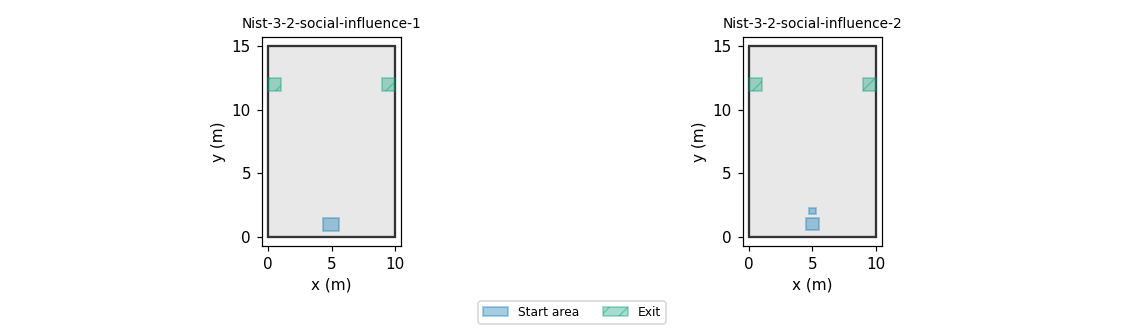
Rendered from the scenario files of this repository (top view).
3. What to expect
The usage of Exit 2 by occupant 1 is higher in Scenario 2 than in Scenario 1. The result is a quantitative comparison of exit usage. A model whose exit choice is a user input or the shortest distance should document that limitation, because it then always chooses the closest exit.
Our criterion: Exit choice shifts under social influence
CollisionFreeSpeedModel has no social-influence model; exit-2 usage is unchanged.
4. Our result
Status: FAIL
Limitation: CollisionFreeSpeedModel has no social-influence model; exit-2 usage is unchanged.
Test cases of this row
| Case | Status | Result | Run |
|---|---|---|---|
test_ | FAIL | free_occupant_exit2_fraction = 0.5, 0.5 fraction | n = 2 · seed 1, 2, 3, 4, 5, 6, 7, 8, 9, 10, 11, 12, 13, 14, 15, 16, 17, 18, 19, 20, 21, 22, 23, 24, 25, 26, 27, 28, 29, 30, 31, 32, 33, 34, 35, 36, 37, 38, 39, 40 |
test_: comparison: measured[0] (free occupants with an exit-2 occupant present) > measured[1] (baseline, Nist-3-2-social-influence-1.zip); expected failuresocial_ influence_ raises_ exit2_ usage
5. Our implementation
Deviations from the standard:
- The criterion is not met by this model. CollisionFreeSpeedModel has no social-influence mechanism, so the two free occupants draw their exit from fixed 50/50 journey weights, independent of other occupants, and the Exit 2 usage in Scenario 2 is not raised.
- Scenario 1 has two free occupants instead of one. They start at random positions in a 1.3 m by 1.0 m area around x = 5 m, 0.5 m to 1.5 m from the bottom wall, instead of one fixed position. Scenario 2 adds one occupant, assigned to Exit 2, at about 2 m from the bottom wall.
- The pass rule is the suite’s own: over 40 seeds (1 to 40), the Exit 2 fraction of the two free occupants in Scenario 2 must be larger than in Scenario 1. TN 1822 asks to repeat until the usage changes by no more than 1 %, and the suite uses a fixed number of seeds.
- Occupants use the suite’s default body radius of 0.15 m.
Model: CollisionFreeSpeedModel
- Test function: tests/vv/test_nist.py::test_social_influence_raises_exit2_usage
- Scenario file: Nist-3-2-social-influence-1.zip
- Scenario file: Nist-3-2-social-influence-2.zip
6. Our notebook
No notebook for this test yet.