Verif.2.9: Group behaviours
FAIL1. Definition
A 15 m by 20 m room has a 1 m exit. Group 1 is five able-bodied adults at the top of the room with no response time: four walk at 1.25 m/s and one at 0.5 m/s. Ten slower adults (Group 2, 0.2 m/s) stand spread over the centre of the room. The occupants of Group 1 must reach the exit. The test asks whether the model can keep a group together even when its members have different walking speeds.
Source: NIST TN 1822, Verif.2.9, pp. 27-28, Fig. 6. This is a paraphrase, not the text of the standard.
Reference: Ronchi, E., Kuligowski, E. D., Reneke, P. A., Peacock, R. D., Nilsson, D. (2013). The Process of Verification and Validation of Building Fire Evacuation Models. NIST Technical Note 1822. National Institute of Standards and Technology. 10.6028/NIST.TN.1822 (Page numbers are the printed page numbers of TN 1822.)
2. Scenario
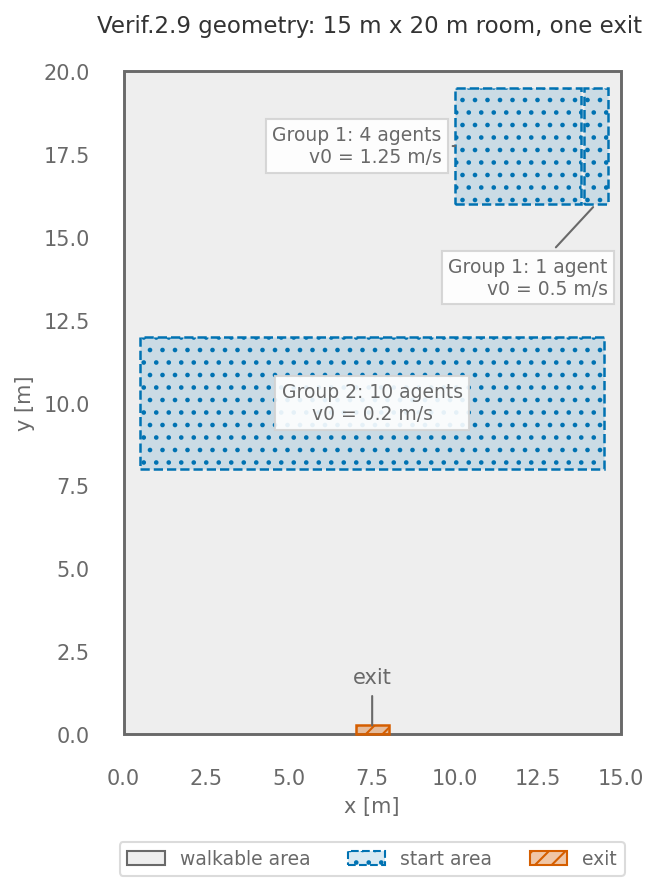
Scenario figure from the executed notebook.
3. What to expect
The members of Group 1 reach the exit together: their arrival times differ by no more than 10 s. TN 1822 states that the 10 s value is a chosen number to allow a quantitative comparison. A model without a group sub-model should document this limitation.
Our criterion: Group 1 arrival spread <= 10 s
CollisionFreeSpeedModel has no group-cohesion model (spread ~24 s).
4. Our result
Status: FAIL
Limitation: CollisionFreeSpeedModel has no group-cohesion model (spread ~24 s).
Test cases of this row
| Case | Status | Result | Run |
|---|---|---|---|
test_ | FAIL | group1_arrival_spread = 23.7 s accepted ≤ 10 s | n = 15 · seed 42 |
test_: bound: measured <= 10.0 (exit-time spread of the 5 Group 1 agents; expected failure)group1_ arrives_ together
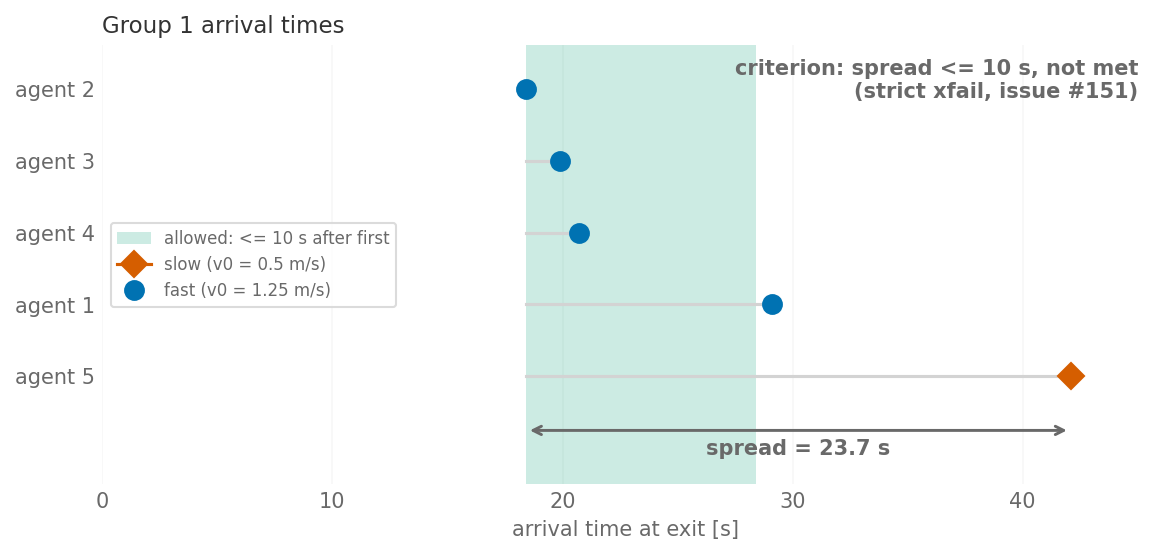
Result figure from the executed notebook.
5. Our implementation
Deviations from the standard:
- Zone 1 lies against the right-hand wall rather than at the top centre of the room as in Fig. 6.
Model: CollisionFreeSpeedModel
- Test function: tests/vv/test_nist.py::test_group1_arrives_together
- Scenario file: Nist-2-9-groups.zip