Verif.2.4: Assigned occupant demographics
TEST-LOCAL1. Definition
A square room of 100 m by 100 m holds 100 occupants spread evenly. Their walking speeds are assigned from a population chosen to match the building’s expected occupants. The test checks that the model assigns these demographic parameters correctly; it is a modified version of IMO Test 7.
Source: NIST TN 1822, Verif.2.4, pp. 20-21. This is a paraphrase, not the text of the standard.
Reference: Ronchi, E., Kuligowski, E. D., Reneke, P. A., Peacock, R. D., Nilsson, D. (2013). The Process of Verification and Validation of Building Fire Evacuation Models. NIST Technical Note 1822. National Institute of Standards and Technology. 10.6028/NIST.TN.1822 (Page numbers are the printed page numbers of TN 1822.)
2. Scenario
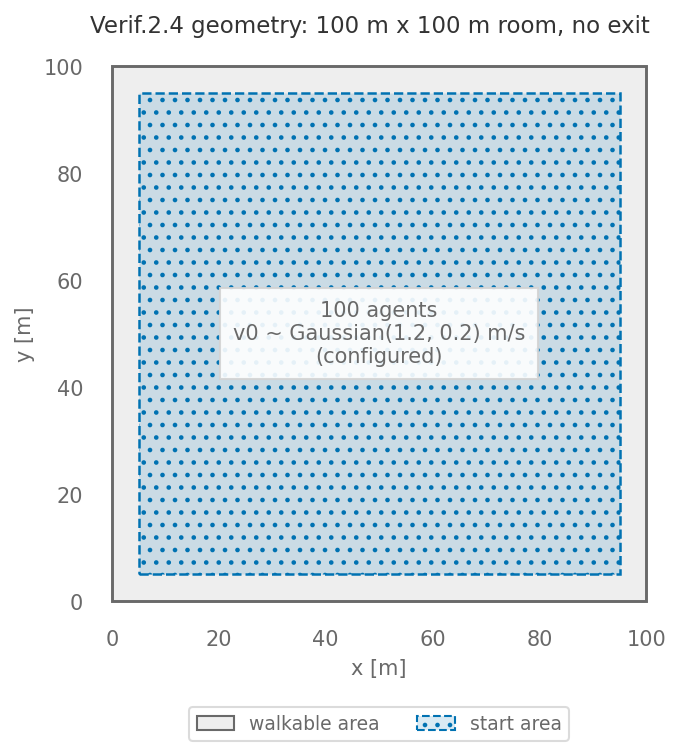
Scenario figure from the executed notebook.
3. What to expect
The walking speeds used in the simulation are consistent with the distribution specified in the scenario. The tester chooses a suitable quantitative method to compare the simulated and assigned distributions.
Our criterion: Gaussian(1.2, 0.2) desired-speed distribution configured
The test reads the scenario file and checks the configured Gaussian(1.2, 0.2) speed distribution; it samples no agent and runs no simulation.
4. Our result
Status: TEST-LOCAL
Measured values not reported yet.
Test cases of this row
| Case | Status | Result | Run |
|---|---|---|---|
test_ | PASS | — | — |
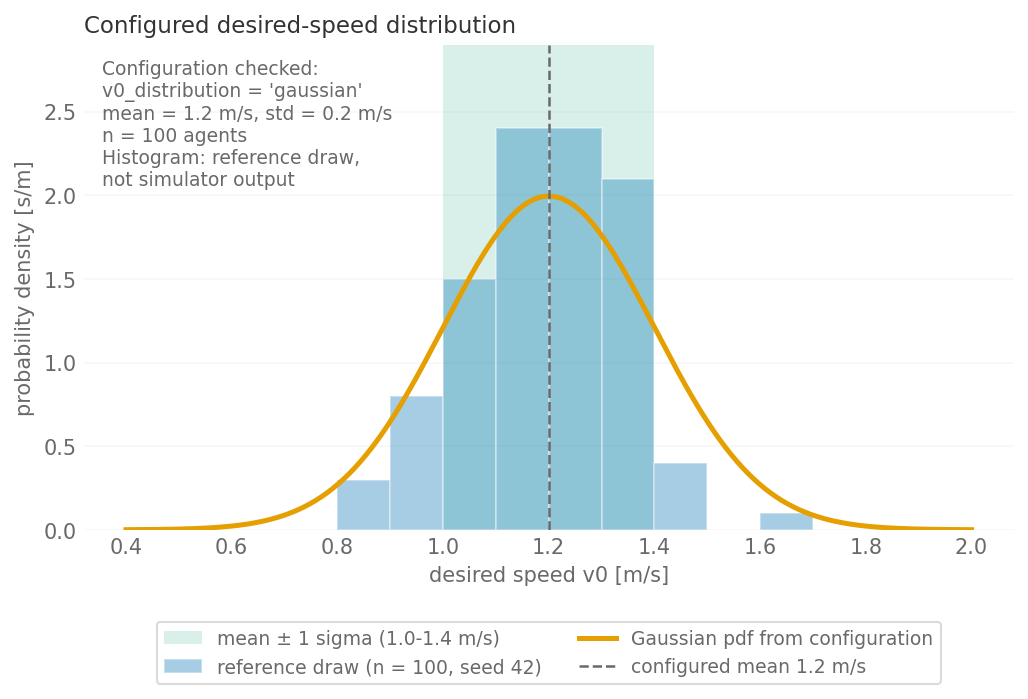
Result figure from the executed notebook.
5. Our implementation
Deviations from the standard:
- The test reads the scenario file and checks the configured Gaussian(1.2, 0.2) m/s desired-speed distribution. It runs no simulation and samples no agent, so it verifies the input, not the model’s assignment.
Model: not available in this run
- Test function: tests/vv/test_nist.py::test_gaussian_distribution_configured
- Scenario file: Nist-2-4-demographics.zip