Verif.2.2: Speed on stairs, upward
PASS1. Definition
One occupant with a walking speed of 1 m/s walks upward along a stair that is 2 m wide and 100 m long, measured along the incline. The test checks that the model keeps an assigned speed on stairs. It is based on IMO Test 2 (upward); IMO Test 3 is the downward case.
Source: NIST TN 1822, Verif.2.2, pp. 18-19. This is a paraphrase, not the text of the standard.
Reference: Ronchi, E., Kuligowski, E. D., Reneke, P. A., Peacock, R. D., Nilsson, D. (2013). The Process of Verification and Validation of Building Fire Evacuation Models. NIST Technical Note 1822. National Institute of Standards and Technology. 10.6028/NIST.TN.1822 (Page numbers are the printed page numbers of TN 1822.)
2. Scenario
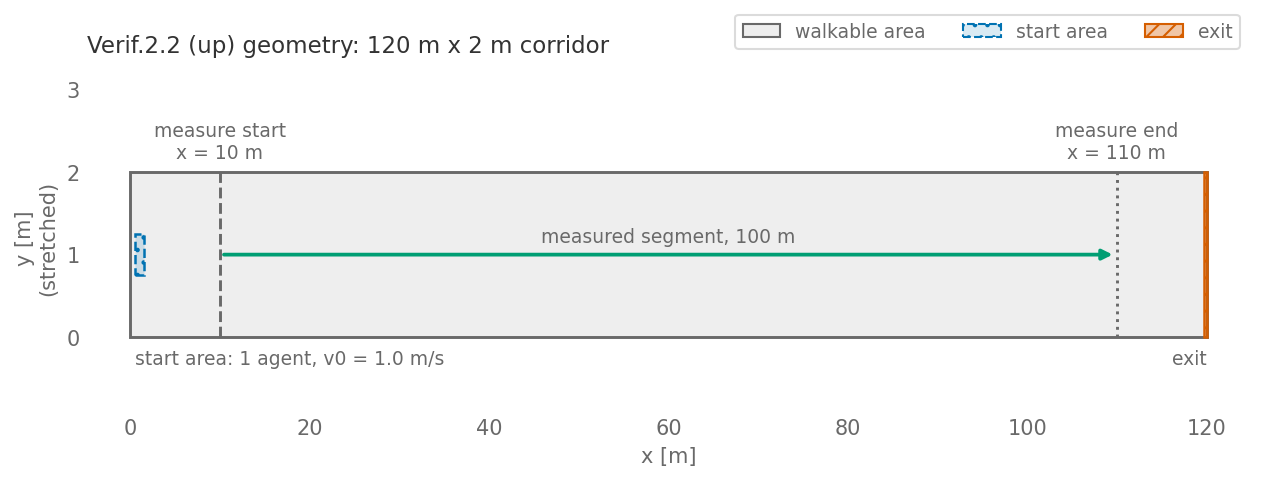
Scenario figure from the executed notebook.
3. What to expect
The occupant covers the 100 m in 100 s. The result is a quantitative comparison of the simulated and the expected time. TN 1822 allows a model to run only one of the upward and downward tests when it uses the same input for both directions, and asks network models to show the sensitivity to the network and to the rotation of the geometry.
Our criterion: Stair speed 1.0 +/- 0.05 m/s upward over 100 m
The scenario is a flat corridor with no stair element, so this checks corridor walking speed over 100 m, as Verif.2.1 does, not movement on stairs.
4. Our result
Status: PASS
Test cases of this row
| Case | Status | Result | Run |
|---|---|---|---|
test_ | PASS | stair_speed = 1 m/s accepted 0.95 – 1.05 m/s | n = 1 · seed 42 |
test_: bound: 1.0 - 0.05 <= measured <= 1.0 + 0.05walking_ speed
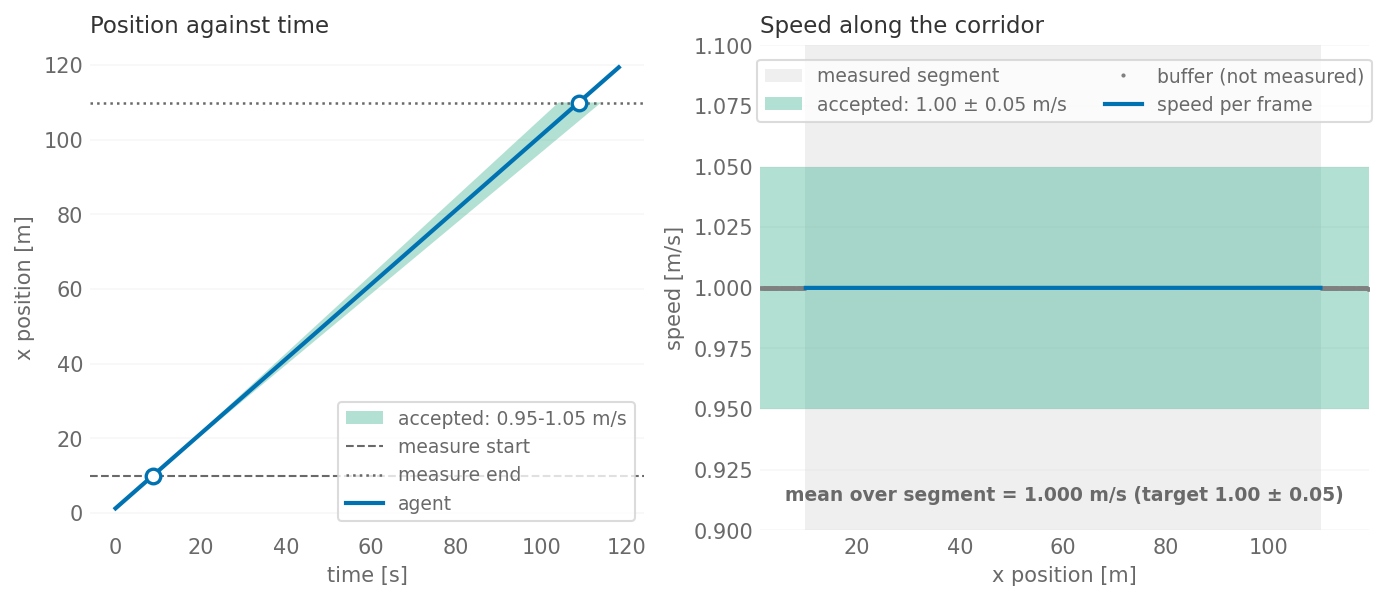
Result figure from the executed notebook.
5. Our implementation
Deviations from the standard:
- Stairs are not modelled. The scenario is a flat corridor of 120 m by 2 m with no stair element, speed zone or speed factor, so the test repeats Verif.2.1 over a 100 m segment and exercises no stair behaviour.
- The corridor is 120 m long: a 10 m buffer at each end surrounds the 100 m measurement segment.
- The pass rule is the suite’s own: the measured speed must be within 0.05 m/s of 1.0 m/s, which equals a time of 95.2 s to 105.3 s over 100 m. TN 1822 sets no tolerance.
- The test runs one seed (42) with the suite’s default body radius of 0.15 m.
- The occupant walks in the +x direction from about x = 1 m to the exit at x = 120 m.
Model: CollisionFreeSpeedModel
- Test function: tests/vv/test_nist.py::test_walking_speed
- Scenario file: Nist-2-2-stairs-up.zip