Verif.2.10: People with movement disabilities
PASS1. Definition
Room 1 (5 m by 4 m, 1 m above ground) and room 2 (5 m long, at ground level) are joined by a ramp 2 m long and 1.5 m wide. A 1 m wide exit is at the end of room 2. Scenario 1: 24 occupants in zone 1 of room 1 have an unimpeded speed of 1.25 m/s and the default body size of the model. One disabled occupant in zone 2 (a 1 m strip of room 1 at the ramp) walks at 0.8 m/s on horizontal surfaces and 0.4 m/s on the ramp, and occupies more than half the ramp width (above 0.75 m), for example a wheelchair user. Scenario 2: zone 2 holds an occupant like the 24 others. All occupants must reach the exit. The test needs a model that gives agents different sizes.
Source: NIST TN 1822, Verif.2.10, pp. 29-30, Fig. 7. This is a paraphrase, not the text of the standard.
Reference: Ronchi, E., Kuligowski, E. D., Reneke, P. A., Peacock, R. D., Nilsson, D. (2013). The Process of Verification and Validation of Building Fire Evacuation Models. NIST Technical Note 1822. National Institute of Standards and Technology. 10.6028/NIST.TN.1822 (Page numbers are the printed page numbers of TN 1822.)
2. Scenario
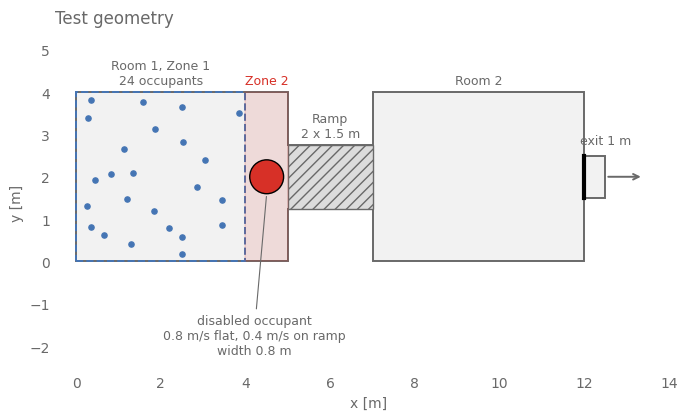
Scenario figure from the executed notebook.
3. What to expect
Occupants of zone 1 reach the exit later in Scenario 1 than in Scenario 2. The evaluation is qualitative: the tester judges whether the model can simulate disabled occupants and their effect on evacuation times. A model without this feature should describe that limitation.
Our criterion: Zone-1 occupants exit later (last and mean exit time) when a slower, larger occupant is present
2 m ramp (TN 1822 Fig. 7). Scenario built by standards/utils/movement_disability.py. The disabled occupant’s ramp speed (0.4 m/s) is set every step in that builder, because jupedsim-scenarios 0.7.3 applies speed zones to every agent; the zone-1 delay is simulator output.
4. Our result
Status: PASS
Test cases of this row
| Case | Status | Result | Run |
|---|---|---|---|
test_ | PASS | zone1_exit_time_disability_vs_control = 22.8, 18.25, 17.36, 12.49 s | n = 25 · seed 42 |
test_: bound: all 25 occupants evacuate in both runs; comparison: measured[0] (last zone-1 exit, disability) > measured[1] (last, control) and measured[2] (mean zone-1 exit, disability) > measured[3] (mean, control)movement_ disability_ increases_ evacuation_ time
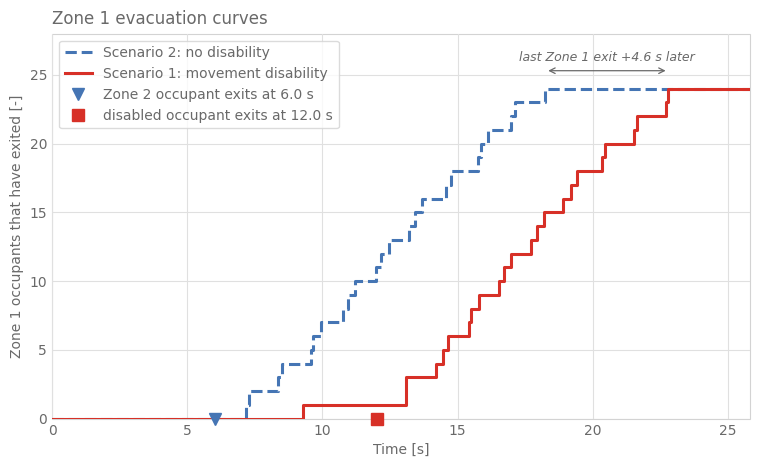
Result figure from the executed notebook.
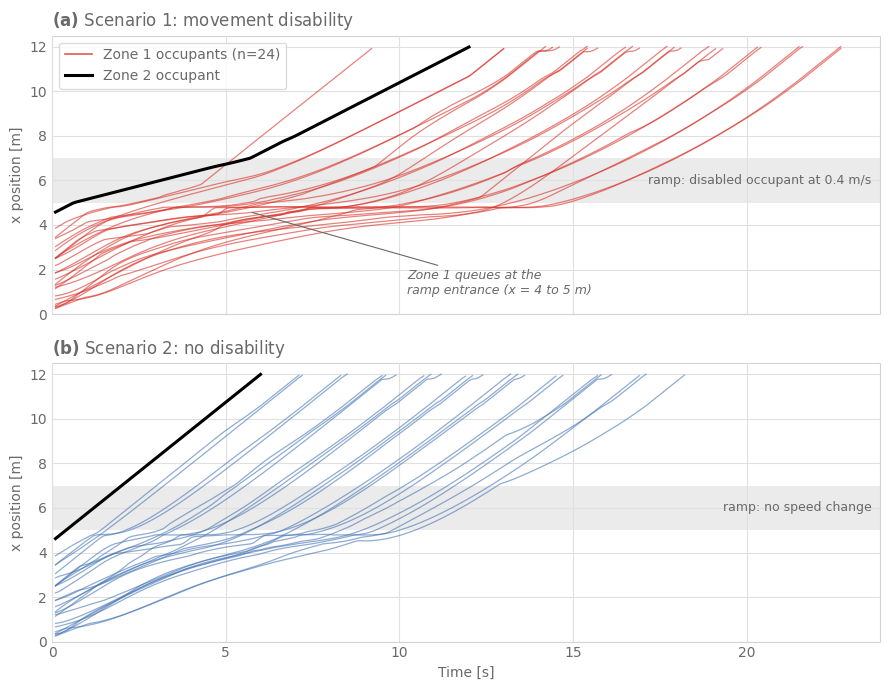
Result figure from the executed notebook.
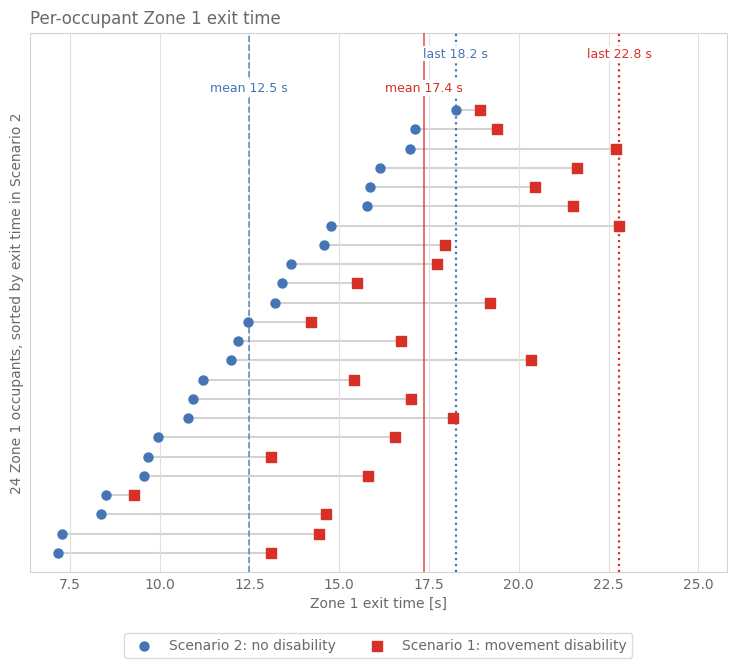
Result figure from the executed notebook.
5. Our implementation
Deviations from the standard:
- The pass rule is the suite’s own (decision D8): all 25 occupants evacuate in both scenarios, and both the last and the mean exit time of the 24 zone-1 occupants are strictly later in Scenario 1. TN 1822 does not say which statistic of the zone-1 times to compare. The evacuation time of the disabled occupant itself is not used.
- The 1 m level difference is not modelled: the rooms and the ramp are flat. The ramp is a 2 m by 1.5 m region of the floor plan.
- The disabled occupant has a body radius of 0.4 m (0.8 m wide) and desired speeds of 0.8 m/s outside the ramp and 0.4 m/s on it. The suite’s builder (standards/utils/movement_disability.py) sets this desired speed on every step from the occupant’s position, because jupedsim-scenarios 0.7.3 applies a speed zone to every agent. The 24 zone-1 occupants keep 1.25 m/s everywhere and the default radius of 0.15 m.
- The test runs one seed (42) with CollisionFreeSpeedModel set to neighbour repulsion strength 2.6 and range 0.1. The scenario is built in code rather than loaded from a scenario file.
Model: CollisionFreeSpeedModel