Verif.1.1: Pre-evacuation time distributions
PASS1. Definition
A room of 8 m by 5 m has a 1 m exit. Ten occupants are placed at random positions in it. Each pre-evacuation time distribution that the model offers (for example uniform, normal or log-normal) is assigned to the occupants in turn, and the test is repeated for every such distribution. It is a modified version of IMO Test 5. The test checks that the model assigns the pre-evacuation times as specified.
Source: NIST TN 1822, Verif.1.1, pp. 16-17. This is a paraphrase, not the text of the standard.
Reference: Ronchi, E., Kuligowski, E. D., Reneke, P. A., Peacock, R. D., Nilsson, D. (2013). The Process of Verification and Validation of Building Fire Evacuation Models. NIST Technical Note 1822. National Institute of Standards and Technology. 10.6028/NIST.TN.1822 (Page numbers are the printed page numbers of TN 1822.)
2. Scenario
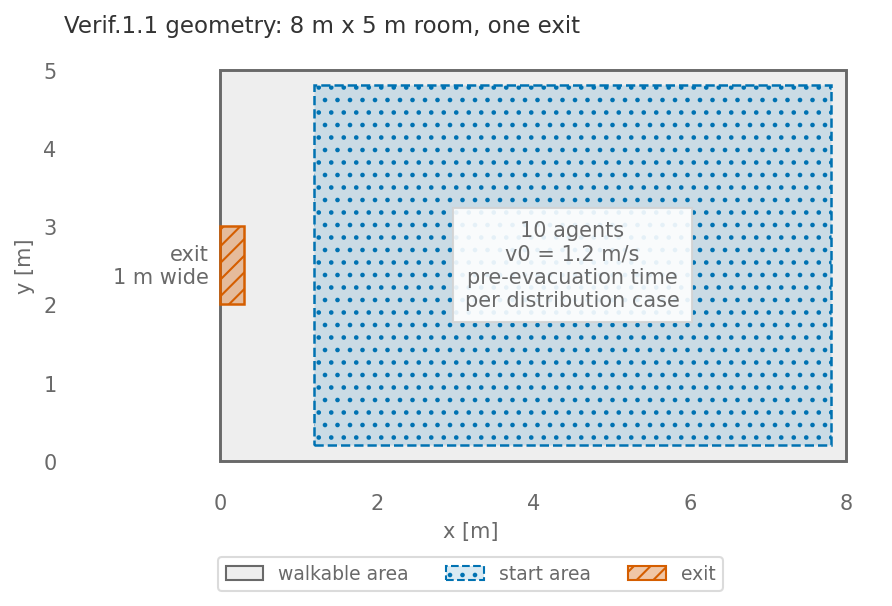
Scenario figure from the executed notebook.
3. What to expect
Each occupant starts moving at its assigned time, and the responses of the population fall within the specified range. The tester chooses a quantitative method to compare the simulated and the assigned distributions. TN 1822 asks for several runs of the same scenario, because the required number of runs depends on the distribution.
Our criterion: KS p > 0.05 for uniform/gamma/lognormal/weibull
4. Our result
Status: PASS
Test cases of this row
| Case | Status | Result | Run |
|---|---|---|---|
test_ | PASS | — | — |
test_ | PASS | premovement_ks_pvalue = 0.8468 accepted ≥ 0.05 | n = 10 · seed 42 |
test_ | PASS | premovement_ks_pvalue = 0.3189 accepted ≥ 0.05 | n = 10 · seed 42 |
test_ | PASS | premovement_ks_pvalue = 0.2823 accepted ≥ 0.05 | n = 10 · seed 42 |
test_ | PASS | premovement_ks_pvalue = 0.9983 accepted ≥ 0.05 | n = 10 · seed 42 |
test_: bound: measured > 0.05 (Kolmogorov-Smirnov, gamma distribution)distribution_ fits[gamma] test_: bound: measured > 0.05 (Kolmogorov-Smirnov, lognormal distribution)distribution_ fits[lognormal] test_: bound: measured > 0.05 (Kolmogorov-Smirnov, uniform distribution)distribution_ fits[uniform] test_: bound: measured > 0.05 (Kolmogorov-Smirnov, weibull distribution)distribution_ fits[weibull]
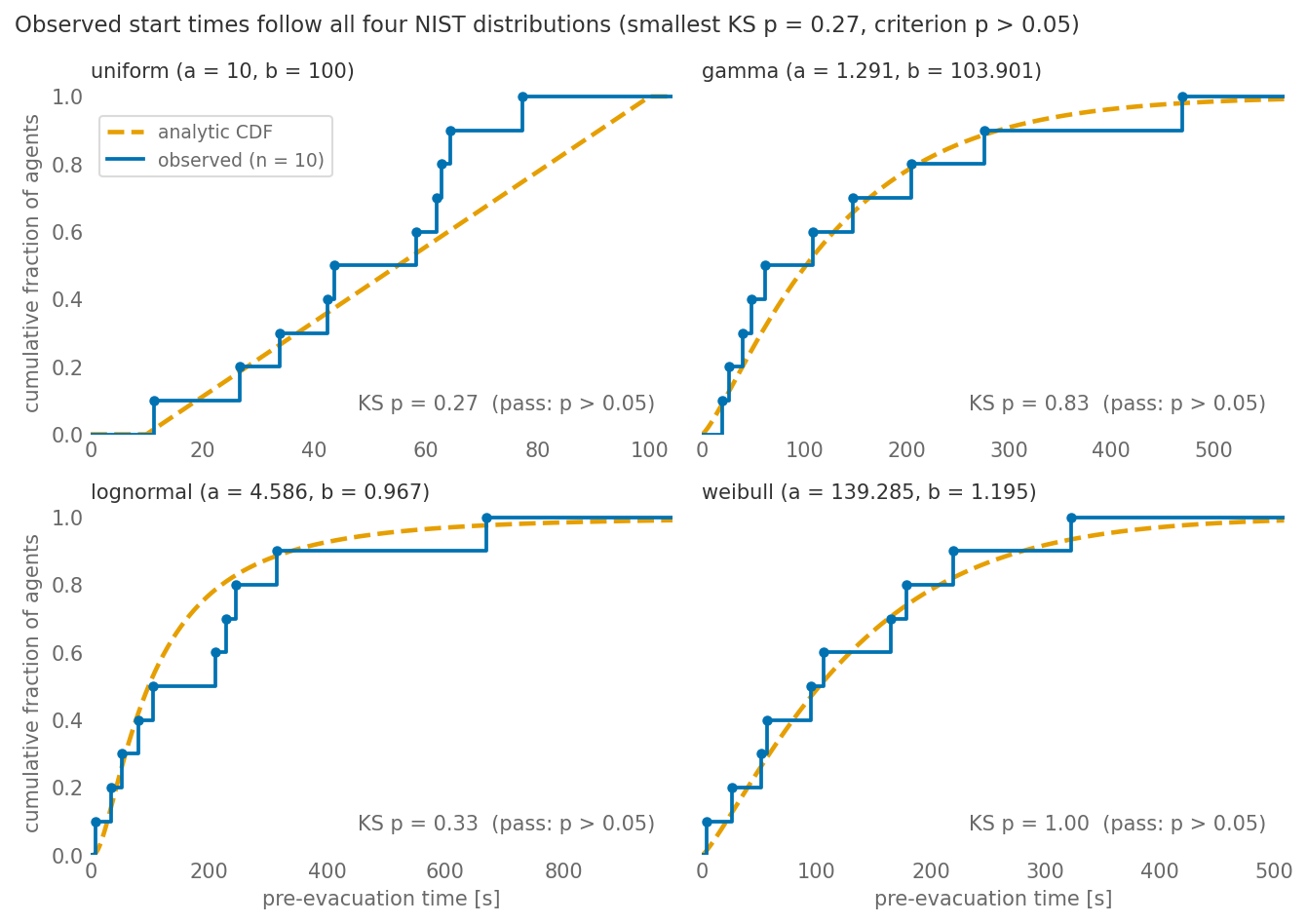
Result figure from the executed notebook.
5. Our implementation
Deviations from the standard:
- The suite tests four distributions: uniform U(10, 100) s, gamma, log-normal and Weibull. TN 1822 names only the types, so the parameters (gamma shape 1.291 and scale 103.901, log-normal 4.586 and 0.967, Weibull scale 139.285 and shape 1.195) are the suite’s choice. A normal distribution, which the standard names as an example, is not run.
- The pass rule is the suite’s own: a one-sample Kolmogorov-Smirnov test of the observed start times against the assigned distribution must give p > 0.05.
- Each case is one run with 10 occupants (seed 42). TN 1822 asks for repeated runs, and a sample of 10 gives the test little power to separate distributions.
- The start time of an occupant is the first frame in which it has moved more than 0.05 m from its spawn point, so it is measured from the trajectory and not read from the model input.
- Occupants are placed in a 6.6 m by 4.6 m area inside the room, use the constant desired speed 1.2 m/s and the suite’s default body radius of 0.15 m.
Model: CollisionFreeSpeedModel
- Test function: tests/vv/test_nist.py::test_base_zip_loads
- Scenario file: Nist-1-1-premovement.zip