Test 9: Dynamic availability of exit
PENDING1. Definition
A room of 10 m by 15 m has two 1 m wide exits, one on each 15 m wall, at equal distance from the short end wall. One occupant with no pre-evacuation time and a constant speed of 1 m/s is placed as in Figure 6. Exit 1 becomes unavailable after 1 s of simulated time, and the exit used by the occupant is recorded. The tester reports how the destination is set. A model that cannot change exit availability during a run documents that limitation.
Source: ISO 20414:2020, Test 9, Table 10, pp. 19-20, Fig. 6. This is a paraphrase, not the text of the standard.
Reference: ISO (2020). ISO 20414:2020, Fire safety engineering - Verification and validation protocol for building fire evacuation models. First edition. International Organization for Standardization, Geneva. https://www.iso.org/standard/78348.html (Page numbers are the printed page numbers of ISO 20414:2020 (the copy read is a proof, so numbers can differ by a page in the published edition). ISO states that its tests are examples and that a tester may use different tests that verify the same component equivalently.)
2. Scenario
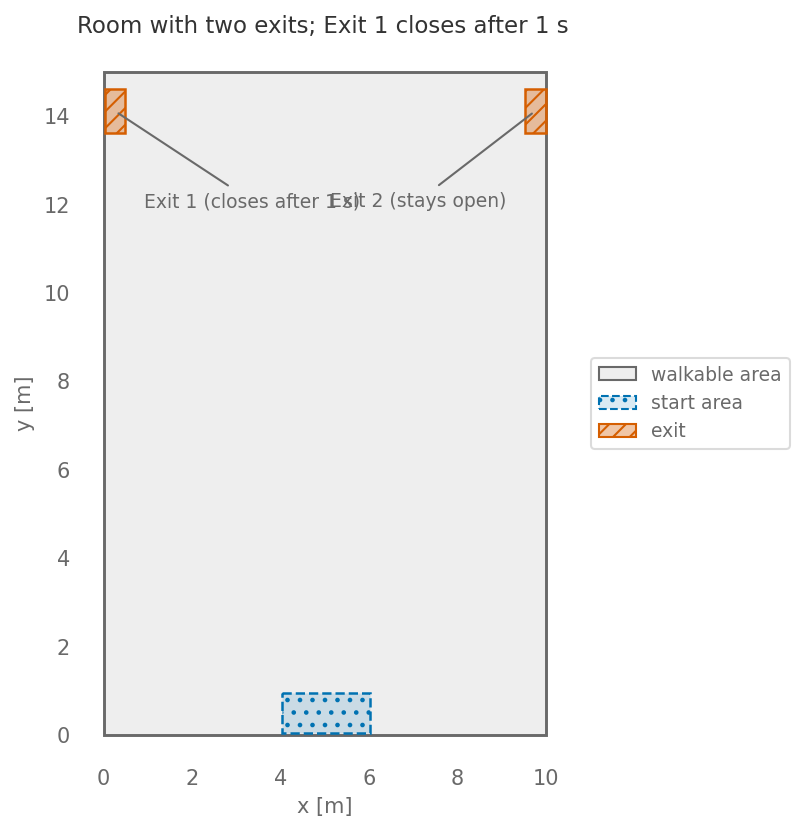
Scenario figure from the executed notebook.
3. What to expect
The occupant does not use Exit 1.
Our criterion: An occupant reroutes when its initially selected exit becomes unavailable
Not run (pytest marker run=False). The public API cannot make an exit unavailable at runtime (jupedsim-scenarios 0.7.3, the locked version, removes exits only before a run and has no runtime exit closure); the test forces the reroute through private runner state and is not run.
4. Our result
Status: PENDING
No measured values: this test is not covered yet.
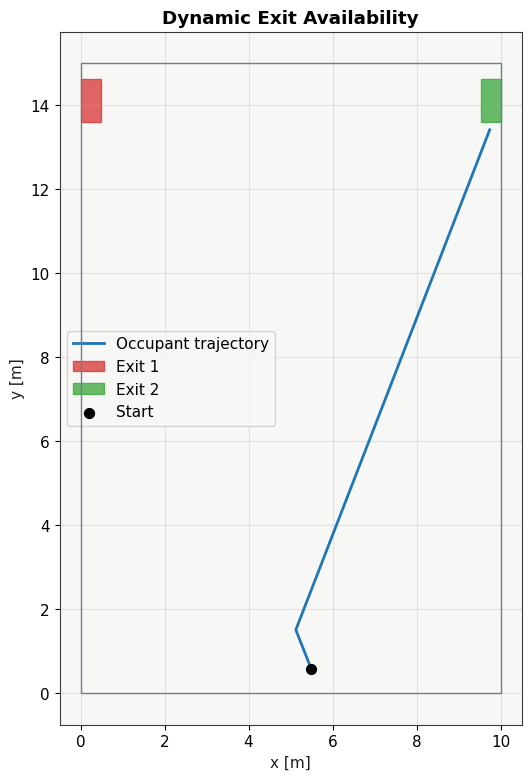
Result figure from the executed notebook.
5. Our implementation
Deviations from the standard:
- Not run. The scenario harness (jupedsim-scenarios 0.7.3, the locked version) removes exits only before a run and has no runtime exit closure. The test forces a reroute by writing the runner’s private agent state, so it would not exercise any public closure feature; it is marked not to run.
- In the scenario file the occupant’s initial exit is set by two journeys with equal weights, so the premise that it first heads for Exit 1 is not fixed by the scenario.
Model: not available in this run
- Test:
TestIso09DynamicExitAvailability(source link not available in this run) - Scenario file: Iso-09-dynamic-exits.zip