Test 3: Walking speed on stairs
PASS1. Definition
A stair 2 m wide and 10 m long, measured along the incline, is walked by one occupant with an assigned speed of 1 m/s, upwards or downwards. Models may use a speed factor or other input to change movement on stairs. The tester reports how the destination is set and documents how stair movement is represented.
Source: ISO 20414:2020, Test 3, Table 4, pp. 12-13. This is a paraphrase, not the text of the standard.
Reference: ISO (2020). ISO 20414:2020, Fire safety engineering - Verification and validation protocol for building fire evacuation models. First edition. International Organization for Standardization, Geneva. https://www.iso.org/standard/78348.html (Page numbers are the printed page numbers of ISO 20414:2020 (the copy read is a proof, so numbers can differ by a page in the published edition). ISO states that its tests are examples and that a tester may use different tests that verify the same component equivalently.)
2. Scenario

Scenario figure from the executed notebook.
3. What to expect
The occupant covers the stair in 10 s, upwards or downwards. ISO gives no numeric tolerance.
Our criterion: 1 m/s on the 10 m stair gives 10 s: stair speed 1.0 +/- 0.05 m/s
The stair is a flat speed-factor zone (0.5); the desired speed is 2.0 m/s so that the speed on the stair is 1 m/s. Up and down use the same mechanism.
4. Our result
Status: PASS
Test cases of this row
| Case | Status | Result | Run |
|---|---|---|---|
test_ | PASS | stair_speed = 1 m/s accepted 0.95 – 1.05 m/s | n = 1 · seed 42 |
test_: bound: 1.0 - 0.05 <= measured <= 1.0 + 0.05stair_ speed
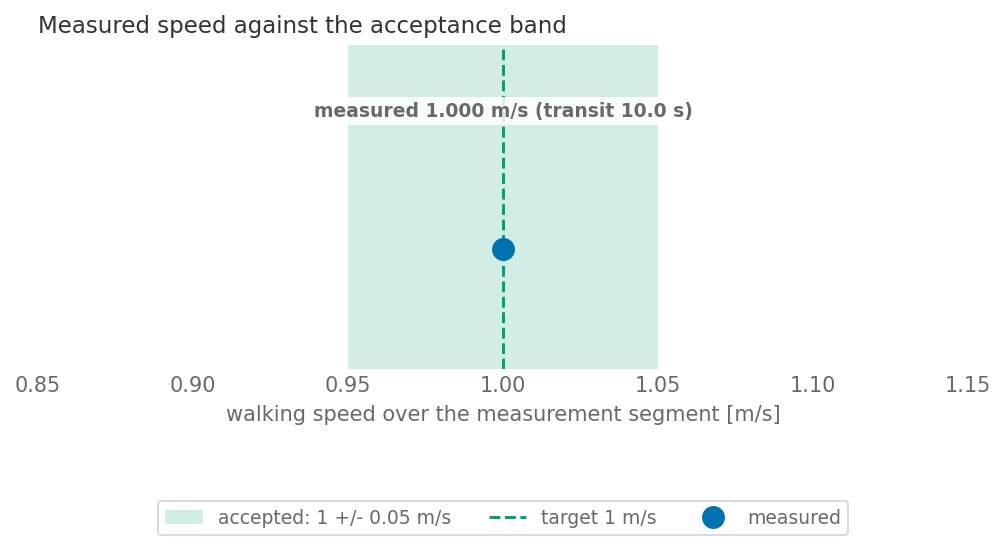
Result figure from the executed notebook.
5. Our implementation
Deviations from the standard:
- The stair is a flat 10 m zone inside a 2 m wide, 30 m long corridor, with a speed factor of 0.5. The desired speed is 2.0 m/s, so the occupant crosses the zone at 1 m/s and takes 10 s, as ISO expects (decision D23). The test checks the speed-factor arithmetic, not a stair model.
- The pass rule is the suite’s own: the mean speed over the 10 m stair segment is 1.0 m/s within 0.05 m/s.
- Up and down use the same flat zone, so the direction is not modelled and a single run stands for both. The effect of tread and width is not modelled.
Model: CollisionFreeSpeedModel
- Test function: tests/vv/test_iso.py::test_stair_speed
- Scenario file: Iso-03-stairs.zip