Test 2: Walking speed in a corridor
PASS1. Definition
A corridor 2 m wide and 40 m long holds one occupant with an assigned walking speed of 1 m/s. The occupant walks the corridor and the covered distance is compared with the assigned speed. Models on a grid should repeat the test with the corridor rotated (for example 0 and 45 degrees) and consider cell-size sensitivity. The tester reports how the destination is set and whether agents accelerate to the assigned speed.
Source: ISO 20414:2020, Test 2, Table 3, p. 12. This is a paraphrase, not the text of the standard.
Reference: ISO (2020). ISO 20414:2020, Fire safety engineering - Verification and validation protocol for building fire evacuation models. First edition. International Organization for Standardization, Geneva. https://www.iso.org/standard/78348.html (Page numbers are the printed page numbers of ISO 20414:2020 (the copy read is a proof, so numbers can differ by a page in the published edition). ISO states that its tests are examples and that a tester may use different tests that verify the same component equivalently.)
2. Scenario

Scenario figure from the executed notebook.
3. What to expect
The occupant covers the corridor in 40 s. ISO gives no numeric tolerance; the comparison is the difference between expected and simulated result.
Our criterion: Walking speed 1.0 +/- 0.05 m/s over the 40 m segment
4. Our result
Status: PASS
Test cases of this row
| Case | Status | Result | Run |
|---|---|---|---|
test_ | PASS | corridor_speed = 1 m/s accepted 0.95 – 1.05 m/s | n = 1 · seed 42 |
test_: bound: 1.0 - 0.05 <= measured <= 1.0 + 0.05walking_ speed
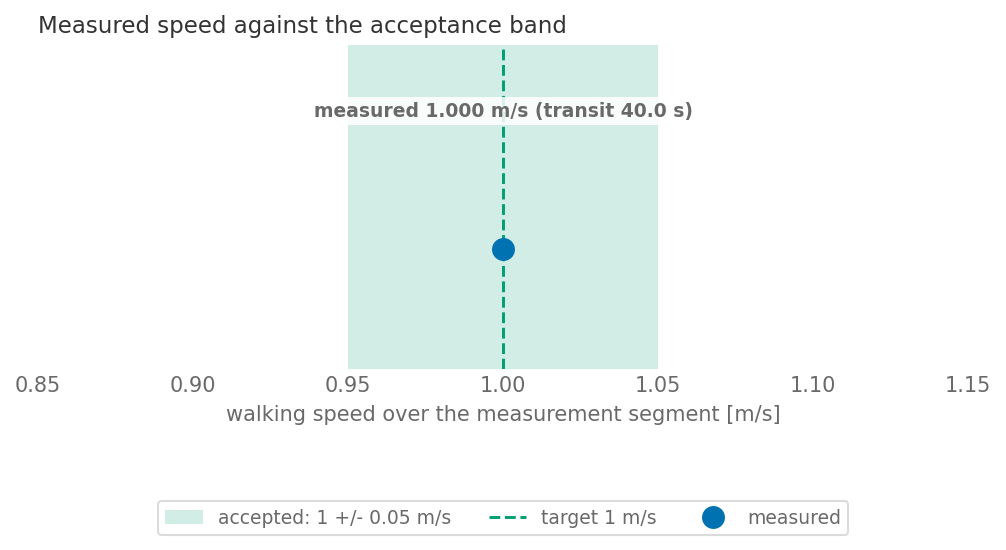
Result figure from the executed notebook.
5. Our implementation
Deviations from the standard:
- The corridor is 60 m long. The speed is measured over a 40 m segment (x = 10 m to 50 m), which excludes the start-up phase, instead of timing the whole corridor.
- The pass rule is the suite’s own: the mean transit speed over that segment is 1.0 m/s within 0.05 m/s.
- Only the unrotated corridor is run. JuPedSim has no grid, so the rotation and cell-size checks do not apply, and the test does not record whether the agent accelerates.
Model: CollisionFreeSpeedModel
- Test function: tests/vv/test_iso.py::test_walking_speed
- Scenario file: Iso-02-corridor.zip