Test 15: Social influence on exit choice
FAIL1. Definition
A room of 10 m by 15 m has two 1 m exits on the 15 m walls, centred 12 m from the short end wall. In Scenario 1 one occupant (occupant 1), with no preferred exit, no pre-evacuation time and a speed of 1 m/s, starts 1 m from the bottom wall at a position equidistant from both exits. The run is repeated until the exit usage changes by less than 1 % with an additional run. In Scenario 2 a second occupant starts 2 m from the bottom wall and is deterministically assigned to Exit 2. The runs are again repeated until usage is stable. Exit usage is recorded. A model whose exit choice is user-defined, so that occupants always take the closest exit, documents that limitation.
Source: ISO 20414:2020, Test 15, Table 17, pp. 26-27, Fig. 11. This is a paraphrase, not the text of the standard.
Reference: ISO (2020). ISO 20414:2020, Fire safety engineering - Verification and validation protocol for building fire evacuation models. First edition. International Organization for Standardization, Geneva. https://www.iso.org/standard/78348.html (Page numbers are the printed page numbers of ISO 20414:2020 (the copy read is a proof, so numbers can differ by a page in the published edition). ISO states that its tests are examples and that a tester may use different tests that verify the same component equivalently.)
2. Scenario
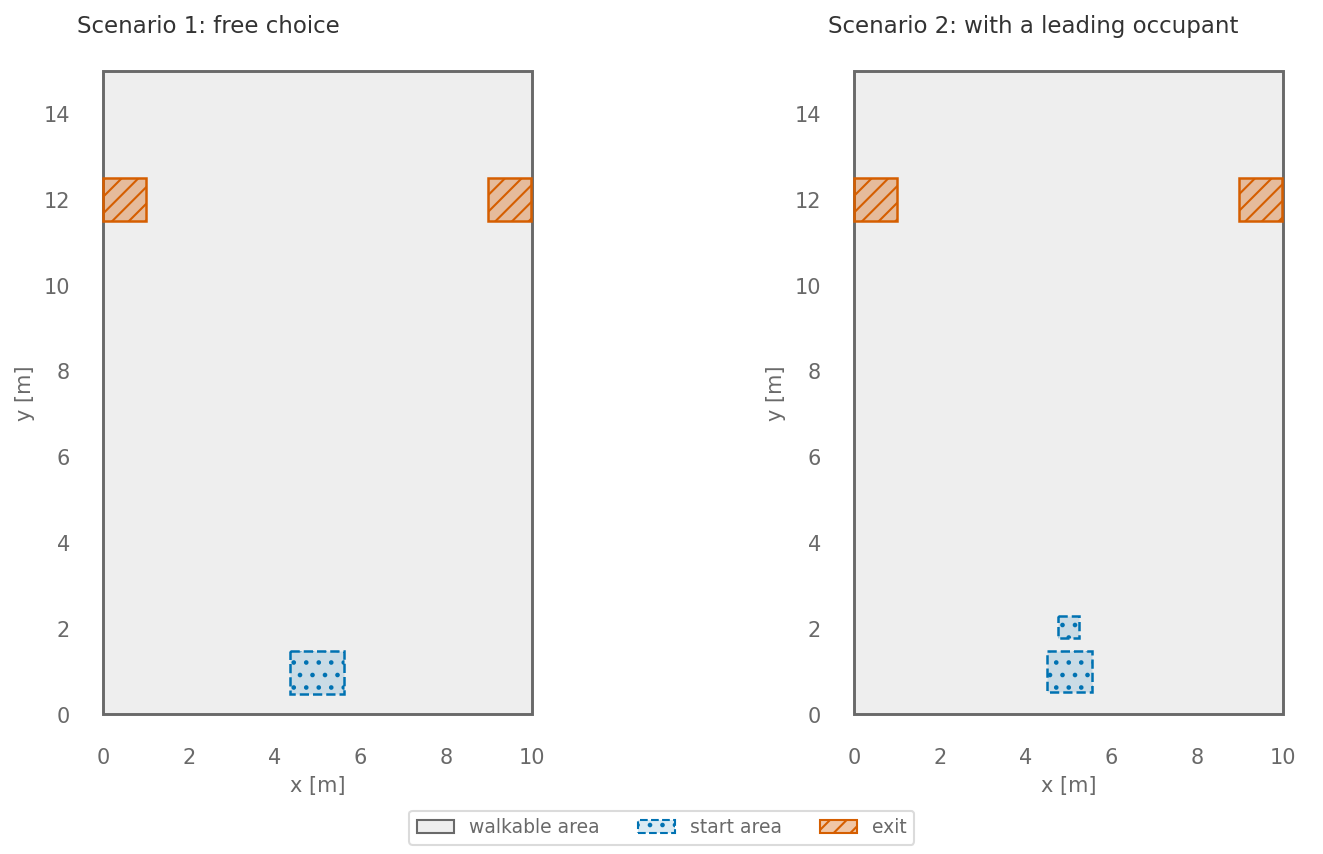
Scenario figure from the executed notebook.
3. What to expect
Occupant 1 uses Exit 2 more often in Scenario 2 than in Scenario 1.
Our criterion: A deterministic exit-2 occupant raises free occupants’ exit-2 usage
CollisionFreeSpeedModel has no social-influence model; exit-2 usage is unchanged.
4. Our result
Status: FAIL
Limitation: CollisionFreeSpeedModel has no social-influence model; exit-2 usage is unchanged.
Test cases of this row
| Case | Status | Result | Run |
|---|---|---|---|
test_ | FAIL | free_occupant_exit2_fraction = 0.5, 0.5 fraction | n = 2 · seed 1, 2, 3, 4, 5, 6, 7, 8, 9, 10, 11, 12, 13, 14, 15, 16, 17, 18, 19, 20, 21, 22, 23, 24, 25, 26, 27, 28, 29, 30, 31, 32, 33, 34, 35, 36, 37, 38, 39, 40 |
test_: comparison: measured[0] (free occupants with an exit-2 occupant present) > measured[1] (baseline, Iso-15-social-influence-1.zip); expected failuresocial_ influence_ raises_ exit2_ usage
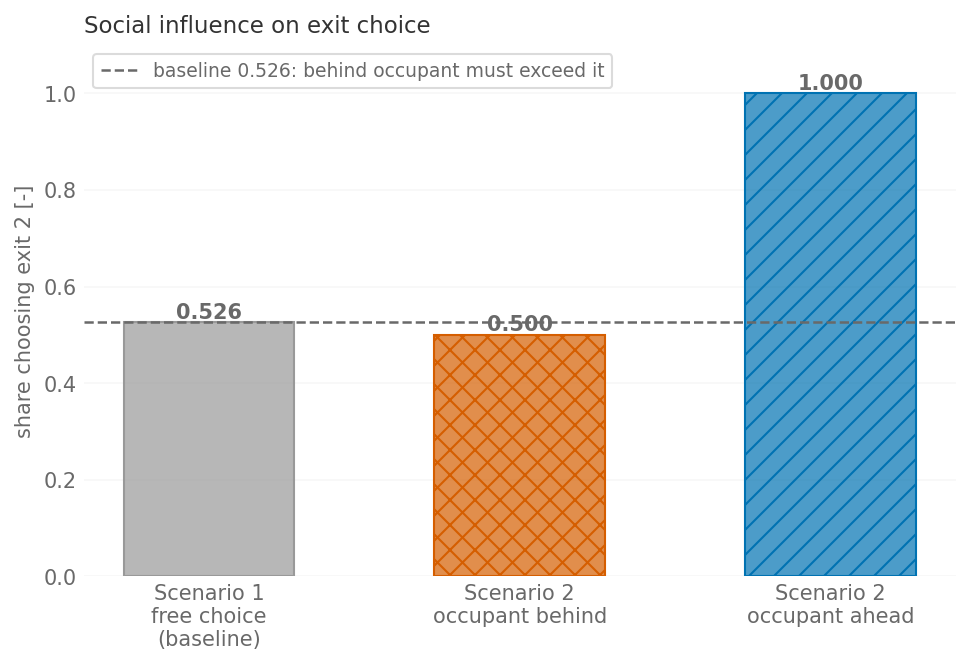
Result figure from the executed notebook.
5. Our implementation
Deviations from the standard:
- Scenario 1 has two free occupants instead of one, each assigned by journey weights of 50 / 50 to the two exits. The exit of the free occupants is set by these input weights, not by a choice the model makes. Their start positions are drawn inside a small box and are not fixed.
- Scenario 2 adds a third occupant, bound to Exit 2, starting about 2 m from the bottom wall. The occupants that start closest to the bottom wall (below 1.5 m) are counted as the free ones.
- ISO’s rule of repeating until the exit usage varies by less than 1 % is replaced by 40 fixed seeds.
- The pass rule is the suite’s own: the Exit-2 fraction of the free occupants in Scenario 2 must be higher than in Scenario 1.
Model: CollisionFreeSpeedModel
- Test function: tests/vv/test_iso.py::test_social_influence_raises_exit2_usage
- Scenario file: Iso-15-social-influence-1.zip
- Scenario file: Iso-15-social-influence-2.zip