Test 14: Group behaviour
PASS1. Definition
A room of 15 m by 20 m has a 1 m exit. Group 1 is five adults at the top of the room with no response time. Four walk at 1.25 m/s and the fifth at 0.5 m/s. Group 2 is ten slower adults at 0.2 m/s, spread uniformly in the central part of the room. Group 1 must reach the exit. The test asks whether a group sub-model keeps the group together, as proximity only, when its members differ in speed. A model without group behaviour documents that limitation.
Source: ISO 20414:2020, Test 14, Table 16, pp. 25-26, Fig. 10. This is a paraphrase, not the text of the standard.
Reference: ISO (2020). ISO 20414:2020, Fire safety engineering - Verification and validation protocol for building fire evacuation models. First edition. International Organization for Standardization, Geneva. https://www.iso.org/standard/78348.html (Page numbers are the printed page numbers of ISO 20414:2020 (the copy read is a proof, so numbers can differ by a page in the published edition). ISO states that its tests are examples and that a tester may use different tests that verify the same component equivalently.)
2. Scenario
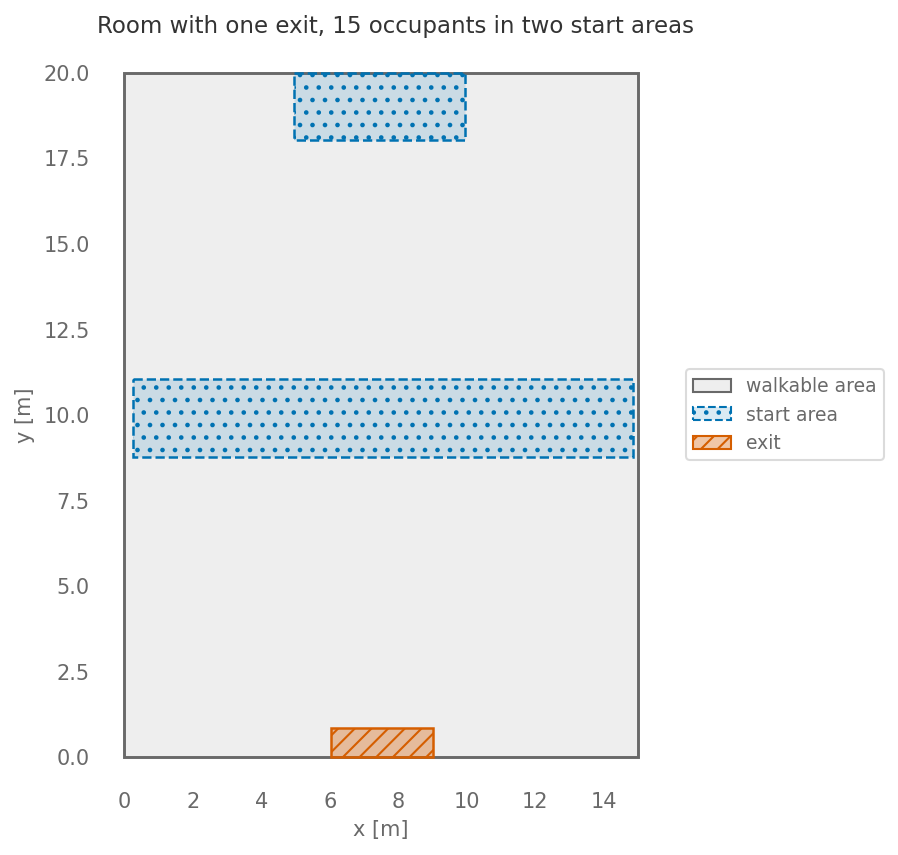
Scenario figure from the executed notebook.
3. What to expect
The members of Group 1 reach the exit together: their arrival times differ by no more than 10 s. ISO states that 10 s is an arbitrary value chosen to allow a quantitative comparison.
Our criterion: The homogeneous fast group reaches the exit together (spread <= 10 s)
4. Our result
Status: PASS
Test cases of this row
| Case | Status | Result | Run |
|---|---|---|---|
test_ | PASS | group1_arrival_spread = 6.5 s accepted ≤ 10 s | n = 15 · seed 42 |
test_: bound: measured <= 10.0 (exit-time spread of the 5 Group 1 agents)group1_ arrives_ together
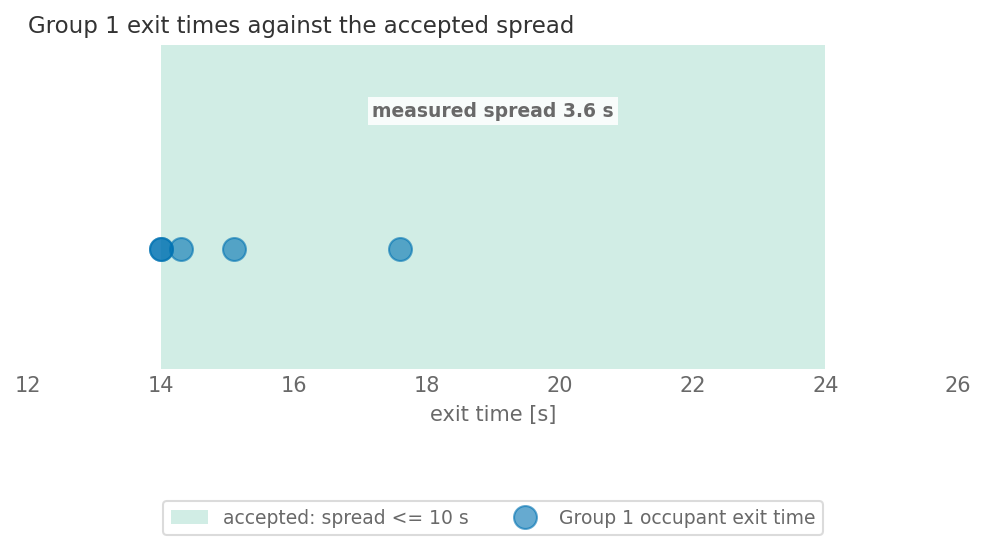
Result figure from the executed notebook.
5. Our implementation
Deviations from the standard:
- Group 1 is homogeneous: all five members walk at 1.25 m/s. ISO’s slow fifth member (0.5 m/s), which is the case that tests group cohesion, is not included. A pass shows that agents of equal speed arrive together and does not show group cohesion.
- Group 2 walks at 0.5 m/s instead of 0.2 m/s.
- The exit is 3 m wide instead of 1 m.
- The threshold of 10 s is ISO’s. Exit time is each agent’s last recorded frame (decision D3). Group 1 is the five agents that start highest in the room. One seed (42) is run.
Model: CollisionFreeSpeedModel
- Test function: tests/vv/test_iso.py::test_group1_arrives_together
- Scenario file: Iso-14-group-behaviour.zip