Test 11: Maximum flow rates at an opening/exit
PASS1. Definition
A room of 8 m by 5 m has a 1 m exit centred on the 5 m wall. One hundred occupants are placed in the room and assigned to the exit. The flow through the exit over the whole period is compared with a predefined maximum. ISO notes that the test is a verification if the model restricts door flow, and an external validation requirement if flow is emergent. The tester documents which of the two applies and, for emergent flow, defines the threshold from the model’s own assumptions. Grid models show the sensitivity to discretisation.
Source: ISO 20414:2020, Test 11, Table 12, pp. 21-22. This is a paraphrase, not the text of the standard.
Reference: ISO (2020). ISO 20414:2020, Fire safety engineering - Verification and validation protocol for building fire evacuation models. First edition. International Organization for Standardization, Geneva. https://www.iso.org/standard/78348.html (Page numbers are the printed page numbers of ISO 20414:2020 (the copy read is a proof, so numbers can differ by a page in the published edition). ISO states that its tests are examples and that a tester may use different tests that verify the same component equivalently.)
2. Scenario
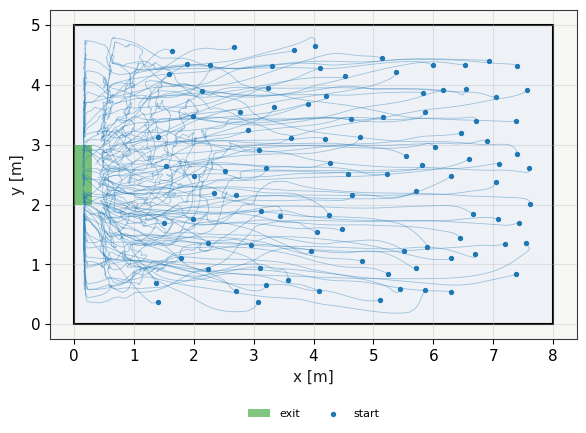
Scenario figure from the executed notebook.
3. What to expect
The flow at the exit does not exceed the predefined maximum. ISO gives 1.33 persons per metre per second (MSC/Circ.1238) as an example value.
Our criterion: Specific flow <= 1.33 p/m/s with the exit throughput limiter enabled (IMO)
Verified with the jupedsim-scenarios exit throughput limiter enabled at 1.33 p/s (maintainer decision D12, restricted-flow reading); measured 1.31 p/m/s on seed 42. Flow is (N-1)/(t_last-t_first) over agent removal times, tolerance 1% for trajectory sampling. The emergent flow with the limiter off (~5.2 p/m/s) is reported in the notebook, not asserted.
4. Our result
Status: PASS
Test cases of this row
| Case | Status | Result | Run |
|---|---|---|---|
test_ | PASS | specific_exit_flow_limiter_off = 5.238 p/m/s | n = 100 · seed 42 |
test_ | PASS | specific_exit_flow_limiter_on = 1.315 p/m/s accepted ≤ 1.3433 p/m/s | n = 100 · seed 42 |
test_: information only: emergent flow, not assertedemergent_ flow_ without_ limiter_ is_ reported test_: bound: measured <= 1.33 * (1 + 0.01); exit limiter on, 1 m exitflow_ within_ cap_ with_ limiter
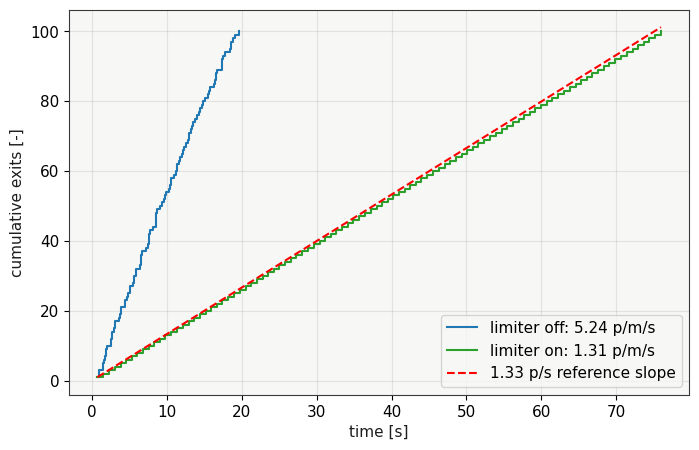
Result figure from the executed notebook.
5. Our implementation
Deviations from the standard:
- Decision D12: the test switches on the scenario harness’s exit throughput limiter at 1.33 persons per second and checks that the measured flow stays at or below the limit (restricted-flow reading). The limiter belongs to the scenario harness, not to the simulation model. The flow without the limiter is printed and not asserted.
- The pass rule is the suite’s own: (N - 1) / (t_last - t_first) over the agents’ last recorded frames, divided by the 1 m exit width, is at most 1.33 persons per metre per second plus a 1 % tolerance for trajectory sampling.
- Occupants walk at a constant 1.2 m/s. No grid sensitivity applies. One seed (42) is run.
Model: CollisionFreeSpeedModel
- Test function: tests/vv/test_iso.py::test_emergent_flow_without_limiter_is_reported
- Scenario file: Iso-11-max-flow.zip