Test 10: Congestion in front of a flight of stairs
PASS1. Definition
A room 8 m wide and 5 m deep opens through a 2 m wide corridor, 12 m long, to a flight of stairs going up (dimensions from Figure 7). One hundred and fifty occupants with no pre-evacuation time and speeds distributed as in the building population start in the room and walk to the stairs. The tester documents the population data.
Source: ISO 20414:2020, Test 10, Table 11, pp. 20-21, Fig. 7. This is a paraphrase, not the text of the standard.
Reference: ISO (2020). ISO 20414:2020, Fire safety engineering - Verification and validation protocol for building fire evacuation models. First edition. International Organization for Standardization, Geneva. https://www.iso.org/standard/78348.html (Page numbers are the printed page numbers of ISO 20414:2020 (the copy read is a proof, so numbers can differ by a page in the published edition). ISO states that its tests are examples and that a tester may use different tests that verify the same component equivalently.)
2. Scenario
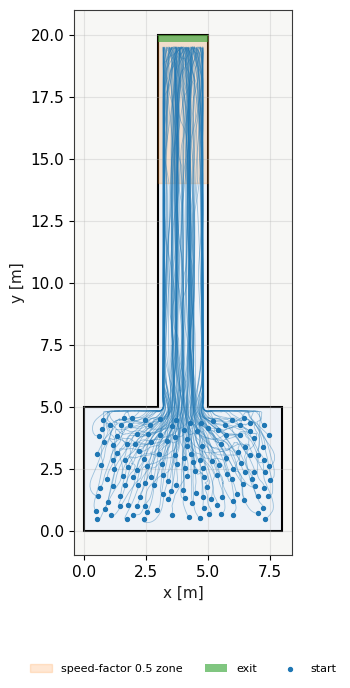
Scenario figure from the executed notebook.
3. What to expect
Congestion forms at the exit of the room, a steady flow follows in the corridor, and congestion forms at the base of the stairs because corridor and stair have different flow characteristics. ISO calls the evaluation qualitative.
Our criterion: Peak density at the room->neck entrance and stair base exceeds the mid-corridor
4. Our result
Status: PASS
Test cases of this row
| Case | Status | Result | Run |
|---|---|---|---|
test_ | PASS | peak_density_neck_stair_vs_corridor = 6, 5, 3.5 1/m^2 | n = 150 · seed 42 |
test_: comparison: measured[0] (neck) > measured[2] (mid-corridor) and measured[1] (stair base) > measured[2]congestion_ at_ neck_ and_ stair
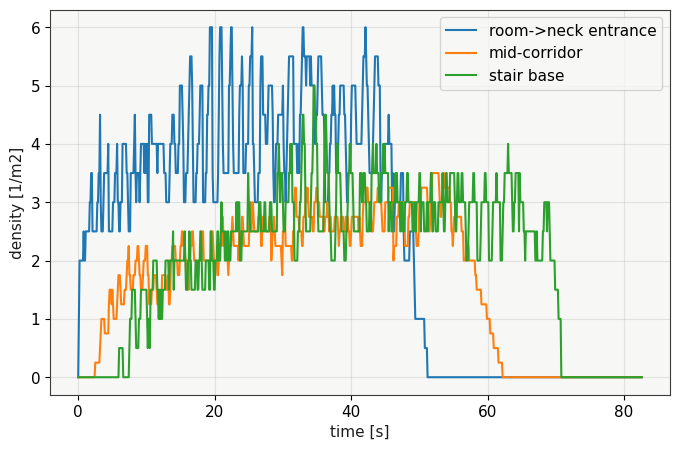
Result figure from the executed notebook.
5. Our implementation
Deviations from the standard:
- The stair is a flat zone with a speed factor of 0.5 that the test adds at y = 14 m to 20 m. The corridor is 15 m long in total, so the flat part is 9 m instead of 12 m. Congestion at the stair base is therefore driven by the input speed factor.
- The pass rule is the suite’s own: the peak density over the run in a 2 square metre window at the room exit and in one at the stair base must each exceed the peak density in a window in the middle of the corridor.
- Desired speeds follow a Gaussian with mean 1.2 m/s and standard deviation 0.2 m/s, the suite’s choice. One seed (42) is run.
Model: CollisionFreeSpeedModel
- Test function: tests/vv/test_iso.py::test_congestion_at_neck_and_stair
- Scenario file: Iso-10-congestion.zip