Update scheme
Time advances in fixed steps $\Delta t$, 0.5 s by default. Every step
runs the five stages below, implemented in simulation._Run. The update
is synchronous: all transfers of a step are decided from the state at
its start and applied together at its end, so they do not depend on the
order in which links or nodes are processed. Agents that reach the same
queue at the same time are served in the order of their populations
(see stage 3).
1. Density
The density of node $n$ at the start of the step adds up the area factor of every agent in the node, including agents still in pre-movement and agents queuing at a link:
$$ D_n = \frac{1}{A_n} \sum_{i \in n} a_i . $$2. Pre-movement
An agent starts walking once $t \ge t_i^\text{pre}$. Its first walking distance is $s_i + L_\ell$, where $\ell$ is the first link of its route.
3. Walking
A walking agent in node $n$ moves at
$$ v_i = \min\!\left(v_i^\text{max},\; k_n\,\bigl(1 - a\,\max(D_n, 0.54)\bigr)\right), $$with $v_i$ clipped at zero. Its remaining distance shrinks by $v_i\,\Delta t$. Once the remaining distance reaches zero, the agent joins the queue of its link, and may pass it in the same step.
The arrival time is interpolated within the step, and the queue is served in order of arrival. Agents with the same arrival time are served in the order in which they were created, that is, in the order of the populations. With two populations that differ only in area factor, the one listed first leaves first (Limitations).
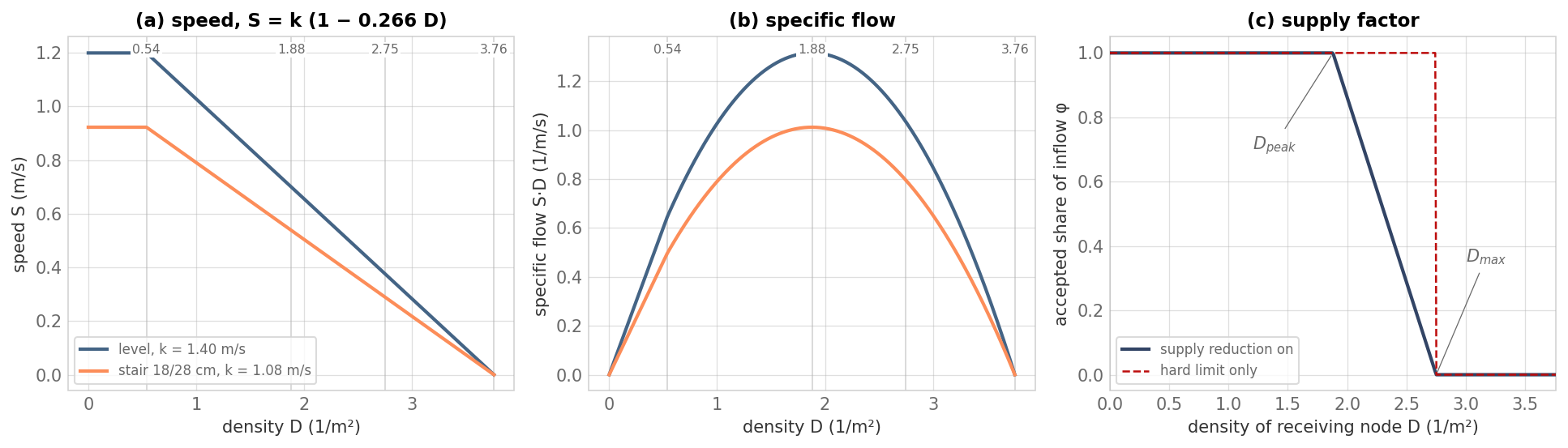
(a) SFPE speed–density relation for level ground and for an 18/28 cm
stair. (b) Specific flow, with its peak at 1.88 m⁻². Below 0.54 m⁻² the
curve is $S(0.54)\,D$, the speed cap of this model, not an SFPE curve.
The level peak is 1.32 persons/s/m, while the default door value is the
tabulated 1.3. (c) Share of its inflow capacity that a node accepts.
With supply reduction (solid line) the share falls linearly from the
peak-flow density to max_density. The dashed line is a hard capacity
limit.
4. Passing links
Link budget. Each link has a budget for the step, made up of a carry $c_\ell$ from earlier steps and its capacity for this step:
$$ \beta_\ell = c_\ell + C_\ell\,\Delta t . $$At most $\lfloor \beta_\ell \rfloor$ agents from the front of the queue ask to pass.
The two links $\ell$ and $\bar\ell$ of a two-way connection form a pair
and share one door. Under counterflow="bounding" (the default) and
"estimate" the pair has one carry $c_P$
and one budget $B_P$ for both directions; while both directions have a
queue, $B_P = c_P + g\,C\,\Delta t$ with $g \le 1$
(Counterflow).
What the target node accepts. A receiving node $n$ that is not safe accepts agents only up to two limits.
Free space is always enforced:
$$ F_n = D_\text{max}\,A_n - \sum_{i\in n} a_i , $$where $D_\text{max}$ is
max_density, 2.75 m⁻² by default.Supply. With
$$ \varphi_n = \operatorname{clip}\!\left( \frac{D_\text{max} - D_n}{D_\text{max} - D_\text{peak}},\, 0,\, 1 \right), \qquad \alpha_n = \gamma_n + \varphi_n \sum_{\ell \in Q_n} \tilde C_\ell\,\Delta t \quad (\varphi_n < 1). $$supply_reduction=True, a node whose density lies above the peak-flow density accepts only part of its inflow capacity:$\tilde C_\ell$ equals $C_\ell$, except for a link whose pair is in counterflow, which counts with its share of the door, $\tilde C_\ell = y_\ell\,g\,C_\ell$ (Counterflow).
Here $D_\text{peak} = 1/(2a) = 1.88$ m⁻². The sum runs over $Q_n$, the links into $n$ that have a queue in this step, the same links that compete in the merge below. Links nobody is waiting at, such as the unused direction of a two-way connection or a feeder whose room has emptied, do not count. If
max_density≤ $D_\text{peak}$, the supply limit is not applied and only the free space counts.The node carry $\gamma_n$ keeps what was allowed but not used, so that low inflow rates aren’t rounded away. It starts at $\gamma_n = 0$ and, after every step, whether or not an agent was ready to pass, becomes
$$ \gamma_n = \operatorname{clip}\!\Bigl(\alpha_n - \textstyle\sum_\text{admitted} a_i,\ 0,\ \max\bigl(\sum_{\ell\in Q_n} \tilde C_\ell\,\Delta t,\ 1,\ a^\ast_n\bigr)\Bigr). $$A node at or below $D_\text{peak}$ has $\alpha_n = \infty$, so after such a step its carry is full. Like the link carry, $\gamma_n$ refills at $\varphi_n \sum_{\ell\in Q_n} \tilde C_\ell\,\Delta t$ per step and holds at most one cap. A node that has just passed $D_\text{peak}$ can take one cap at once, then takes the share $\varphi_n$. The cap uses the same sum over links with a queue as $\alpha_n$. $a^\ast_n$ is the largest area factor among the agents still waiting at the head of a queue into $n$ after this step’s admissions, 0 if nobody waits. The cap lets a node save enough supply for an agent with a large area factor, so that agent waits but is not shut out.
Candidates pass one at a time while their summed area factors stay within $\min(F_n, \alpha_n)$.
The supply reduction is a modelling choice and has not been calibrated against experiments.
Merging. When several links compete for what a node accepts, the node serves them in the order of the key
$$ \kappa = \tau_\ell + \frac{r + 1}{m_\ell}, $$where $r$ is the candidate’s place in its own queue in this step. Equal keys are broken at random. The virtual time $\tau_\ell$ grows by $q_\ell / m_\ell$ when $q_\ell$ agents pass, and a link with an empty queue is moved up to the smallest $\tau$ of the active links into the same node. Over time each link’s share approaches $m_\ell / \sum m$. This interleaving rule is an implementation choice of this model. After the target has admitted its candidates, a pair in counterflow keeps only $\lfloor B_P \rfloor$ of them, in order of its own pair key; the merge key itself is unchanged.
Carry update
After $q_\ell$ agents have passed, the link keeps its unused budget, but never more than one agent:
$$ c_\ell = \min\bigl(\beta_\ell - q_\ell,\ 1\bigr). $$The carry starts at $c_\ell = 1$. A fresh link, or one idle for at least $1/C_\ell$, therefore lets the first agent through at once. After a passage, the next credit builds up at rate $C_\ell$. Unused capacity is never kept beyond one agent, whether the link was idle or blocked downstream. As a result, no link passes more than $1 + C_\ell\,t$ agents in any interval $t$.
Under "bounding" and "estimate" the two links of a pair hold one
carry, $c_P = \operatorname{clip}(B_P - q_\ell - q_{\bar\ell},\ 0,\ 1)$,
so a pair passes at most $1 + C\,t$ agents in any interval $t$, in
both directions together. Under "independent" each link keeps its own
carry.
When $N$ agents queue at a fresh link, the first passes at once and the last after $(N-1)/C_\ell$. This is the convention of this model. The SFPE hand calculation gives the passage time $t_p = N/C_\ell$ [1, Eq. 67.9, p. 2177], one headway $1/C_\ell$ longer. For 100 agents through a 1 m door at 1.33 persons/s/m, that is 106.3 s against 107.4 s (Verification).
5. Commit
Agents that passed a link move to its target node. There they walk the
length of their next link, or they are marked safe with exit time
$t + \Delta t$. An agent that has passed a link walks again only in the
next step, so every link on a route costs at least one step. A node
can use, in the same step, the space of agents who leave it, unless they
leave through a two-way connection that has counterflow in that step.
The result is the same as serving the nodes downstream first, so it
does not depend on the order in which nodes are processed. A node held at max_density stays full. If its
agents walk out on a link of length $L$ longer than the node, each of
them needs $\lceil L/(S\,\Delta t)\rceil$ whole steps to walk out, and
a coarse step is slightly slow
(Limitations).