Model
The network model estimates evacuation times from a coarse graph instead of a continuous geometry. Spaces such as rooms, corridors and stair flights are nodes with an area. Doors, openings and stair entries are links with a flow capacity. Individual agents move through this graph by relations adapted from the SFPE hydraulic model [1].
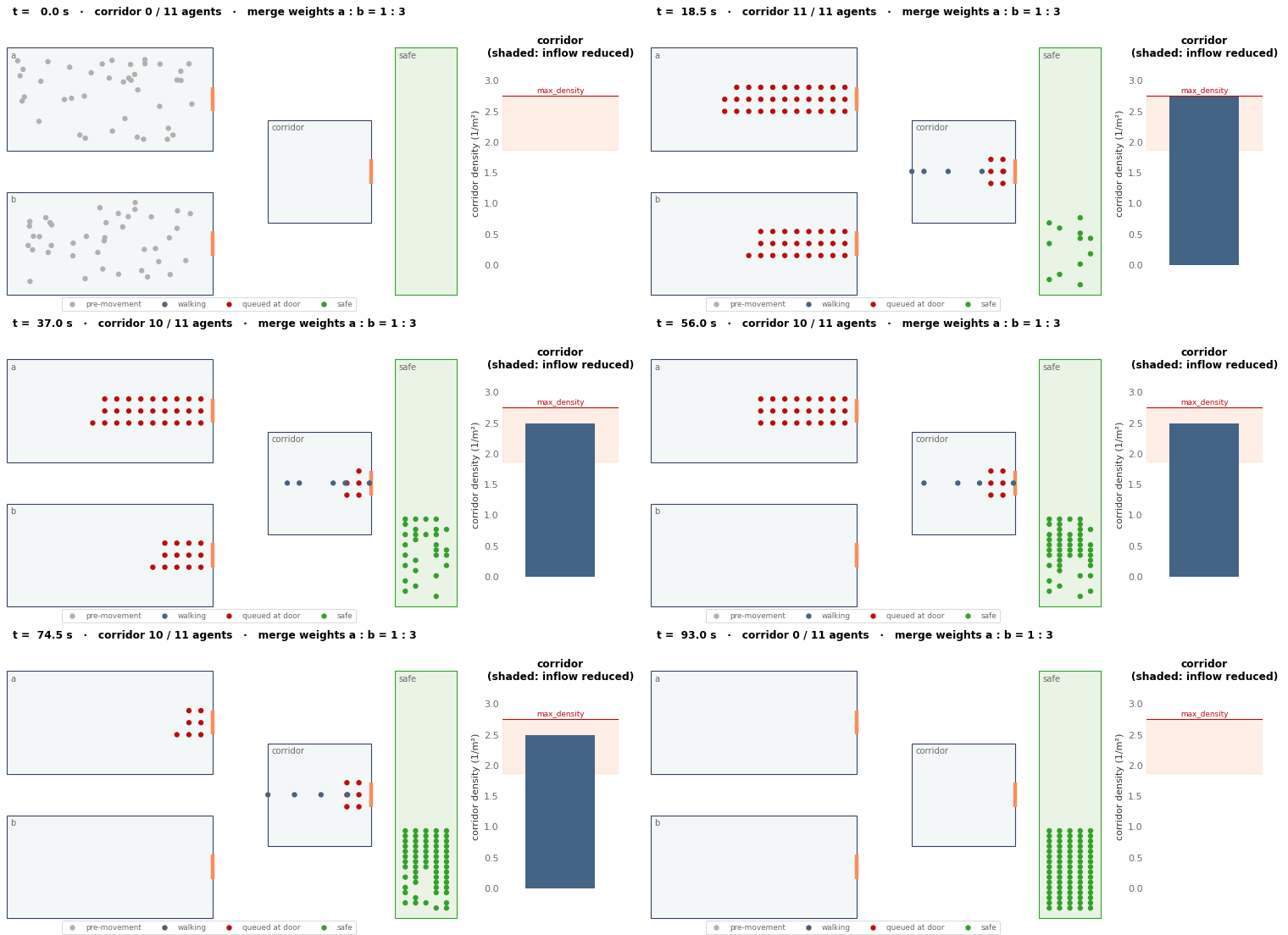
Two rooms of 40 agents each empty into a corridor of 4 m², which holds at most 11 agents. The corridor is close to its limit most of the time. Its inflow is then reduced and shared between the rooms by the merge weights 1 : 3. Positions inside a node are drawn for illustration only, since the model tracks a remaining walking distance per agent.
Where it sits
- Compared with a hand calculation, the model automates the second-order hydraulic calculation [1, pp. 2177–2178] and samples pre-movement times, occupant loads and walking speeds. A run of a ten-storey building with 600 agents takes about 0.1 s, so a scenario can be repeated hundreds of times.
- Compared with a microscopic model, it knows nothing about positions inside a node. We recommend checking geometry details and the critical cases found with the network model with the microscopic models of JuPedSim. SFPE also suggests using several models together [1, p. 2185].
The model follows the approach of EvacuatioNZ [2; 3]. It differs in several algorithms, most importantly the update scheme, full-node handling and the walking distance of queued agents (Comparison with EvacuatioNZ).
Network models
A building can be represented as a network of spaces and connections with flow capacities [14, p. 8]. This coarse network is an established method of egress modelling [16, §2.2, p. 745; 17, p. 70; 7, manuscript p. 3]. This model simulates individual agents forward in time along routes fixed before the run, so its results are estimates for those routes. It does not search for the fastest routing.
Network flow optimisation, network simulation and this model
Network flow optimisation (EVACNET). Nodes have static capacities, the maximum number of people in a location. Arcs have flow capacities in people per time period and travel times [14, p. 13]. A linear program over a time-expanded network finds the routing that minimises the evacuation time, with perfect knowledge of all time periods [14, pp. 3, 15, 93–94, 97]; the journal version of the model is [37, pp. 89–92]. In optimisation models such as EVACNET4, occupants therefore do not necessarily take their shortest route [17, p. 78]. The model counts people and does not identify individuals [14, p. 20]. Capacities and travel times do not depend on crowding [14, pp. 94–95]. The authors present the result as a benchmark of how fast the building can be evacuated if people follow the model’s pattern [14, p. 8].
Network simulation with a speed–density law (EXIT89). Individual occupants, all with the same properties, move forward in time from node to node. Their walking speed is set by the density of the node they cross [15, pp. 815, 818, 820–821], from the relations of Predtechenskii and Milinskii with emergency speeds by default [15, pp. 819–820]. Queues form only through the lower walking speed at high density [15, p. 822]. Occupants take the shortest route on each floor; when smoke blocks a node, the routes on that floor are recomputed [15, pp. 817–819, 822].
Merging packs (WAYOUT). The building is a tree of “twigs”, each a compartment of constant width with its exit door, that merges towards one final exit. Branching flows are not modelled: the user divides the building along “watersheds” and computes each part separately [19, pp. 625–626]. Routes are fixed by the tree. The authors argue that minimum-time routes have little to do with reality, because people choose routes by psychological factors such as the memory of their entry route and the marking of emergency exits [19, p. 626]. Speeds follow from the density relations of Predtechenskii and Milinskii [19, pp. 625–626], with the density $D = Nf/(wL)$ and $f = 0.113$ m² [19, p. 626]. Occupants move in compact packs. The speeds of movement within a twig and of entry into it follow from the population density, and there is no overtaking: “the newcomers join the queue” [19, p. 627].
This model. Each time step updates all individual agents at once,
with no optimisation. By analogy, max_density times the node area
(agents of area factor 1) plays the role of EVACNET’s node capacity,
and the link capacity $C_\ell = F_s\,(w_\ell - 2 b_\ell)$
(links) plays the role
of its arc flow capacity. In the example of EVACNET+, a later program
with Francis as co-author, node capacities follow from the usable area and
Fruin’s levels of service [20, pp. 216–217, Table 1], and
the dynamic capacity of an arc is its width restriction WR times the
average flow volume AFV, per time period. WR is usually the width of
the doorway between the two nodes; for arcs from stairwells to
landings or from hallway to hallway it is the minimal width of the
stairwell or hallway [20, pp. 217–218, Table 2]. Walking speeds
and, by default, the inflow into a node depend on the node density, as
the entry speed into a twig does in WAYOUT. The
movement relations are adapted from SFPE [1], while EXIT89 uses those of
Predtechenskii and Milinskii [15, p. 819]. As in WAYOUT,
where entry speeds into a twig at maximum density are corrected and
newcomers join the queue [19, p. 627], agents wait to enter
a full node. Routes are fixed
before the run: by default the shortest walking distance to the nearest
safe node or to a given target, or with
routing_policy="shortest_free_flow_time" the shortest free-flow
reference time. In the
code: the module docstring of jupedsim_network.simulation,
NetworkSimulation.run, Network.route_table and
hydraulic.SPEED_DENSITY_SLOPE.