The Station nightclub
A published network model of a real building, rebuilt here and run
against the results that its author reports for EvacuatioNZ. The
building is the Station nightclub, the case is NIST’s Scenario #1 (the
design-load evacuation, not the night of the fire), and the network
comes from Spearpoint’s study [8, Fig. 1(b), p. 167; Table 1, p. 160]. The
script is
examples/station.py;
read Getting started and the
office wing first.
scripts/figures/scenarios.py with the current version.
The dimensions are read from a figure of the paper
(Limits of this study).The building and Scenario #1
The nightclub has ten spaces and four exits: the front, platform, side and kitchen exit doors. At the design load of Table 1 it holds 420 people [8, Table 1, p. 160]. EvacuatioNZ v2.3 evacuates them in 493 s when every occupant takes the nearest exit [8, p. 166]. NIST’s Simulex and buildingEXODUS models give 188 s and 202 s when the occupants use the exits that NIST assigned [38, §6.6, Table 6-2], [8, Table 3, p. 162]. This page builds the network of Spearpoint’s study, runs the cases of that study and compares each result with its published value or with a hand calculation. The page names every difference.
The drawing is a schematic. Circles are spaces with their number of occupants, the empty circles are the exits, and every arrow is one link in the direction of egress.
The network
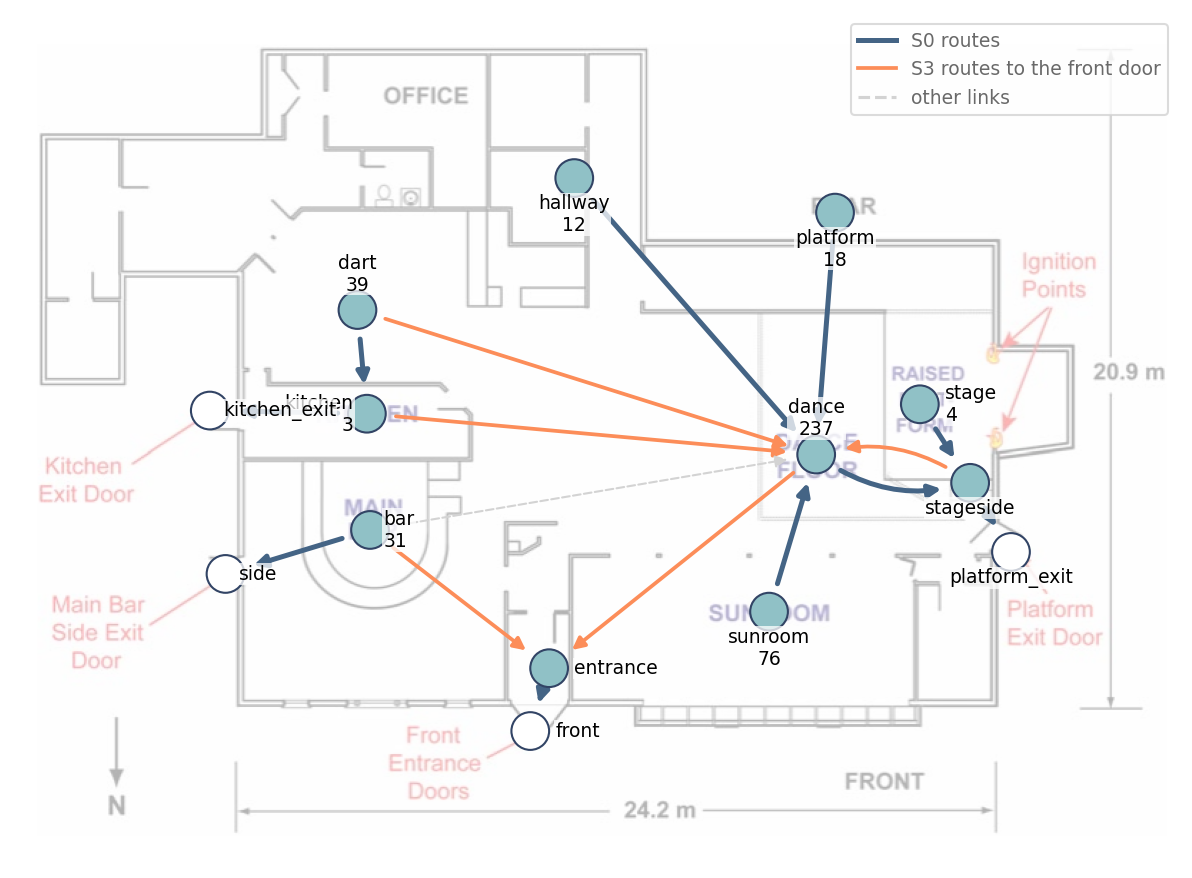
The network on the floor plan of The Station nightclub [38, p. xviii]. The positions of the doors, the kitchen, the main bar, the dance floor and the sunroom are read from the labelled plan. The dart room, the back hallway, the back platform, the stage, the stage side and the entrance are placed from the room sizes of Fig. 1(b) [8, p. 167] and are approximate. The numbers are the occupants of each node. Link lengths are not to scale.
Nodes
Every space is a room node with its length and width from the figure of the paper (Fig. 1(b), p. 167). The occupants are those of Spearpoint’s Table 1 [8, Table 1, p. 160]. NIST gives no list per room; its simulations place the same 420 people by density [39, pp. L-1–L-2, L-5] [38, §6.6, p. 6-25], and Spearpoint’s counts of each space are the only per-room listing. The area and the initial density are derived from these inputs.
| Node | Size (m) | Area (m²) | Occupants | Initial density (m⁻²) |
|---|---|---|---|---|
| dart | 7.2 × 5.4 | 38.9 | 39 | 1.00 |
| kitchen | 7.2 × 2.2 | 15.8 | 3 | 0.19 |
| bar | 8.5 × 7.6 | 64.6 | 31 | 0.48 |
| dance | 13.2 × 7.8 | 103.0 | 237 | 2.30 |
| entrance | 2.0 × 4.6 | 9.2 | 0 | 0.00 |
| sunroom | 10.9 × 4.6 | 50.1 | 76 | 1.52 |
| hallway | 4.8 × 8.2 | 39.4 | 12 | 0.30 |
| platform | 12.2 × 2.2 | 26.8 | 18 | 0.67 |
| stage | 5.2 × 3.6 | 18.7 | 4 | 0.21 |
| stageside | 2.4 × 3.6 | 8.6 | 0 | 0.00 |
The dance floor starts at 2.30 m⁻², above the 1.88 m⁻² where the supply
reduction begins and below the default max_density of 2.75 m⁻². The
model refuses a limit below 2.302 m⁻² for this start.
Both values come from the model, not from the paper: 1.88 m⁻² is
$1/(2a)$ with $a$ = 0.266 m², and 2.302 m⁻² is the max_density check of
NetworkSimulation
(Limitations).
Links
Every link is a one-way door (kind="door") in the direction that the
route tables use, with specific_flow=1.33. Widths and lengths are
inputs read from Fig. 1(b) [8, p. 167]. Spearpoint applies
the boundary layer of 0.15 m to all constrictions
[8, p. 169]; here it is applied to every link by reading that
statement, including the 9.2 m opening to the sunroom and the 2.5 m
opening of the dart room. Spearpoint’s lengths run from centre to centre
[8, p. 166]; this model walks the length inside the source
node.
| From → to | Width (m) | Length (m) | Capacity (persons/s) |
|---|---|---|---|
| dart → kitchen | 0.6 | 3.7 | 0.399 |
| dart → dance | 2.5 | 10.4 | 2.926 |
| kitchen → dance | 0.91 | 10.4 | 0.811 |
| kitchen → kitchen_exit | 0.91 | 3.6 | 0.811 |
| bar → side | 0.91 | 3.8 | 0.811 |
| bar → dance | 1.2 | 11.6 | 1.197 |
| bar → entrance | 0.91 | 5.2 | 0.811 |
| dance → entrance | 0.91 | 9.6 | 0.811 |
| sunroom → dance | 9.2 | 6.1 | 11.837 |
| entrance → front | 1.83 | 2.3 | 2.035 |
| hallway → dance | 1.6 | 8.0 | 1.729 |
| platform → dance | 1.4 | 10.0 | 1.463 |
| stage → stageside | 1.4 | 3.8 | 1.463 |
| dance → stageside | 2.4 | 8.9 | 2.793 |
| stageside → platform_exit | 0.91 | 1.8 | 0.811 |
The capacity is $C = F_s\,(w - 2b)$ with $F_s = 1.33$ persons/s/m and
$b = 0.15$ m on each side [8, p. 169]; the 0.30 m of
Spearpoint is both sides. The model computes the capacities in the table
(Link.capacity). A 0.91 m door passes 0.811 persons/s. The links into the exits are
dart → kitchen → kitchen_exit, bar → side, entrance → front and
stageside → platform_exit.
The tables and the builder in the script
The script starts with its imports:
import math

import numpy as np

from jupedsim_network import (
    Network,
    NetworkSimulation,
    Population,
    Uniform,
)
# Spaces: name -> (length, width) in m, read from Fig. 1(b) of Spearpoint.
ROOMS = {
"dart": (7.2, 5.4),
"kitchen": (7.2, 2.2),
"bar": (8.5, 7.6),
"dance": (13.2, 7.8),
"entrance": (2.0, 4.6),
"sunroom": (10.9, 4.6),
"hallway": (4.8, 8.2),
"platform": (12.2, 2.2),
"stage": (5.2, 3.6),
"stageside": (2.4, 3.6),
}
SAFE = ("front", "side", "kitchen_exit", "platform_exit")# Occupants of each space (Table 1 of Spearpoint), 420 in all.
OCCUPANTS = {
"dart": 39,
"kitchen": 3,
"bar": 31,
"dance": 237,
"sunroom": 76,
"hallway": 12,
"platform": 18,
"stage": 4,
}# Links in the direction of egress: (source, target, clear width in m,
# connection length in m walked inside the source). The widths are the
# door widths before the boundary layer is taken off.
LINKS = [
("dart", "kitchen", 0.6, 3.7),
("dart", "dance", 2.5, 10.4),
("kitchen", "dance", 0.91, 10.4),
("kitchen", "kitchen_exit", 0.91, 3.6),
("bar", "side", 0.91, 3.8),
("bar", "dance", 1.2, 11.6),
("bar", "entrance", 0.91, 5.2),
("dance", "entrance", 0.91, 9.6),
("sunroom", "dance", 9.2, 6.1),
("entrance", "front", 1.83, 2.3),
("hallway", "dance", 1.6, 8.0),
("platform", "dance", 1.4, 10.0),
("stage", "stageside", 1.4, 3.8),
("dance", "stageside", 2.4, 8.9),
("stageside", "platform_exit", 0.91, 1.8),
]
# The stage side is walked back to the dance floor only by the stage
# occupants who head for the front entrance.
STAGESIDE_LINK = ("stageside", "dance", 2.4, 8.9)# Exits assigned to the occupants of each space (Table 5 of Spearpoint).
TABLE_5 = {
"dart": {"front": 39},
"sunroom": {"front": 38, "platform_exit": 38},
"dance": {"front": 118, "platform_exit": 119},
"bar": {"front": 11, "side": 20},
"platform": {"front": 6, "platform_exit": 12},
"hallway": {"platform_exit": 12},
"stage": {"platform_exit": 4},
"kitchen": {"kitchen_exit": 3},
}
PREFERRED_SHARE = 0.6
SPEED = 1.2
SPECIFIC_FLOW = 1.33build_network turns the tables into a Network. Its arguments are
the ones that the cases below change: the boundary layer, the extra
link of the 60/40 case, the specific flow, and a factor on the length of
dance->entrance for the tie.
def build_network(
    boundary_layer=0.15,
    stageside_link=False,
    specific_flow=SPECIFIC_FLOW,
    dance_entrance_factor=1.0,
    parameters=None,
):
    """The nightclub; every link is a one-way door."""
    net = Network(parameters=parameters)
    for name, (length, width) in ROOMS.items():
        net.add_room(name, length=length, width=width)
    for name in SAFE:
        net.add_safe(name)
    links = LINKS + [STAGESIDE_LINK] * stageside_link
    for source, target, width, length in links:
        if (source, target) == ("dance", "entrance"):
            length *= dance_entrance_factor
        net.connect(
            source,
            target,
            kind="door",
            width=width,
            length=length,
            specific_flow=specific_flow,
            boundary_layer=boundary_layer,
            bidirectional=False,
        )
    return net
Routes
Each space leaves by the nearest exit. By hand: the dart room goes to the kitchen door (3.7 + 3.6 = 7.3 m against 21.1 m by the dance floor), the main bar to its side door (3.8 m against 7.5 m through the entrance), the kitchen to the kitchen door, and every other space to the platform door. From the dance floor the platform door is 8.9 + 1.8 = 10.7 m away and the front door 9.6 + 2.3 = 11.9 m [8, p. 168]. The split is 347 through the platform door, 31 through the side door, 42 through the kitchen door and none through the front door, the split that EvacuatioNZ v2.3 reports [8, p. 166]. The model’s route table gives the same (Run it).
Settings mapped from Spearpoint
Spearpoint’s settings are on pp. 164–166 [8, pp. 164–166], and his door flow of 1.33 persons/s/m is on p. 169.
| Spearpoint (EvacuatioNZ v2.3) | This model | Kind of decision |
|---|---|---|
| time step 1 s | dt=0.5, repeated at 0.1 and 1.0 | engineering choice |
| speed 1.2 m/s, $S = k(1 - 0.266\,D)$ | speed=1.2, level $k$ = 1.4 m/s, floor $D$ = 0.54 m⁻² | same relation |
| door flow 1.33 persons/s/m | specific_flow=1.33 on each link | engineering choice (below) |
| boundary layer 0.15 m on every constriction | kind="door", boundary_layer=0.15 everywhere | literature [8, p. 169] |
| “widened by 0.30 m, no boundary layer” | boundary_layer=0.0, widths unchanged | identity |
| node limit 2.75 m⁻², hard | max_density=2.75, supply reduction on (S0) and off (S0s) | model difference, reported |
| connection length between nodes; random start | length walked in the source; start distance 0 | engineering convention |
| exit by minimum distance, ties random | shortest distance, ties alternated | matters only at an exact tie |
| exits prescribed by room and preferred route (60 %) | target with fixed counts | approximation |
| sequential update, $N/C$ per door | synchronous steps, $(N - 1)/C$, exit at $t + \Delta t$ | model difference, up to 1/C per door |
| no counterflow | no two-way pair in the network | identity |
HydraulicParameters(door_specific_flow=1.33) is rejected, because
1.33 persons/s/m is above the maximum flow k/(4a) = 1.316 persons/s/m
that the model allows for a door. The flow is therefore set on each link,
which skips that check
(issue #83).
For buildingEXODUS, NIST sets a flow of 1.22 persons/s/m on two 0.5 m
nodes for every 36 in door, “in order to equate to the default of 1.33
occ/m/s” on 0.91 m, and no boundary layer; the main door is 2 m wide at
1.2 persons/s/m [39, p. L-1]. That is 1.22 persons/s per
door, which is 1.33 × 0.91 to within rounding. For Simulex, NIST gives
the widths and no flow [39, p. L-5].
Occupants and settings
Three assignments of the occupants to exits are used, selected by case.
"nearest" sends everyone to the nearest exit, the baseline.
"table5" sends each space to the exits that Spearpoint lists in his
Table 5 [8, p. 170]. "preferred" is the 60/40 case
[8, p. 171]: 60 % of each space, rounded to whole agents with
round, go to the front door, and the others take the nearest exit.
That gives 252 of the 420 to the front door, 60.0 %.
The 60/40 case sends some occupants of the stage to the front door, which they reach only by walking back to the dance floor. It therefore adds the link stageside → dance, in the one direction. The link lies on no shortest route, and no other case has it.
def exits(case, node):
    """(target, agents) of the occupants of ``node``; ``None`` is nearest."""
    count = OCCUPANTS[node]
    if case == "nearest":
        return [(None, count)]
    if case == "table5":
        return list(TABLE_5[node].items())
    front = round(PREFERRED_SHARE * count)
    return [("front", front), (None, count - front)]


def populations(case="nearest", random_start=False):
    """Everyone moves at t = 0. ``case`` is ``"nearest"``, ``"preferred"``
    (60 % of each space head for the front door) or ``"table5"``."""
    pops = []
    for node in OCCUPANTS:
        start = Uniform(0.0, math.hypot(*ROOMS[node])) if random_start else 0.0
        for target, count in exits(case, node):
            pops.append(
                Population(
                    node,
                    count,
                    speed=SPEED,
                    start_distance=start,
                    target=target,
                )
            )
    return pops
def simulation(
case="nearest",
random_start=False,
dt=0.5,
max_density=2.75,
supply_reduction=True,
routing_policy="shortest_distance",
**network_options,
):
"""The case on a network; ``network_options`` go to ``build_network``."""
network_options.setdefault("stageside_link", case == "preferred")
return NetworkSimulation(
build_network(**network_options),
populations(case, random_start),
dt=dt,
t_max=1800.0,
max_density=max_density,
supply_reduction=supply_reduction,
routing_policy=routing_policy,
)- Start. Everyone starts at once with no pre-movement time and walks at 1.2 m/s (Spearpoint’s first phase). The start distance is 0, so the walk to a door is the link length.
t_max=1800.0is far above every result below.max_density=2.75is the default and the limit of EvacuatioNZ [8, pp. 164–166].
Run it
Clone the repository, install the package from the clone and run the script from the repository root. It takes a few seconds.
git clone https://github.com/PedestrianDynamics/jupedsim-network.git
cd jupedsim-network
pip install .
python examples/station.py
The script runs these steps:
def main():
    net = build_network()
    report_network(net)
    print()

    report_run("S0", simulation().run(seed=1))
    report_run("S0s", simulation(supply_reduction=False).run(seed=1))
    report_run("S1", simulation(boundary_layer=0.0).run(seed=1))
    report_run("S3", simulation("preferred").run(seed=1))
    report_run("S3n", simulation("preferred", boundary_layer=0.0).run(seed=1))
    report_run("S2", simulation("table5", boundary_layer=0.0).run(seed=1))
    report_run("S2b", simulation("table5").run(seed=1))
    print()

    result = simulation().run(seed=1)
    door = "stageside->platform_exit"
    for number in (1, 5):
        print(
            f"passage {number} through the platform door: "
            f"{passage_time(result, door, number):.1f} s"
        )
    for dt in (0.1, 0.5, 1.0):
        print(f"dt {dt}: {simulation(dt=dt).run(seed=1).evacuation_time:.1f} s")


if __name__ == "__main__":
    main()
The report functions
They only read the network and the results.
def exit_links(result):
    """Names of the links into the four exits, in the order of ``SAFE``."""
    return [name for name in result.link_names if name.split("->")[1] in SAFE]


def exit_counts(result):
    """Agents through the platform, side, kitchen and front exits."""
    order = ("platform_exit", "side", "kitchen_exit", "front")
    flow = {
        name.split("->")[1]: result.link_flow[:, result.link_names.index(name)]
        for name in exit_links(result)
    }
    return [int(flow[exit].sum()) for exit in order]


def agents_inside(result, time):
    """Agents in the building at ``time``."""
    row = np.isclose(result.times, time)
    return int(result.node_occupancy[row].sum())


def passage_time(result, link, number=1):
    """Time of the ``number``-th passage through ``link``."""
    flow = result.link_flow[:, result.link_names.index(link)]
    passed = np.cumsum(flow)
    return float(result.times[np.argmax(passed >= number)])
def report_network(net):
for link in net.links:
print(f"{link.name:26s} {link.capacity:.3f} persons/s")
routes = net.route_table()
for name in OCCUPANTS:
link = net.links[routes[net.node(name).index]]
print(f"{name} leaves through {link.name}")
def report_run(label, result):
platform, side, kitchen, front = exit_counts(result)
print(
f"{label}: {result.evacuation_time:.1f} s; platform {platform}, "
f"side {side}, kitchen {kitchen}, front {front}; "
f"{agents_inside(result, 90.0)} inside at 90 s"
)The first part of the output is the capacity of every link and the exit of every space from the route table:
dart->kitchen              0.399 persons/s
dart->dance                2.926 persons/s
kitchen->dance             0.811 persons/s
kitchen->kitchen_exit      0.811 persons/s
bar->side                  0.811 persons/s
bar->dance                 1.197 persons/s
bar->entrance              0.811 persons/s
dance->entrance            0.811 persons/s
sunroom->dance             11.837 persons/s
entrance->front            2.035 persons/s
hallway->dance             1.729 persons/s
platform->dance            1.463 persons/s
stage->stageside           1.463 persons/s
dance->stageside           2.793 persons/s
stageside->platform_exit   0.811 persons/s
dart leaves through dart->kitchen
kitchen leaves through kitchen->kitchen_exit
bar leaves through bar->side
dance leaves through dance->stageside
sunroom leaves through sunroom->dance
hallway leaves through hallway->dance
platform leaves through platform->dance
stage leaves through stage->stageside
The second part is one line per case: the evacuation time, the agents through each exit and the agents still inside at 90 s.
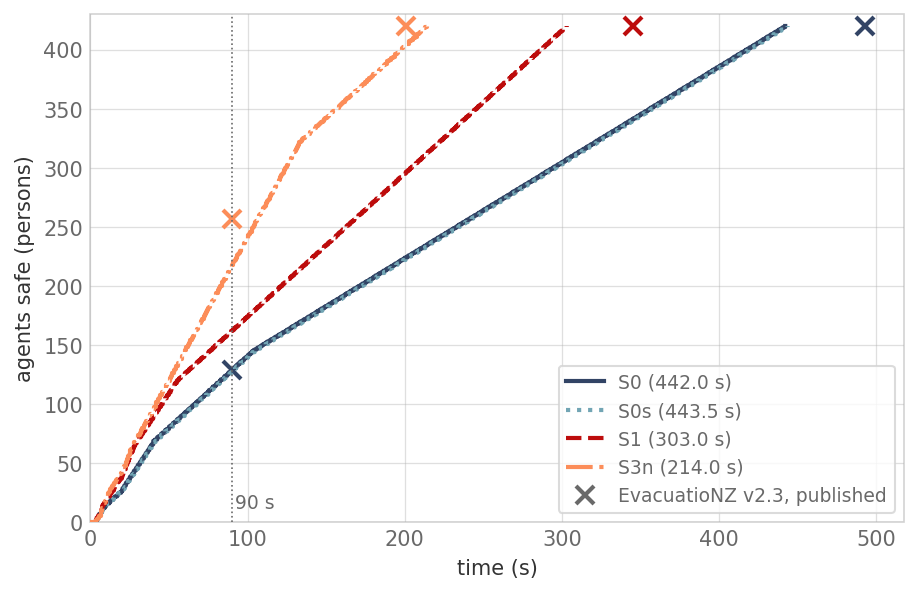
S0: 442.0 s; platform 347, side 31, kitchen 42, front 0; 291 inside at 90 s
S0s: 443.5 s; platform 347, side 31, kitchen 42, front 0; 292 inside at 90 s
S1: 303.0 s; platform 347, side 31, kitchen 42, front 0; 258 inside at 90 s
S3: 308.0 s; platform 139, side 12, kitchen 17, front 252; 257 inside at 90 s
S3n: 214.0 s; platform 139, side 12, kitchen 17, front 252; 202 inside at 90 s
S2: 187.5 s; platform 185, side 20, kitchen 3, front 212; 214 inside at 90 s
S2b: 269.0 s; platform 185, side 20, kitchen 3, front 212; 269 inside at 90 s
The last part is the time of the first and of the fifth passage through the platform door and the baseline at three time steps:
passage 1 through the platform door: 5.5 s
passage 5 through the platform door: 20.5 s
dt 0.1: 441.3 s
dt 0.5: 442.0 s
dt 1.0: 442.0 s
Baseline: S0
Case S0 sends everyone to the nearest exit, with the boundary layer and the
supply reduction on, at dt=0.5. The model evacuates the 420 people in
442.0 s: 347 through the platform door, 31 through the side door, 42
through the kitchen door and none through the front door. 291 are still
inside at 90 s.
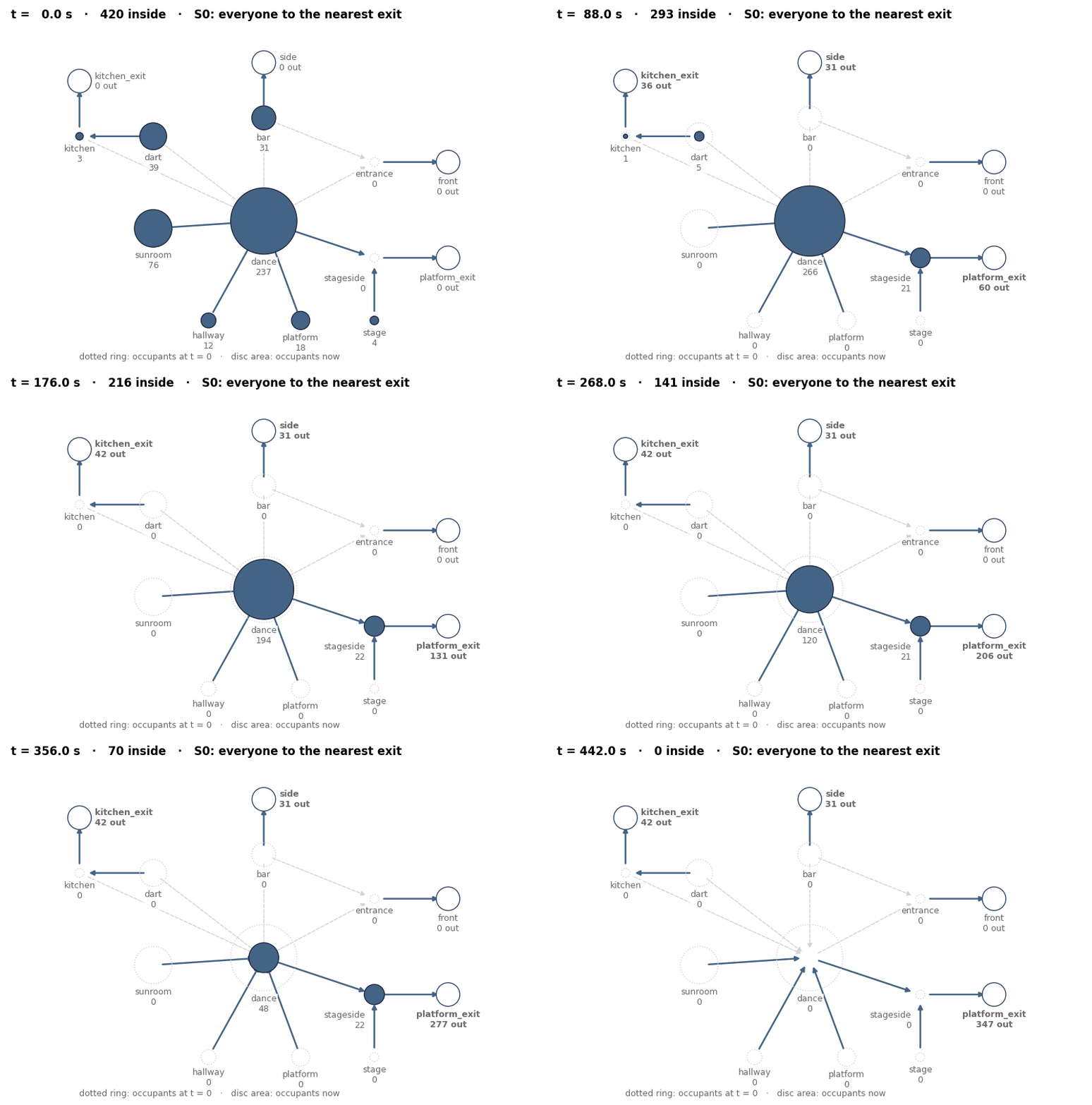
The animation replays the S0 run on the schematic plan: each disc shrinks with the occupants of its space, and each exit counts the people who have left through it.
How the result arises
The evacuation time is a door-flow calculation: in every case it is the first arrival at the controlling 0.91 m door plus (N − 1)/C. Here the controlling door is the platform door, with $C$ = 0.8113 persons/s.
- Other doors. The side door has passed its 31 agents after 40.0 s and the kitchen door its 42 after 102.5 s, limited by the 0.6 m door of the dart room (0.399 persons/s).
- First arrival. The four occupants of the stage pass the platform door first, from 5.5 s. The fifth passage is the first agent of the dance floor, at 20.5 s. By hand, the first agent walks 8.9 m at $S(D)$ for $D$ between 2.30 and 2.75 m⁻², then 1.8 m in the stage side: between 17.9 s and 25.2 s.
- Then the door is busy. The door passes at most $1 + C\,t$ agents in any interval $t$, and it does not idle. The other 342 agents take 342/0.8113 = 421.5 s, so $T = t_5 + 342/C$ = 20.5 + 421.5 = 442.0 s, the model’s value.
- Hand value of the paper. Spearpoint’s hand calculation is $N/C$ = 347/0.811 = 428 s [8, p. 169]. The model’s 442.0 s lies 14 s above it, less than the 20.5 s of the first arrival. This model reproduces the route split of EvacuatioNZ v2.3 exactly and Spearpoint’s hand calculation within the first arrival time.
- Inside at 90 s. By 90 s the platform door has passed the first four and then 0.811 persons/s from 20.5 s, the dart door 0.399 persons/s from 14.0 s (the kitchen door follows 3 s later, the walk of 3.6 m), and the side door all 31. That leaves 290.5 inside, to within 8 agents (one per door, and a spread of 4 s in the arrival). The model has 291 and EvacuatioNZ 291 [8, p. 166].
The gap to EvacuatioNZ
EvacuatioNZ v2.3 gives 493 s, 51 s more than the model (−10 % for the model). Spearpoint’s own hand value is 428 s [8, p. 169], so v2.3 lies 65 s above its hand value and this model 14 s. The difference to EvacuatioNZ v2.3 (493 s against 442 s) is a difference between the two models; its cause in v2.3 is not published.
The paper describes the hand value as lower than the EvacuatioNZ result “when the modeling also includes some additional travel time through the front entrance” [8, p. 169], although no agent uses the front door in this baseline. It does not name door start-up, the node limit or the time step as causes. The differences between the models that the settings table lists do not account for 51 s:
- Supply reduction changes the result by 1.5 s (S0s below).
- The time step moves it by at most 0.7 s (S0 at three steps below).
- The passage convention, $(N - 1)/C$ against $N/C$ and one step for the exit, is at most 1.2 s per door.
Variants of S0
| Variant | Change | Time (s) | Difference to S0 (s) |
|---|---|---|---|
| S0s | supply_reduction=False | 443.5 | +1.5 |
S0, dt=0.1 | time step 0.1 s | 441.3 | −0.7 |
S0, dt=1.0 | time step 1.0 s | 442.0 | 0.0 |
Supply reduction changes the result by 1.5 s here, because it acts only while the dance floor is above 1.88 m⁻² and delays the first arrival. The split is 347, 31, 42 and 0 at every time step.
S0r: random start distances. Spearpoint starts each agent at a random
distance from the door [8, p. 166]. S0r draws the start distance from
$U(0, R)$, with $R$ the diagonal of the start node, in 100 runs with
seeds from SeedSequence(1).spawn. The one-sided range is a choice of
this study: the limits $L \pm R$ of the paper, with $L$ the connection
length, have a negative lower end for all eight occupied nodes. All 100 runs give the split 347, 31, 42 and 0, and
times from 441.5 s to 442.5 s: a start spread of up to 15 m is absorbed
in the queue at the door. The paper lists the random start as a
sensitivity that it did not test [8, p. 178].
Without boundary layer: S1
S1 removes the boundary layer on every link (boundary_layer=0.0),
which is the same capacity as widening every constriction by 0.30 m
[8, p. 169]. A 0.91 m door then passes
$C$ = 1.33 × 0.91 = 1.210 persons/s. The model evacuates in 303.0 s with
the same split, and 258 inside at 90 s.
By hand, $t_5 + 342/C$ = 20.5 + 282.6 = 303.1 s. EvacuatioNZ v2.3 gives
345 s [8, p. 169] (the model is −12 % below). By the same
formula, 347/1.210 = 287 s (the model is +6 % above); this is arithmetic
of this study, because the paper gives no hand value for this case. The
difference is of the same kind as in S0: this model equals the hand bound
plus $t_5$; the paper does not explain the excess of EvacuatioNZ v2.3 over
its own hand value. S1s, without supply reduction,
takes 304.5 s, and S1 at dt=0.1 takes 302.4 s.
Prescribed exits: S2 and S2b
S2 sends each space to the exits of Spearpoint’s Table 5 [8, p. 170]: 212 to the front door, 185 to the platform door, 20 to the side door and 3 to the kitchen door. Spearpoint chose the assignment of the dance floor and the sunroom (half and half) and set the main bar and the back platform so that the totals match NIST’s, and says that the assignment “has required some judgment”. S2 has no boundary layer, S2b has the boundary layer of 0.15 m.
At the front door the controlling link is dance → entrance (0.91 m), which 201 agents of the dance floor, the sunroom, the dart room and the back platform pass; the 11 of the main bar use bar → entrance.
| Case | Time (s) | $t_5$ (s) | $t_5 + (201 - 5)/C$ + walk (s) | Published (s) |
|---|---|---|---|---|
| S2 | 187.5 | 23.5 | 187.4 | 195 [8, p. 170]; NIST 188 and 202; hand 177 [8, p. 169] |
| S2b | 269.0 | 25.0 | 268.5 | 272 ± 2 [8, p. 170]; hand 261 [8, p. 170] |
The walk is 2.3 m from the entrance to the front door at 1.2 m/s, 1.9 s. S2 is −4 % from the published 195 s and S2b −1 %, 1 s below the published mean minus one standard deviation (272 ± 2 s, mean and standard deviation [8, p. 170]). NIST’s 188 s and 202 s are from [38, §6.6, Table 6-2]. At 90 s NIST has 166 (Simulex) and 208 (buildingEXODUS) agents inside [8, Table 3, p. 162]; S2 has 214.
Preferred exit: S3
S3 is the 60/40 case of Spearpoint [8, p. 171] as an approximation: a fixed count per space, 60 % to the front door and the rest to the nearest exit. The paper does not state whether the boundary layer was on. The paper applies the boundary layer reduction to the incident scenario “so as to match Proulx”, the SFPE Handbook chapter [8, p. 174], and its conclusions credit “door flows without a boundary layer” [8, p. 179]. The boundary layer of the 60/40 case is therefore inferred to be off. The comparison is the run without boundary layer, S3n, and S3 has the boundary layer on.
The split is 252 through the front door, 139 through the platform door, 17 through the kitchen door and 12 through the side door: 60.0 %, 33.1 %, 4.0 % and 2.9 %. In 428 runs EvacuatioNZ reports 67 ± 3 % through the front door, 23 ± 3 % through the platform door, 6 ± 2 % through the kitchen door and 3 ± 2 % through the side door [8, p. 171]. A fixed split of 60 % per space cannot give a front-door share above 60 %, because for every occupied space the nearest exit is the platform, the side or the kitchen door. The preferred route of EvacuatioNZ therefore acts differently from a per-room split of the destinations. How v2.3 draws the preferred route is not described.
The controlling link is dance → entrance, which 233 agents pass.
| Case | Time (s) | Inside at 90 s | Published |
|---|---|---|---|
| S3 | 308.0 | 257 | – |
| S3n | 214.0 | 202 | 201 ± 8 s, about 163 inside at 90 s |
The published 201 ± 8 s is the mean and one standard deviation of 428 runs [8, p. 171]. S3n is +6 % above the published 201 s: 13 s above the mean and 5 s above the mean plus one standard deviation, so the results differ. S3n has 202 agents inside at 90 s where the paper has about 163.
Sensitivity
A tie in the connection length
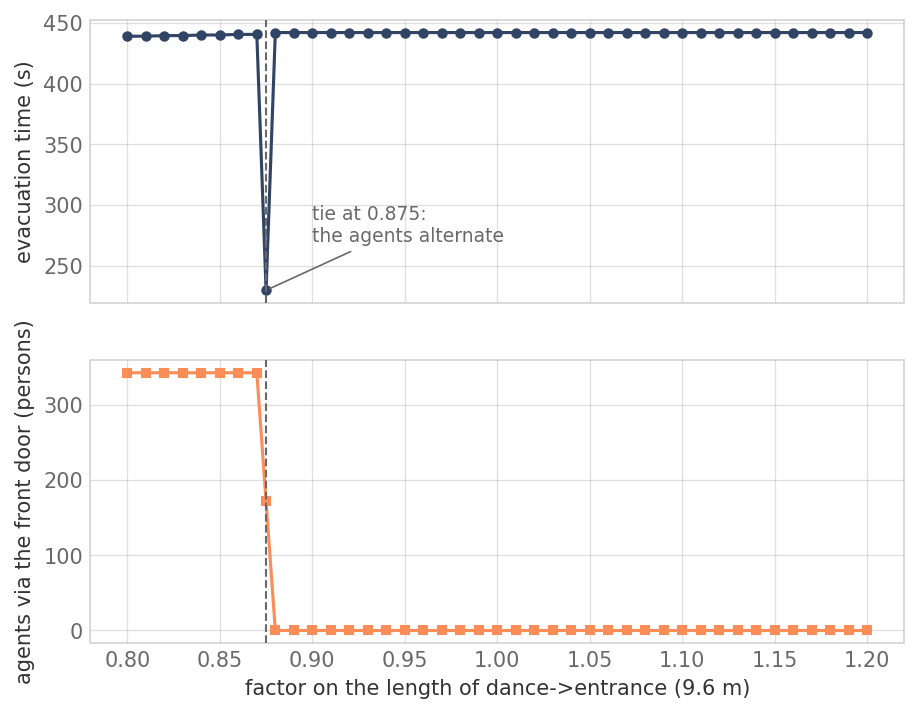
Static shortest-distance routing is discontinuous in one link length. The sweep scales the length of dance → entrance by a factor $f$, in 42 values: 0.80 to 1.20 in steps of 0.01 and the tie at 0.875. The dance floor takes the front door if $9.6 f + 2.3 < 8.9 + 1.8$, that is for $f < 0.875$, and the platform door above. Spearpoint notes that slightly different distances between nodes would give a shorter path to the front entrance and change the outcome significantly [8, p. 168]. In this study the flip is at 8.4 m, which is $0.875 \times 9.6$ m; the paper gives no such value.
- Below the tie. 343 agents leave through the front door (those of the dance floor, the sunroom, the back hallway and the back platform) and the time does not decrease as $f$ grows.
- Above the tie. None leaves through the front door, and the time is 442.0 s from $f$ = 0.88.
- At the tie. The flip is at the exact tie $f$ = 0.875. $0.875 \times 9.6 + 2.3 = 8.9 + 1.8$ exactly, so the agents alternate: 172 go to the front door and 175 to the platform door. Static shortest-distance routing is discontinuous in one link length; at the tie the alternation rule gives the shortest time of the sweep, 230.0 s.
The two routing policies, shortest distance and shortest free-flow time, give the same time in all 42 values, because there are no stairs.
Door flow and boundary layer
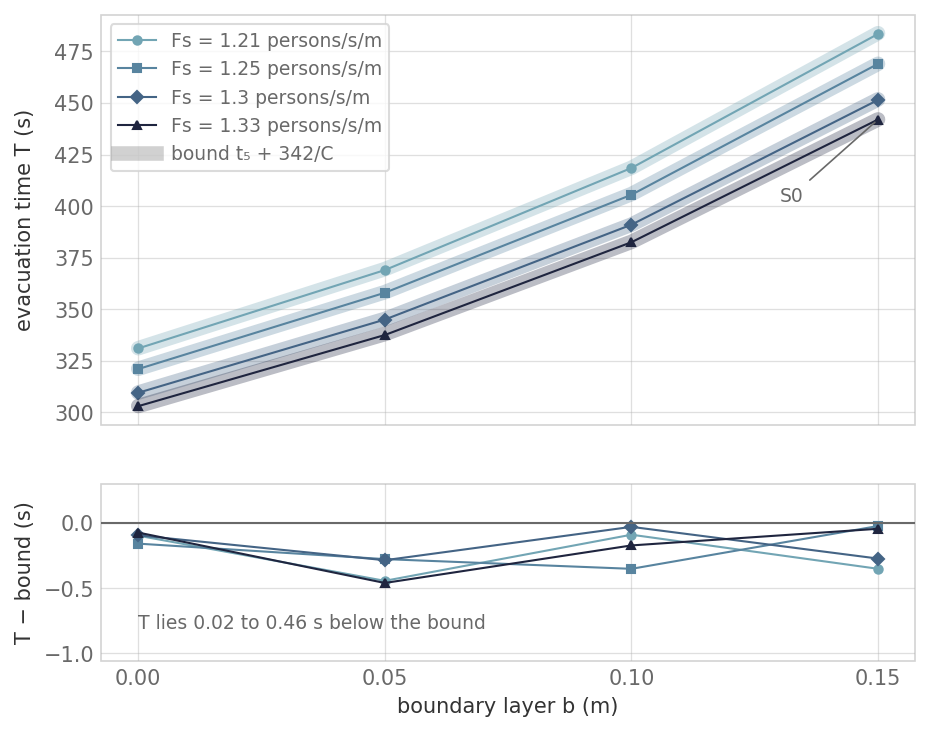
The platform door controls the time, so $T = t_5 + 342/C$ with $C = F_s\,(0.91 - 2b)$. The grid varies the specific flow of every link and the boundary layer (S4b); the entries are evacuation times in s.
| $F_s$ (persons/s/m) | $b$ = 0 | $b$ = 0.05 | $b$ = 0.10 | $b$ = 0.15 |
|---|---|---|---|---|
| 1.21 | 331.0 | 369.0 | 418.5 | 483.5 |
| 1.25 | 321.0 | 358.0 | 405.5 | 469.0 |
| 1.3 | 309.5 | 345.0 | 391.0 | 451.5 |
| 1.33 | 303.0 | 337.5 | 382.5 | 442.0 |
In all 16 cases $T$ lies between 0.46 s and 0.02 s below $t_5 + 342/C$, within one step. The base case, $F_s$ = 1.33 and $b$ = 0.15, is S0.
Node density limit
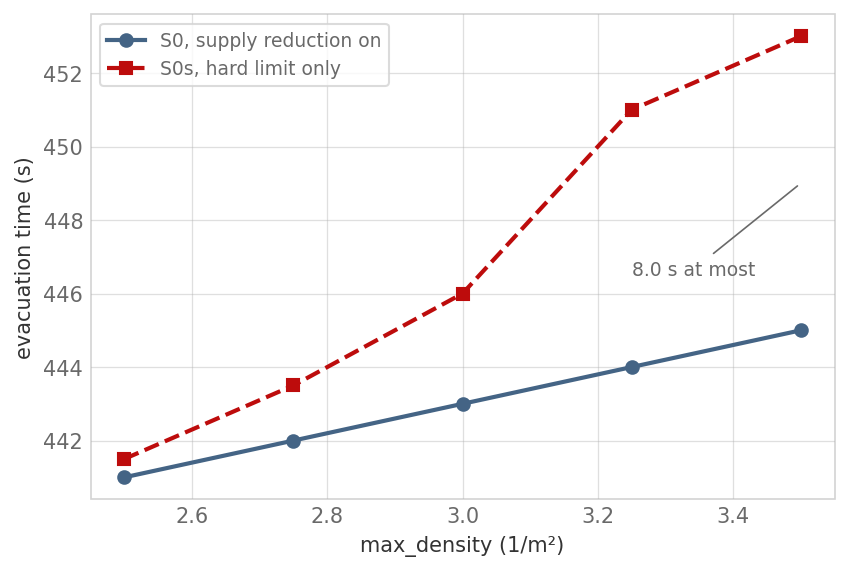
max_density from 2.5 to 3.5 m⁻²; smaller limits are rejected, because
the dance floor starts at 2.30 m⁻². The entries are evacuation times in s.
max_density (m⁻²) | supply reduction on | supply reduction off |
|---|---|---|
| 2.5 | 441.0 | 441.5 |
| 2.75 | 442.0 | 443.5 |
| 3.0 | 443.0 | 446.0 |
| 3.25 | 444.0 | 451.0 |
| 3.5 | 445.0 | 453.0 |
A higher limit lets the dance floor fill beyond 2.75 m⁻², and the walk to the platform door is slower: the fifth passage is later (19.5 s at 2.5 m⁻², 23.5 s at 3.5 m⁻² with supply reduction, 31.5 s without), and the door flow afterwards is the same. With the supply reduction on the time is never longer than without it, and the two differ by 8.0 s at most.
Comparison with the published values
Differences are reported in bands, a convention of this study: up to 5 % the result agrees, from 5 % to 15 % it differs and gives the reason where one is known, and above 15 % it differs. The tests do not assert the published values.
| Case | This model | Published | Difference | Band |
|---|---|---|---|---|
| S0 | 442.0 s | 493 s [8, p. 166] | −10 % | differs; the paper does not explain the excess of v2.3 over its own hand value |
| S0, inside at 90 s | 291 | 291 [8, p. 166] | 0 % | agrees |
| S1 | 303.0 s | 345 s [8, p. 169] | −12 % | differs; the paper does not explain the excess of v2.3 over its own hand value |
| S2 | 187.5 s | 195 s [8, p. 170] | −4 % | agrees |
| S2b | 269.0 s | 272 ± 2 s [8, p. 170] | −1 % | agrees |
| S3n | 214.0 s | 201 ± 8 s [8, p. 171] | +6 % | differs; boundary layer of the case inferred, and the fixed 60 % split cannot give the published 67 % front share |
| S3 | 308.0 s | 201 ± 8 s [8, p. 171] | +53 % | differs |
The split of S0 and the split of S2 are exact. The 67 % of the paper for the front door of S3 is not reproduced.
Limits of this study
- Model against model. This is model-to-model agreement on a published network. It is not validation against the incident, a drill or an experiment; Spearpoint states the same for EvacuatioNZ (p. 180).
- Dimensions. The sizes and widths are read from Fig. 1(b), a raster figure. A misread digit would move a capacity or the dance-floor density, and no test would notice. The length of dance → entrance is 12.5 % from the tie of the routes, so a misread there would flip the whole split.
- One building. One storey, level walking only, everyone moving at $t = 0$, flow controlled by doors. The result scales as 1/$C$ of one 0.91 m door. Nothing here tests stairs, merge weights, counterflow or pre-movement time.
- Supply reduction. The dance floor starts above 1.88 m⁻², inside the range of the supply ramp, which is not calibrated (Limitations). S0s shows that its effect is 1.5 s here.
- Specific flow. The flow is set on each link, which skips the check against k/(4a) (issue #83).
- Link lengths. The length is walked in the source node at the density of that node. Splitting each length between the source and the target would give the same routes and slightly different speeds.
- One-way links. Every connection is used in one direction, so the counterflow and reverse-link supply limitations stay out of the comparison. Spearpoint does not state whether EvacuatioNZ allowed reverse movement.
- Exit assignment. Table 5 is a matter of judgement of the author, and the 60/40 case is a fixed split, not a draw per agent. The boundary layer of the 60/40 case is inferred [8, pp. 174, 179].
- Static exit choice. The 40 % take the nearest exit, as in the paper [8, p. 171], and no agent re-chooses.
- Agreement not claimed. Agreement with the published 60/40 result is not claimed, nor correctness of the exit choice, nor generalisation.
Conclusion
- Routes and occupancy agree. The network reproduces the exit split of EvacuatioNZ in S0 and S2, and the 291 people still inside at 90 s. The S0 time of 442.0 s is a door-flow bound, 14 s above Spearpoint’s hand value of 428 s.
- EvacuatioNZ v2.3 is slower. It gives 493 s for S0 and 345 s for S1, against 442.0 s and 303.0 s here. The settings checked on this page move the result by 1.5 s at most, so the gap is between the two models. Its cause is not published.
- The preferred-route case is not reproduced. A fixed 60 % split per space cannot give the 67 % front-door share of the paper, and the paper does not describe how EvacuatioNZ draws its preferred route.
- The result depends on the geometry. The front-door share of S0 flips at a 12.5 % change in one link length, and at a fixed flow the boundary layer alone moves the time from 303 s to 442 s. A misread dimension from Fig. 1(b) would change the answer, and no test would catch it.
This is model-to-model agreement on one published network. The study does not validate the model against the incident, a drill or an experiment.
Next steps
- Scenario #2*. Spearpoint lets 5.5 % of the 397 agents of the front door and platform group opt for the platform door, 22 agents [8, p. 172], and reports 326 ± 4 s over 81 runs [8, p. 172]. The paper does not state which spaces supply them, so the case is not built. NIST’s own rule moves the 39 occupants who would have left by the platform door within 30 s [39, p. L-5] [38, p. 6-25].
- The incident. The scenario of the night of the fire has other occupants and a different exit use; it is a separate study.
- Kitchen door. NIST closes the kitchen door to occupants who are not in the kitchen: in buildingEXODUS after 5 s [39, p. L-1], in Simulex only the kitchen starters use it [39, p. L-5]. Spearpoint sends 42. A variant without the link dart → kitchen would isolate that difference; the dart room would then walk 21.1 m to the platform door.
- Per-agent exit choice. A random exit per agent would be a feature request; the model has none.