Documentation
jupedsim_network estimates how long the occupants of a building need to
reach safety. Rooms, corridors and stair flights are nodes with an area.
Doors, openings and stair entries are links with a flow capacity. Agents
move through this graph by relations adapted from the SFPE hydraulic
model. A run of a ten-storey building with 600 agents takes about 0.1 s,
so a scenario can be sampled hundreds of times.
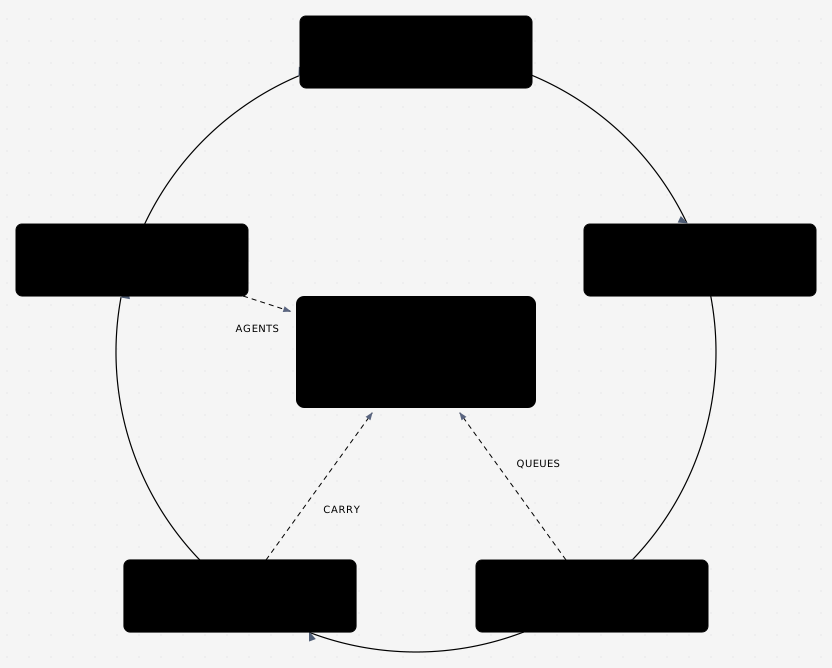
Each time step of length $\Delta t$ runs these five stages in order and then repeats. Passing links is where capacity, carry, counterflow and the supply limit of a full node act (Update scheme).
New here. Install the package, run a first scenario, then work
through a complete example. Without Python, run jupedsim-network init
and then jupedsim-network run scenario.json
(Command line), or edit
and run the file in forms in the
Terminal UI.
Building your own scenario. Describe the building, the occupants and the run, and read the results:
Checking the model. How it works, how it is tested, and where it stops:
The evacuation_time of a run is the pre-movement time plus the
movement time of the simulated occupants. Detection and alarm times are
not modelled unless they are added to the pre-movement time, so the
output is an RSET only under that condition.