IBIT Conference 2026
Overview and Topics
The 11th IBIT Conference on Crowdmanagement & Event Safety Management brought together professionals from diverse fields, including representatives from authorities, event organizers, operators, safety planners, security services, and researchers. This year’s conference featured six distinct sessions addressing various aspects of contemporary challenges in event safety:
- Back to Basics: Introduction to Modern Safety Planning 2026
- Hostile Vehicle Mititgation as a Guarantee for Safe Events?
- Best Practice: Transferable Insights and Pragmatic Approaches
- Where do the Rules come from? Regulations, Standards, and Guidelines
- Operational Aspects and Procedures
- Legal Aspects
Unlike previous years, the conference did not include a dedicated research session. However, research topics were integrated into several sessions, highlighting the importance of scientific input for practical applications in event safety—and vice versa.
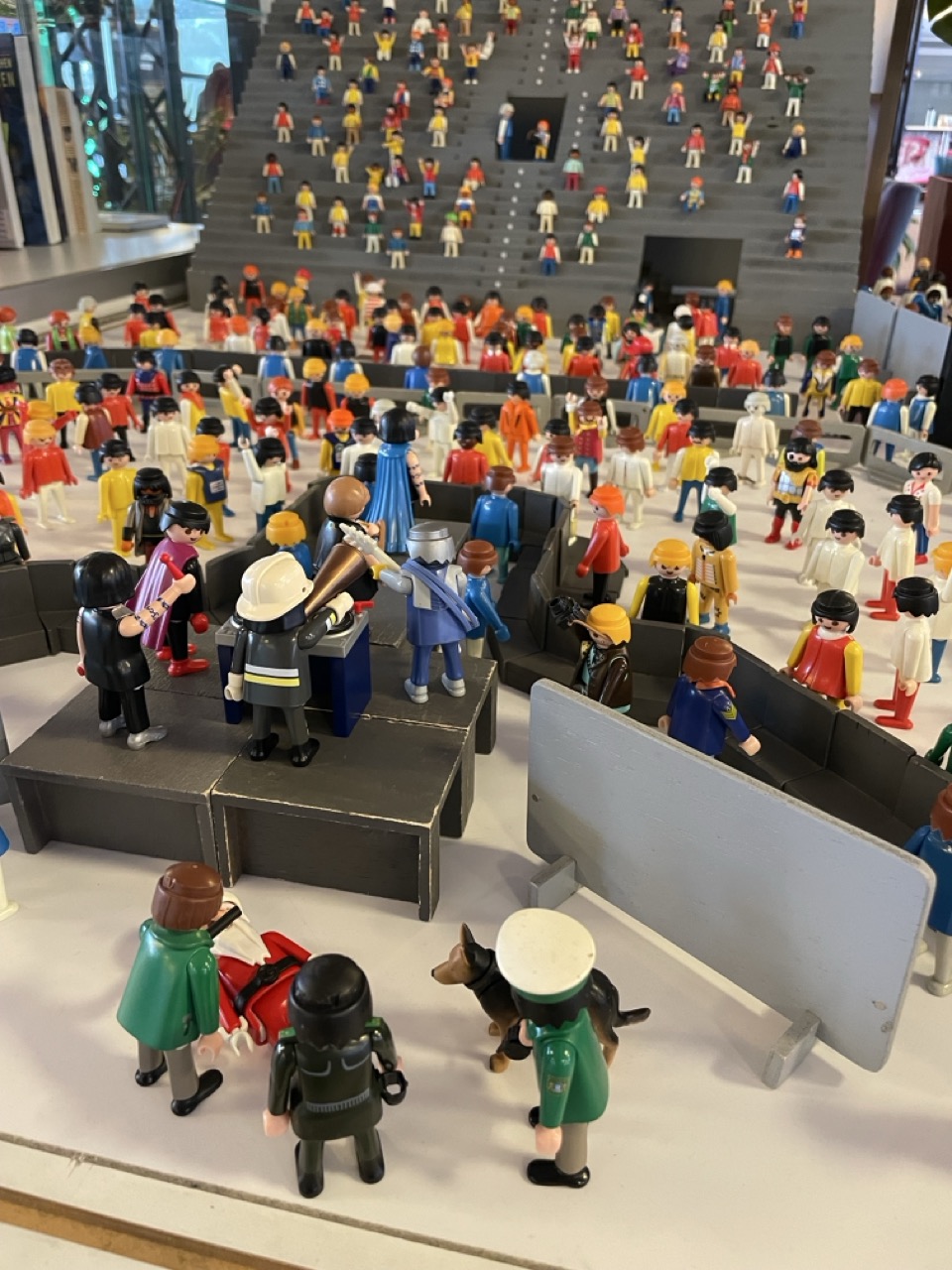
Concert crowd model in the exhibition area
Contributions from the Pedestrian Dynamics Community
Speaker: Anna Sieben, Jette Degenhardt and Mohcine Chraibi
Transfer Workshop
The workshop “Pedestrian Dynamics: From Laboratory to Practice – From Practice to Laboratory,” presented by Anna Sieben and Jette Degenhardt, addressed the challenge of knowledge transfer between research and practice.
In research, knowledge is generated that does not always reach practical implementation. Scientific findings are relevant for all stakeholders, as they continuously influence guidelines and standards. Practitioners, on the other hand, possess extensive knowledge about crowds, often communicated differently than scientific insights and therefore not systematically incorporated into research. There is a lack of mechanisms to actively shape research based on practical input (and vice versa).
Anna and Jette provided an overview of current research questions and facilitated a discussion. The discussion revealed that practitioners desire more insights on the following topics:
- Influence of lighting conditions and different floor surfaces on crowds
- Research on perception of signs and wayfinding systems
- Behavior under stress conditions and in extreme situations (perceptible dangers such as loud noises or fires)
- Analysis of decision-making processes in dynamic crowd situations
- Further development of VR tools for crowd simulation and training purposes
JuPedSim News: From Research to Practical Application
Mohcine Chraibi presented “From Research for Practice: A Simulation Tool for Pedestrian Flow Analysis,” introducing the JuPedSim Web App. The open-source software, previously used primarily within the scientific community, is now accessible through this online platform.
The tool enables the configuration and simulation of pedestrian flow scenarios based on validated models. While currently focused on basic scenarios, the long-term vision includes application to more complex situations. The JuPedSim team aims to enhance the tool’s practical applicability and seeks user feedback to further improve its functionality for broader use.
By: Jette Degenhardt