Pedestrian Dynamics
Basic questions and applications
Pedestrian dynamics studies how people move in crowds. Crowd flow shows emergent behavior on many length and time scales, and physics provides useful tools to describe and model it. The composition of the crowd matters as well: who is walking, with whom, and for what purpose all influence how a crowd moves.

Image design: Panar Ege Uesten.
The field matters to scientists and practitioners alike because it addresses three concerns of everyday life: efficient transport systems, safety, and comfort.
Transportation Improvement
Train stations and airports work well when people can move through them easily. As cities grow, understanding how pedestrians behave in such facilities becomes essential for designing transportation systems that function. Quantities such as the flow through a bottleneck or the number of people a facility can evacuate per hour help planners reduce congestion and support sustainable urban mobility. A basic tool here is the fundamental diagram, which relates density, speed, and flow. A good reference on this topic is 75 Years of the Fundamental Diagram for Traffic Flow Theory: Greenshields Symposium, covering the history, developments, and practical applications of traffic flow theory.
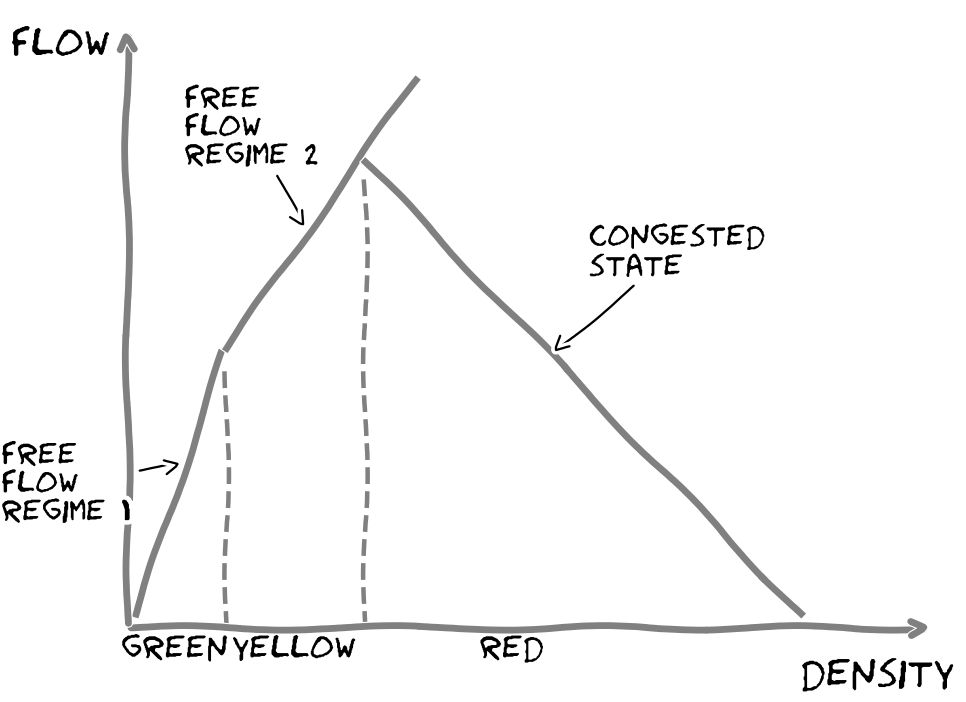
The fundamental diagram describes the relationship of flow and density and helps to understand the formation of congestions.
Further reading on the fundamental diagram is found in this dissertation: Pedestrian fundamental diagrams: Comparative analysis of experiments in different geometries
Pedestrian dynamics also applies to large events. The arrival and departure of thousands of visitors happens in stages, each with its own behavior, such as waiting in queues. Knowing how pedestrians queue, and how long queues take to clear, helps organizers keep crowds moving.
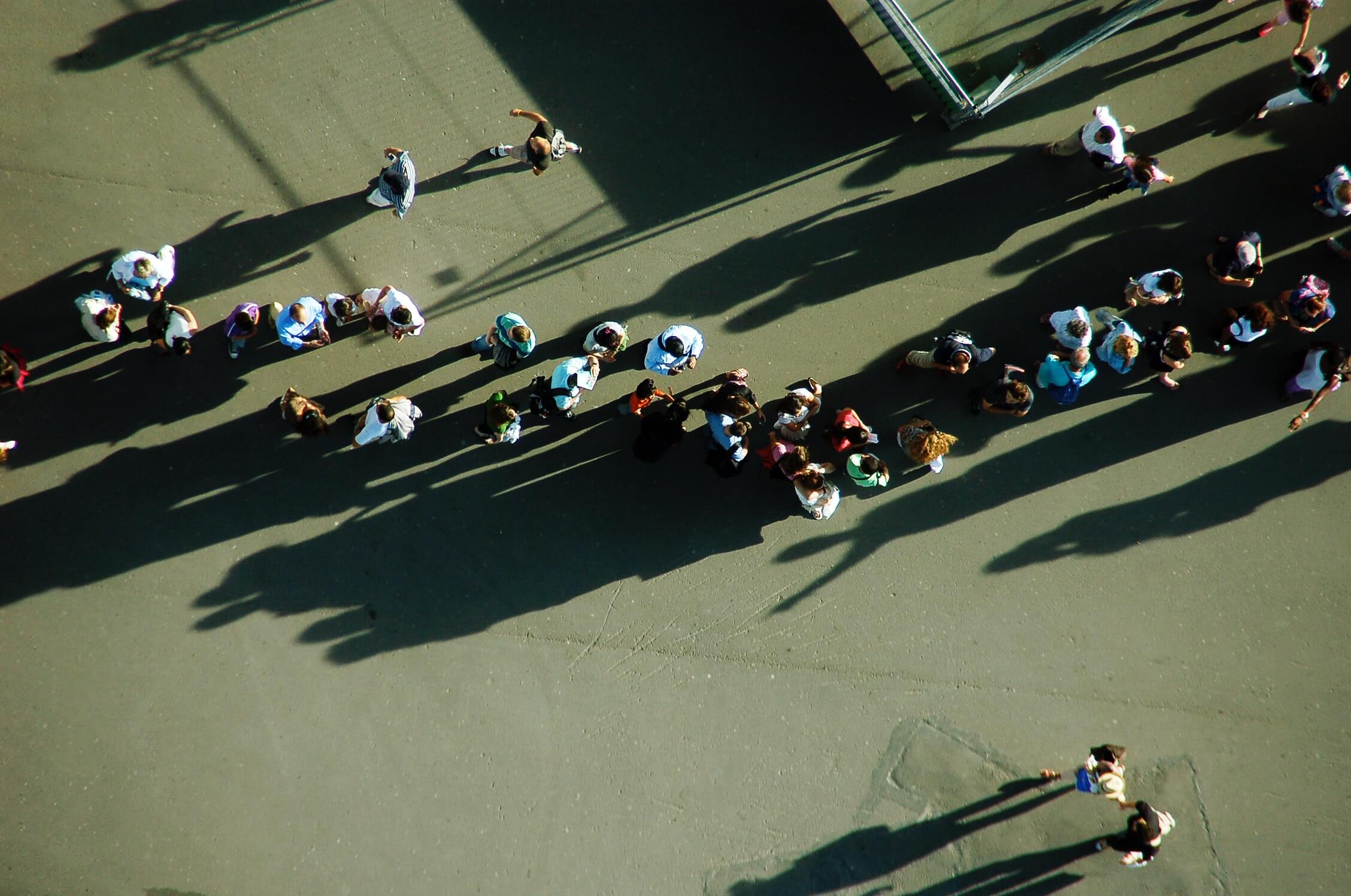
Photo by Hal Gatewood on Unsplash
Safety and Comfort
Analyzing pedestrian movement helps identify bottlenecks, hazardous areas, and workable evacuation strategies, so that crowds stay safe in emergencies. The same analysis improves comfort: public spaces with smooth pedestrian flow are more pleasant to use.
How safe people feel in a crowd is a research topic of its own. Perceived safety is subjective, so researchers develop tools and methods to measure it as objectively as possible and to capture how crowd members actually experience a situation.
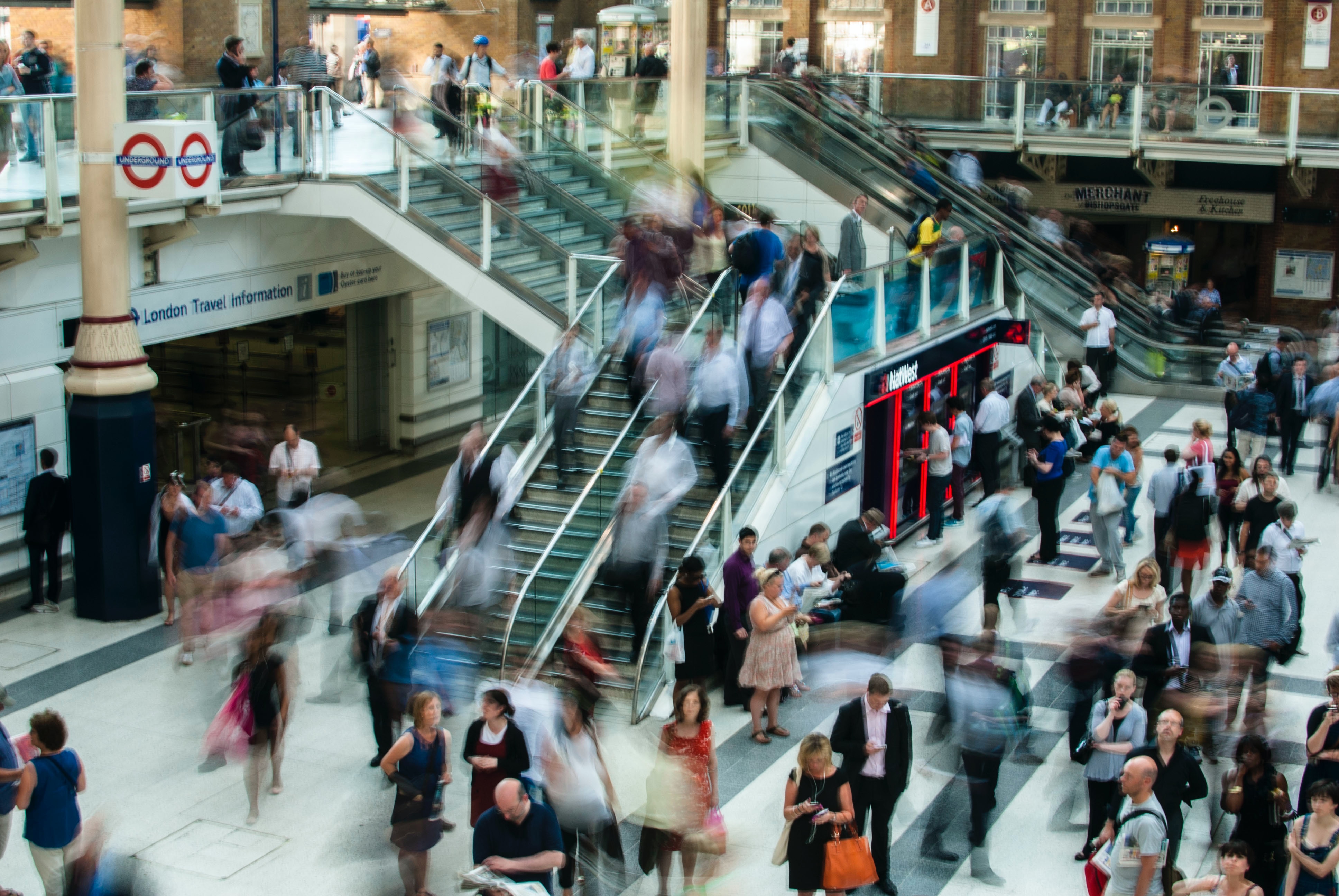
Photo by Anna Dziubinska on Unsplash
Collective phenomena
Collective phenomena emerge when many individuals interact. A central question in pedestrian dynamics is how individuals form a crowd. Answering it involves social interactions, behavior, emotions, and culture, and the answer differs between social groups.
Typical collective phenomena in pedestrian crowds include:
- Lane Formation: In bidirectional streams, pedestrians spontaneously form lanes, which reduces friction between the opposing directions.
- Clogging at Bottlenecks: Near a narrow passage, several people (or particles) can form an arch that jams the opening and reduces, or even stops, the flow.

Clogging in a bottleneck
- Stop-and-Go Waves: In congested crowds, as in vehicle traffic, people alternate between moving and standing, and these fluctuations travel through the crowd as waves.
Understanding these phenomena is the basis for crowd management, whether at a football match, a music festival, or a train station.
For further reading see this review on collective behavior modeling and simulation: building a link between cognitive psychology and physical action.
Interactions and relationships: From individuals to groups, from communities to cities
The key to understanding the different forms of collective organization lies in the type and the nature of interactions between individuals and groups of individuals. One factor is the distance: The closer we are to each other, the more senses are used to ‘feel’ the presence of others. When bodies are touching, we can feel the heat and, in some cases, even other people’s heartbeats.
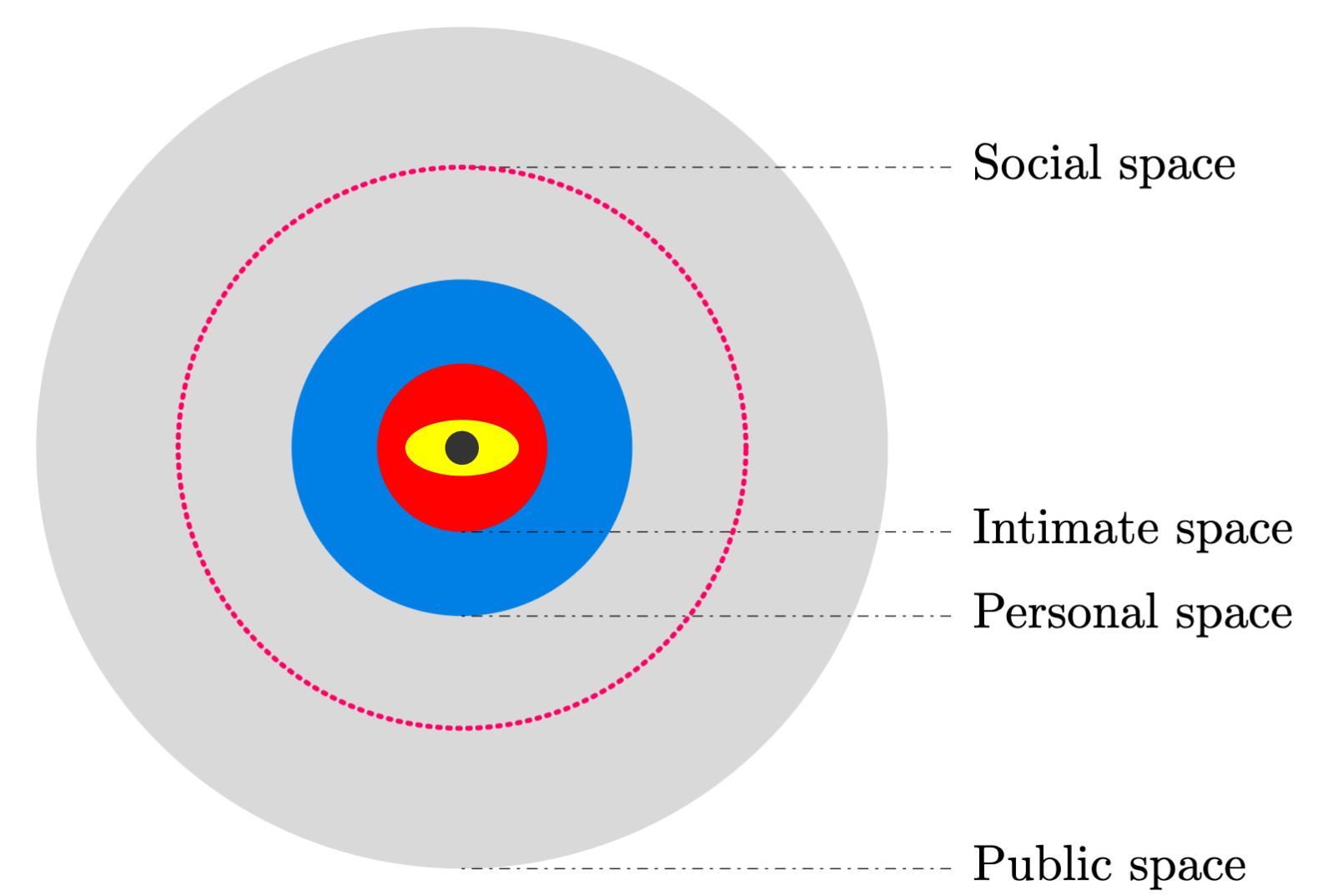
Edward T. Hall’s interpersonal distances of man (The Hidden Dimension)
This creates a sensation that may be unpleasant in a crowded train but can help lead to the emergence of helpful behavior in case of dangerous situations. When walking in a crowded space, sight plays an important role. However, what we see and how we process visual clues largely depends on the distance. From a close distance, we can read someone’s facial expression and understand, for example, where someone is looking. This information, in addition to shoulder orientation and other minor cues, can help us understand where someone is heading and whether that person is looking at us. From a greater distance, it becomes challenging to discern the intentions of other people. However, if we can see them, we can choose to either join a crowded place or avoid it, so the mere presence of people will also influence our decisions. For instance, people sitting along a river and seeking privacy or intimacy will often avoid others, typically choosing a spot equidistant from other groups of people. On the other hand, in an unfamiliar place where we are aware that specific customs are followed, we may choose to line up by following others, as is the case in places like a city hall, for example.
The article discusses pedestrian dynamics in gatherings, emphasizing that pedestrians not only respond to stimuli but also act based on social norms and identities. It proposes integrating social psychology with natural sciences, suggesting three categories for study: phenomena, behavior, and action.
Many aspects of interactions and relationships within a crowd follow exponential laws. Distance thresholds defined to characterize different degrees of personal space usually grow larger and larger the less familiar we are with someone. A distance of a few centimeters can create a different feeling in a packed train, but it takes a change of several meters to feel distant from a person already dozens of meters apart. Similarly, collision avoidance is also subject to exponential laws. Steering maneuvers are performed much more quickly when people are approaching very quickly, and minimum corrections are made for distant individuals. See for instance the direction model in the collision free speed model. Even more interesting is that higher-level aggregations also follow similar laws. In a given country, only a few cities exceed a population of one or several million, while hundreds of cities may have several dozens of thousands of people. A large number of villages can also be found with small populations. This dimension also changes with culture, reflecting differences at the microscopic scale in some way. What may be considered a small city in Asian countries could be considered a metropolis in Europe or South America. Yet, the same principle typically applies to each distinct geographical area, demonstrating the universal nature of human social organization.
In short, our perception and cognition shape the world in which we live and the way we interact with other people. Although we can only walk short distances and move within limited spaces, our planning occurs on larger scales, and migration, while slow, can span significant distances. Not surprisingly, collective organization at a microscopic scale is reflected in similar laws found on a macroscopic scale. We cannot escape from our human nature, as we are a part of the natural world, which also adheres to similar laws.
Methods
Research into Pedestrian Dynamics employs various methods, including simulations, experiments under laboratory conditions, real-life measurements, and qualitative observations. The emergence of computer vision technology has enabled the integration of insights from simulation studies with systematic data collection efforts.
Experiments
In the early 2000s, laboratory experiments became a leading method: participants walk through controlled setups under the supervision of experimenters, often wearing colored vests and helmets that make tracking easier and more accurate. Controlled settings allow precise definition of conditions such as density, geometry, and even emotional state. Their limits are the small number of volunteers, restricted time, and possible psychological bias. Even so, laboratory data remain a benchmark for the field.
Field observations
Field observations, in contrast, allow continuous data collection throughout the year and capture behavior beyond the average case. Virtual reality has also proven useful for studying pedestrian movement and behavior, thanks to its low cost and high experimental control; how well findings from virtual worlds transfer to real ones is an ongoing research question.
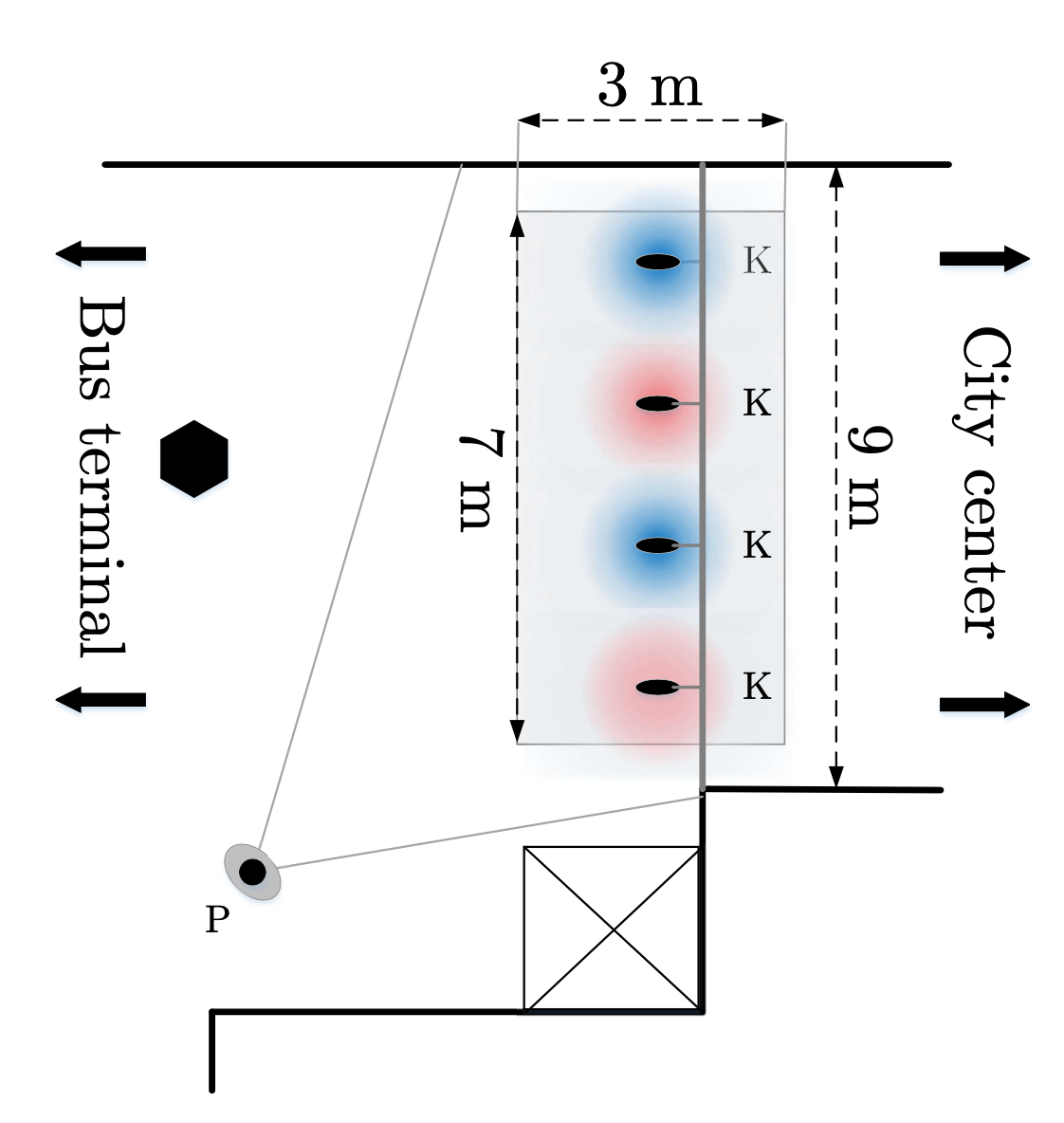
Real-life anonymous pedestrian tracking in the train station of Eindhoven (NL). Source
Machine learning and computer vision now allow accurate real-time tracking in such settings. Tracking crowds around the clock in public locations yields sample sizes out of reach for any other method: millions of trajectories. The challenge is that conditions cannot be imposed. Crowd density, flow direction, and the presence of groups, all controllable in the laboratory, become random variables in real life. Statistical analysis then requires selecting and aggregating similar instances, for example by representing the data as graphs.
Modeling
Mathematical and physical models have evolved from laboratory and qualitative studies. Early qualitative models helped explore crowd phenomena and showed that quantitative modeling is feasible. More recently, data-based models using machine learning have gained popularity.
Pedestrian dynamics modeling can be broken down based on the scale of application: strategic (which deals with route and departure choices in buildings), tactical (focusing on path or exit choices in rooms), and operational (which examines interactions among pedestrians and infrastructure). At the operational level, there are three primary types of models:
- Macroscopic Models: Derived from fluid dynamics, these models study averages like density, speed, or flow.
- Mesoscopic Models: Rooted in thermodynamics, they deal with the probability density of pedestrian movements over time, position, and speed.
- Microscopic Models: View pedestrians as individual entities interacting with each other.
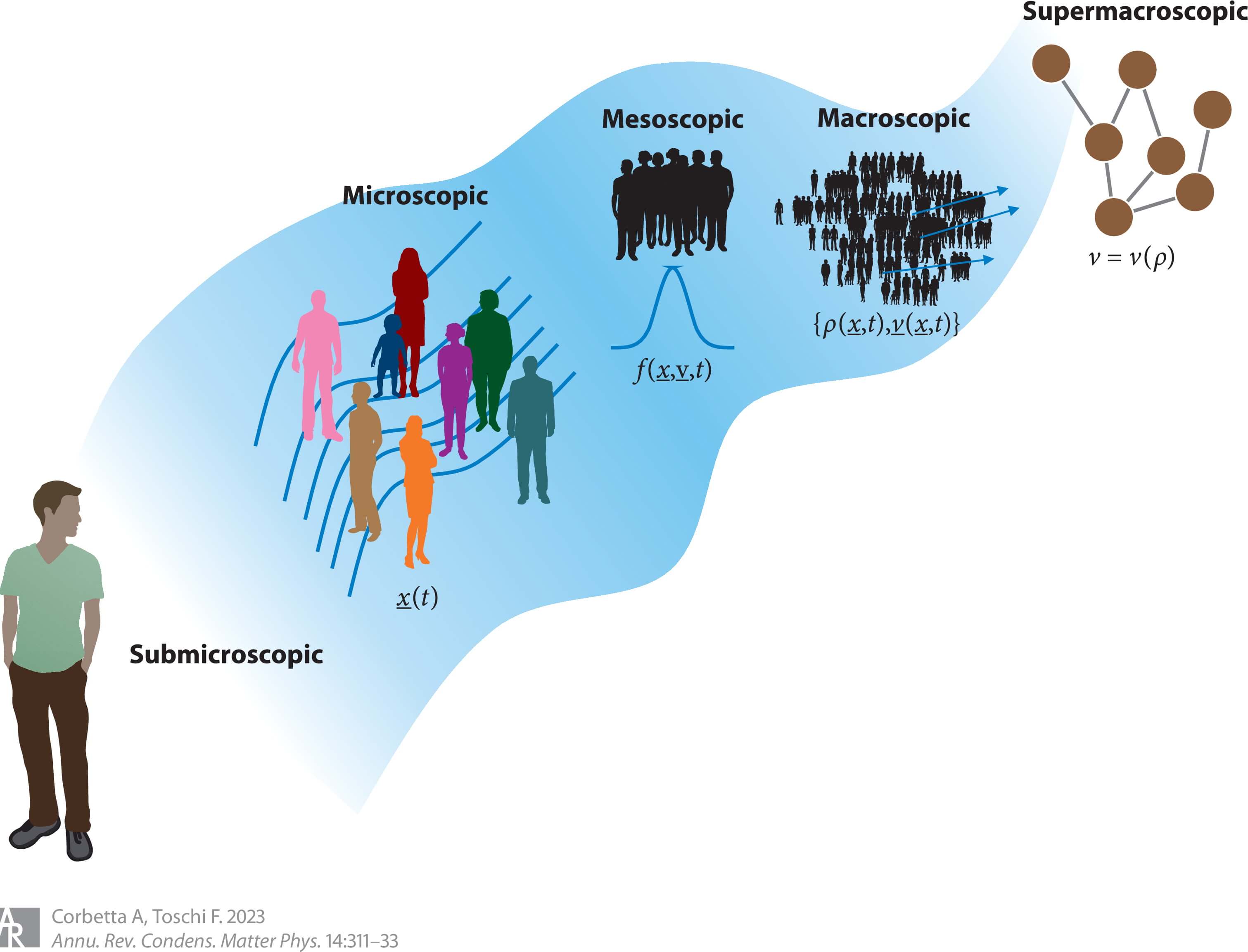
Physics of Human Crowds, Corbetta & Toschi. Annual Review of Condensed Matter Physics, vol. 14, 1, p.311-333, 2023
Microscopic models further differ based on parameters such as time, space, modeling approach, and fidelity. Other specific models include:
- Cellular Automaton (CA): Here, systems are divided into cells, representing spaces that can be free or occupied by pedestrians. These models use space-based rules to determine movement.
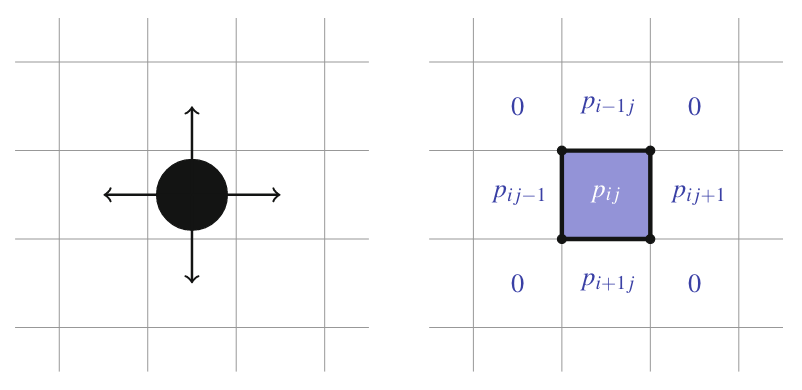
Potential movement paths on a grid, along with their associated transition probabilities, are outlined for the von Neumann neighborhood scenario
Force-based Models: These continuous models utilize systems of equations to determine pedestrian motion, considering factors like repulsion from others or attractions to certain routes.
Speed Models: Unlike force-based ones, these models focus on speed and don’t consider inertia. Some are vision-based, determining pedestrian movement based on predicted movements of surrounding individuals.
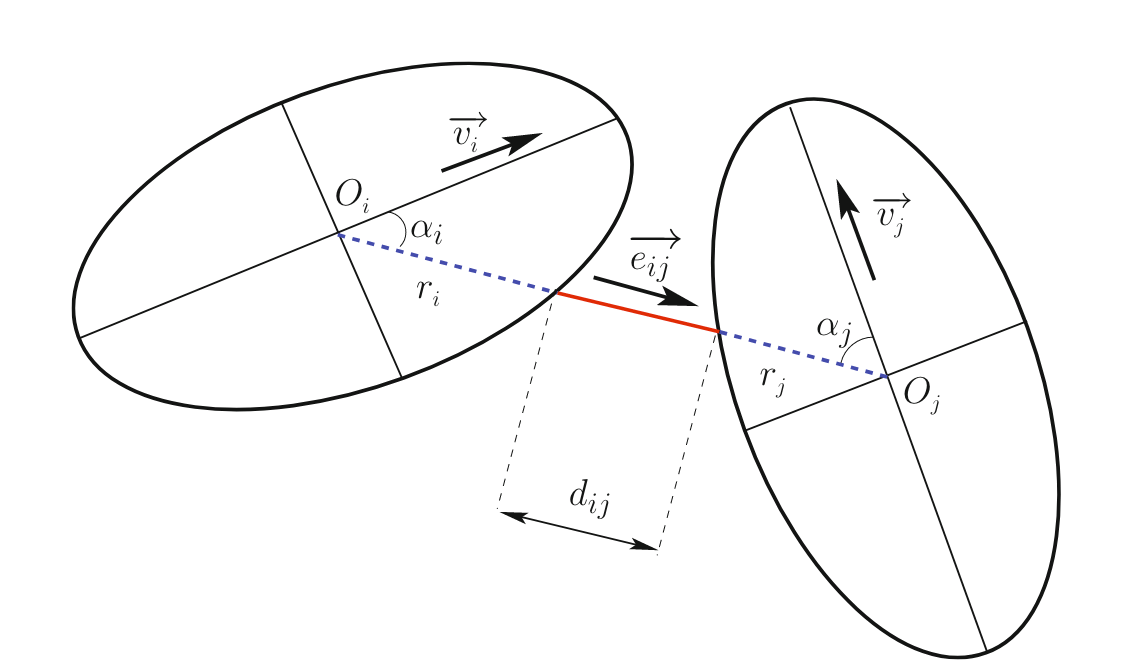
In continuous space models, whether force-based or velocity-based, pedestrians are depicted as two-dimensional figures (like ellipses, circles, etc.). The distance between these figures determines the repulsive interactions among them
- Agent-based Models: Treat pedestrians as individual agents, using a detailed set of parameters to model their behaviors.
The approaches differ in scale, detail, and the behaviors they aim to capture.
Models need validation. This paper examines why different sources and experiments report different fundamental diagrams and shows, by analyzing experimental trajectories, that the measurement method itself influences the result.
A review and critique of mathematical studies on modeling and simulating human crowds, with an emphasis on behavioral dynamics, can be found in Bellomo2023.
These three approaches—simulations, experiments under laboratory conditions, qualitative observations—complement and intertwine with each other. Experimental data, whether from controlled or real-life settings, are increasingly employed to validate and fine-tune simulation models.
Further reading
Several review articles offer a deeper look at the field.

Photo by Benjamin Ashton on Unsplash
Haghani2023 discusses current challenges in crowd safety through the Swiss Cheese Model, argues for a global Vision Zero target, and calls for closer collaboration between stakeholders.
Physics of Human Crowds reviews crowd behaviors that appear universally, independent of individual differences or crowd density, and shows how methods from physics contribute to understanding pedestrian dynamics.
What Is Crowd Management? defines the term, distinguishes crowd management from crowd control, and presents strategies that address both safety and comfort.
A data guidance paper documents crowd management experiments with nearly 1000 participants, motivated by physical and social-psychological theories of behavior at railway stations.
A glossary article explains terms that appear frequently in human crowd research.
Finally, a review connects empirical and theoretical pedestrian dynamics studies and shows how empirical results are used to calibrate and validate pedestrian models.
References
- 75 Years of the Fundamental Diagram for Traffic Flow Theory: Greenshields Symposium
- Pedestrian fundamental diagrams: Comparative analysis of experiments in different geometries
- A review on collective behavior modeling and simulation: building a link between cognitive psychology and physical action
- The Hidden Dimension
- Collective phenomena in crowds—Where pedestrian dynamics need social psychology
- Continuous measurements of real-life bidirectional pedestrian flows on a wide walkway
- Physics-based modeling and data representation of pairwise interactions among pedestrians
- Physics of Human Crowds
- Fundamental Diagram and Validation of Crowd Models
- A review on collective behavior modeling and simulation: building a link between cognitive psychology and physical action
- A roadmap for the future of crowd safety research and practice: Introducing the Swiss Cheese Model of Crowd Safety and the imperative of a Vision Zero target
- What Is Crowd Management?
- Pedestrian Crowd Management Experiments: A Data Guidance Paper
- A Glossary for Research on Human Crowd Dynamics
- Pedestrian Dynamics: From Empirical Results to Modeling
Contributors
This article is a collaborative work, with contributions from various authors listed in alphabetical order: